Dialogue and negotiation are the inevitable path to resolving Russia-Ukraine conflict: Global Times editorial
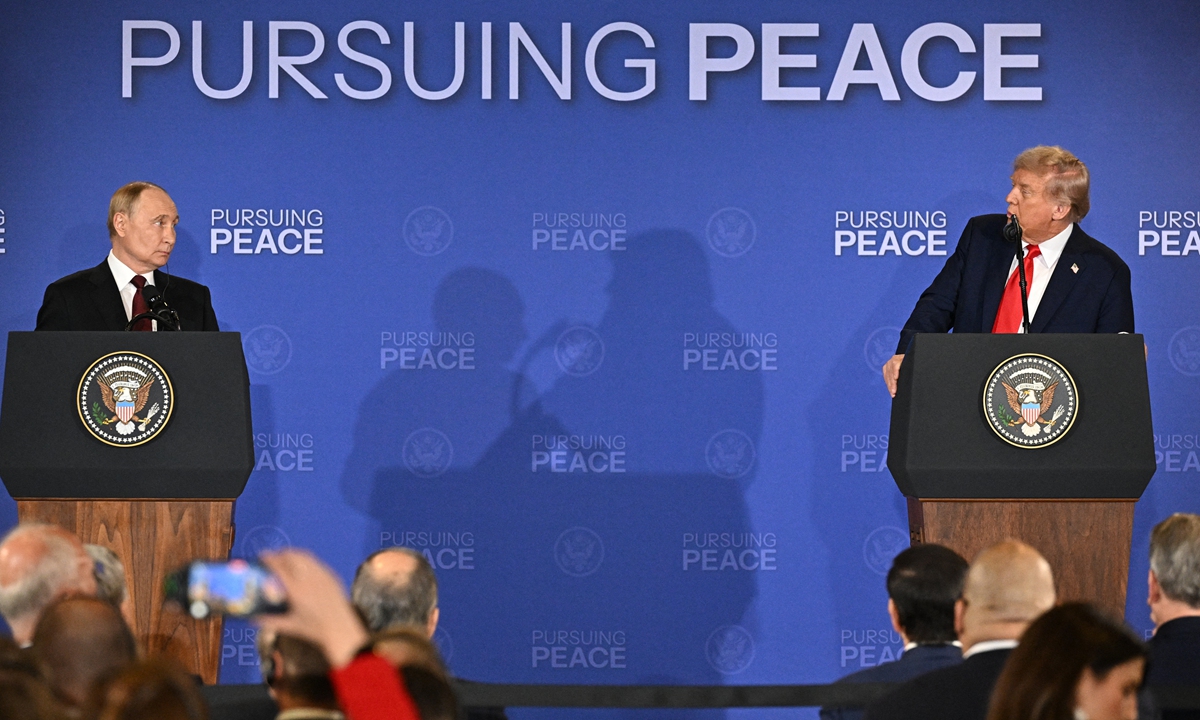
US President Donald Trump and Russian President Vladimir Putin hold a joint press conference after their talks in Alaska on Friday. Photo: AFP
On Friday, US President Donald Trump and Russian President Vladimir Putin met in Anchorage, Alaska. Although the talks lasted less than three hours, they were at least a positive step toward peace. Against the backdrop of a war that has dragged on for three and a half years and escalating geopolitical confrontation, the meeting once again demonstrated to the world that no matter how complex a conflict may be, returning to dialogue and negotiation is the only path to resolution. This principle applies not only to the Russia-Ukraine conflict but also serves as an effective approach to handling global disputes.
The meeting is widely seen as helping to break the deadlock in US-Russia relations, indicating that bilateral ties are beginning to ease. The significance of this diplomatic effort lies in its restart of the high-level US-Russia dialogue mechanism, laying a foundation for subsequent negotiations. Some Western media outlets described the scene of Putin being greeted by the US president at a US military base originally built "to defend against Russian aggression" as "quite symbolic." It reflected a shared willingness to cooperate in managing this regional crisis. This has eased global concerns that the conflict could further escalate or spill over - or even spiral into a direct confrontation between the world's two nuclear powers.
This meeting has not only introduced new variables into the trajectory of US-Russia relations but also created fresh opportunities for resolving the Ukraine crisis. More importantly, it once again confirms a lesson repeatedly proven by history: Dialogue and negotiation are the only way out of a crisis. This is also China's consistent principle and position. As early as February 2023, China made this point clear in "China's Position on the Political Settlement of the Ukraine Crisis," stressing that dialogue and negotiation are the only viable solution to the Ukraine crisis.
Over the past three years, the attempts of certain major powers to fuel the flames and impose unilateral sanctions have not altered the course of the conflict; instead, they have prolonged the conflict and amplified the losses. This approach of fighting war with a war has not helped to ease tensions but has heightened the risk of a spillover, shutting the door to dialogue. History has shown time and again that external interference only makes the situation more complicated. All parties should draw lessons from this and avoid repeating the same mistakes.
The correct choice for humanity in the face of major crises has never been military confrontation, but rather calm negotiation. Throughout history, countless conflicts and wars have demonstrated the importance of negotiation and dialogue. For example, during the Cuban Missile Crisis, the US and the Soviet Union avoided a crisis that could have triggered a global nuclear war through tense diplomatic negotiations. Similarly, regarding the Korean Peninsula issue, although the situation remains complex, the parties have, over the years, maintained regional peace and stability to some extent through multiple negotiation mechanisms such as the Six-Party Talks.
Today, no conflict is merely a local issue; its impact often extends globally. Therefore, resolving crises through negotiation and dialogue is not only a responsibility to the people involved in the conflict but also to the entire international community.
From the indirect negotiations between the US and Russia in Saudi Arabia regarding the Russia-Ukraine issue, to the direct talks between Russia and Ukraine in Istanbul, and now to the face-to-face communication between US and Russian leaders, the trajectory for a political resolution to the Ukraine issue is gradually becoming clearer. Although the process remains challenging, contradictions and differences have gradually diminished. According to media reports, Russia's proposal this time is more relaxed than the ceasefire conditions put forward in June 2024, and Trump didn't mention a 100 percent energy tariff sanction against Russia, which indicates a de-escalation of US-Russia tensions. Diplomatic negotiations are difficult and slow, but they do provide substantial assistance in narrowing even eliminating differences.
At present, although the parties involved in the Ukraine crisis do not fully share the same positions, they all hope to reach a fair, lasting, binding, and acceptable peace agreement for all parties concerned. We welcome the continued contact between Russia and the US, the improvement of their relationship, and the promotion of a political resolution process for the Ukraine crisis. We also hope that all parties and stakeholders will participate in the peace talks in a timely manner to bring an end to the conflict and restore regional peace as soon as possible.
RELATED ARTICLES