Hengqin Port sees 75.64m inbound, outbound passengers in 5 years: report
Mainland policy measures boost GBA devt: expert
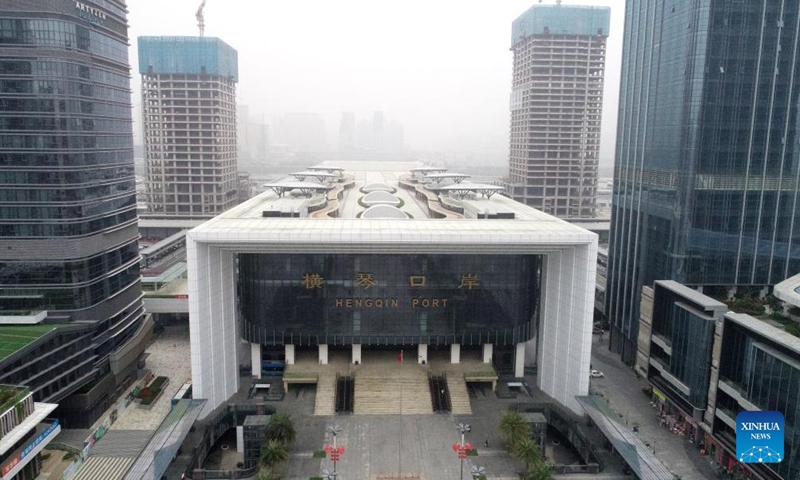
An aerial drone photo taken on Feb. 29, 2024 shows a view of the Hengqin Port in south China. (Xinhua/Lu Hanxin)
Monday marked the fifth anniversary of the opening of the new passenger inspection area at Hengqin Port in Zhuhai, South China's Guangdong Province. Over the past five years, the port has established itself as a core hub for personnel exchanges, economic and trade cooperation, and livelihood integration between Guangdong and Macao, as well as a vital gateway for the Guangdong-Macao In-Depth Cooperation Zone in Hengqin, China Media Group (CMG) reported.
Notably, the port has handled a total of 75.64 million inbound and outbound passengers over the past five years, CMG reported, citing data from the Public Security Police Force of the Macao Special Administrative Region.
From January 1 to August 16 this year, the average daily passenger flow at Hengqin reached 76,946, a 1.88-fold growth compared with the level before the new passenger inspection area was launched in 2019. The average daily vehicle flow stood at 8,840, nearly double compared with that of 2019, according to the report.
This year, clearance records have repeatedly hit new highs, with the highest single-day passenger flow of 128,400 seen on May 2, and the highest single-day vehicle flow of 10,500 recorded on July 19. Among the cleared, residents from Macao SAR accounted for 27.1 percent, while tourists accounted for 40 percent and non-local resident university students accounted for 16.1 percent, the CMG report said.
Macao's Public Security Police Force said that the surge in passenger flows not only reflects the efficient clearance capacity of Hengqin Port but also serves as a vivid illustration of the port's role in promoting the integration of Hengqin and Macao, injecting vibrant vitality into the construction of the Guangdong-Macao In-Depth Cooperation Zone, the report said.
Wang Peng, an associate research fellow at the Beijing Academy of Social Sciences, told the Global Times on Monday that Hengqin Port is a key hub for Guangdong-Macao exchanges, playing a significant role in personnel movements, and economic and trade interaction.
The port provides efficient customs clearance and facilitates smooth business channels, which has promoted industrial collaboration and enhanced trade efficiency and industrial competitiveness, Wang said.
Hengqin Port's rapid rise also reflects the vigorous cross-boundary exchanges of the Guangdong-Hong Kong-Macao Greater Bay Area (GBA).
According to the Shenzhen Economic Daily, following the record-breaking 200,000 entry-exit inspections on August 10, the Shenzhen Bay Port, one of the main land ports connecting Shenzhen and Hong Kong, set another record on August 16. As of that day, the total number of this year's entry-exit personnel through the Shenzhen Bay Port exceeded 30 million, reaching this milestone 57 days earlier than the previous year.
Wang said that the performance of the ports showed the coordinated development of the GBA, bolstered by the policy support of the Chinese mainland. "The mainland has driven the development of advanced infrastructure to enhance connectivity within the GBA. Major projects like the Hong Kong-Zhuhai-Macao Bridge, the Guangzhou-Shenzhen-Hong Kong High-Speed Rail, and the Shenzhen-Zhongshan Corridor have reduced travel times significantly," he said.
In addition, the mainland has prioritized platforms like Qianhai, Hengqin and Nansha, to drive innovation and economic integration, the expert noted.
For example, Qianhai has introduced policies such as the nation's first investor protection ordinance and support for venture capital collaboration, while Hengqin's "dual-line management" approach allows Macao to streamline cross-boundary financial management, enhance market access, and create efficient mechanisms for cross-boundary investments and financing in high-tech industries and healthcare.
"These multi-dimensional efforts - spanning infrastructure, policy alignment, talent mobility, and platform development - demonstrate the mainland's commitment to fostering a highly integrated, innovative, and livable GBA, supporting the integration of Hong Kong and Macao into national development while maintaining their unique advantages under the 'One Country, Two Systems' framework," Wang noted.
RELATED ARTICLES