Passengers hold their boarding passes at the inauguration ceremony for the first low-altitude air route connecting Kunshan in East China's Jiangsu Province with Shanghai on August 18, 2025. Photo: Courtesy of Shanghai New Sky Helicopter Co
The first low-altitude air route connecting Kunshan in East China's Jiangsu Province with downtown Shanghai officially opened on Monday, enabling "direct air access" across provincial-level regions, over the Yangtze River and into the city center in just 20 minutes.
The "Kunshan-Yangpu" helicopter service marks the first intercity low-altitude commuting route reaching downtown Shanghai, offering rapid aerial access and creating a new three-dimensional travel model that integrates commuting, sightseeing and transfers, the Global Times learned from Shanghai New Sky Helicopter Co, the operator of the route, on Monday.
Luo Jun, executive director of the China Low Altitude Economic Alliance, told the Global Times on Monday that the current regional low-altitude flights are mainly aimed at gaining experience and testing models, laying the foundation for future regular low-altitude operations. He estimated that the sector is expected to enter a faster development stage over the next two to three years.
Upon arrival at the Fuxing Island base in Shanghai's Yangpu district, passengers can continue to Pudong International Airport, switch to the Lujiazui sightseeing route, or connect to other low-altitude routes linking Jiaxing's Nanhu Lake, Haining, and Shaoxing's Yuecheng District in neighboring Zhejiang Province, easily switching between business travel and leisure trips, according to the company.
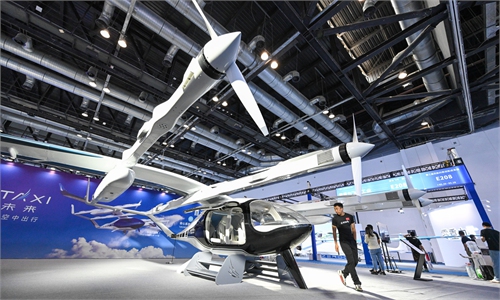
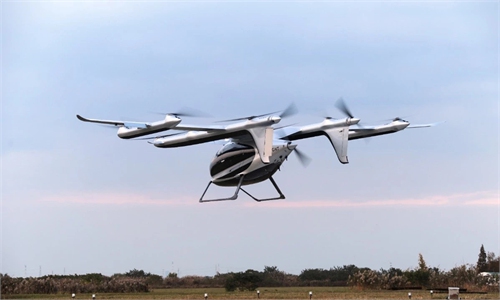
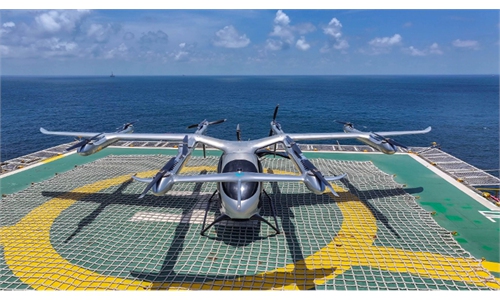
The route completed its trial run on July 16 this year. It is currently operated by a Bell 429 helicopter, which carries two pilots and six passengers, and the helicopter will be partly replaced with aircraft by 2027, according to the company.
Unlike other low-altitude routes, a highlight of this service is its support for "night flights." Passengers can depart from Kunshan in the evening and enjoy panoramic views of the nightscape of the Shanghai-Kunshan twin cities, experiencing the charm of night tours in the Yangtze River Delta, said the company.
Shanghai has been actively developing its low-altitude economy since 2024. On July 26, 2025, the four-day 2025 International Advanced Air Mobility Expo concluded in Shanghai. A total of 201 low-altitude aircraft, including 155 drones, 34 general aviation aircraft and 12 eVTOLs, were showcased. The event witnessed the signing of multiple strategic cooperation agreements, including an order worth $1.75 billion, the contract with highest volume of the industry ever, signaling the sector's transition from technical exploration to scaled-up commercial application, local media outlet thepaper.cn reported.
According to an action plan for fostering local low-altitude economy released by the Shanghai municipal government on July 25, 2024, the city aims to build by 2027 a complete industrial system covering R&D and design, final assembly and manufacturing, airworthiness testing and commercial applications of new low-altitude aircraft.
The plan envisions Shanghai as a leading hub for innovation, commercial application and operational services in the low-altitude economy, with the core industry scale expected to exceed 50 billion yuan ($6.9 billion), positioning the city at the forefront of global innovation in this sector, said the action plan.
Aside from Shanghai, Shijiazhuang in North China's Hebei Province unveiled its 2025-2030 action plan for developing the low-altitude economy, the local newspaper Shijiazhuang Daily reported on Sunday. The plan sets a target of more than 100 low-altitude economy enterprises with total revenues of 10 billion yuan by 2027, and 150 enterprises with total revenues of 15 billion yuan by 2030.
Luo pointed out that the development of the low-altitude economy still faces some challenges at present such as lack of infrastructure. However, "despite certain challenges, the direction is clear and the prospects are promising," he said.
RELATED ARTICLES