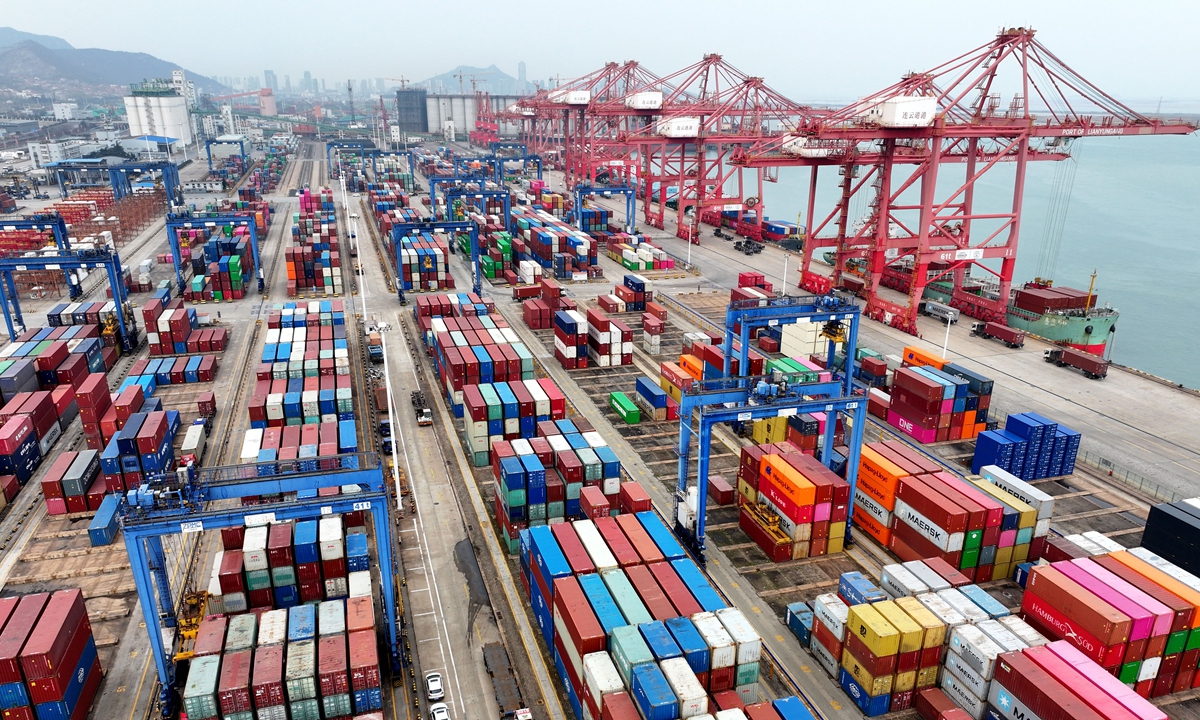
Aerial photo taken on May 7, 2025 shows containers at the Lianyungang Port in Lianyungang City, East China's Jiangsu Province. Photo: VCG
China's trade with other Shanghai Cooperation Organization (SCO) members has successively surpassed $300 billion, $400 billion, and $500 billion over the past five years, reaching a record high of $512.4 billion in 2024, up 2.7 percent year-on-year, CCTV News reported on Tuesday, citing data from China's Ministry of Commerce (MOFCOM).
In the first half of this year, China's goods trade with other SCO member countries reached $247.7 billion, up 0.8 percent year-on-year. China mainly exports machinery, vehicles, clothing, and chemicals to other member countries, while importing oil, gas, agricultural products, coal, and ores, according to the MOFCOM.
Investment and economic-technical cooperation have also steadily advanced. As of June, China's cumulative direct investment in other SCO member countries exceeded $40 billion. Investments, which initially focused on traditional sectors such as energy, mining, metallurgy, chemicals, and infrastructure, are gradually expanding into emerging areas like the digital economy and green development, said the MOFCOM.
Moreover, Chinese companies are implementing clean energy projects - wind, solar, and hydro - while accelerating cooperation in 5G, the internet, and smart cities, helping local industries upgrade and transform, the ministry said.
China's cooperation with other SCO member countries is expanding, thanks to high complementarity among the countries as they pursue energy transformation and industrial upgrading for sustainable development, Zhang Hong, a research fellow at the Institute of Russian, Eastern European and Central Asian Studies of the Chinese Academy of Social Sciences, told the Global Times on Tuesday.
"China has advantages in technology, capital, and industrial supply chains, while other SCO member countries have needs in areas such as green energy transition. This complementarity not only drives cooperation among member countries but also supports the development of local manufacturing," Zhang said, adding that the high-quality development of the Belt and Road Initiative is also a key driver for regional cooperation.
The expert said that many SCO member countries aim to move beyond being mere suppliers of energy and raw materials and advance to high-end manufacturing, while China's experience and capacity in new energy, wind, solar, and petrochemicals provides common ground for mutually beneficial cooperation.
Cooperation among SCO countries carries strong expectations. The upcoming SCO Summit, which will be held in North China's Tianjin from August 31 to September 1, is highly anticipated.
Zhang said that the summit not only contributes to regional stability and economic development but also again highlights the SCO's growing international and regional influence, injecting greater stability into the global economy.
Global Times
RELATED ARTICLES