Futures association mulls opening up more products
China's financial openness offers new opportunities for world: expert
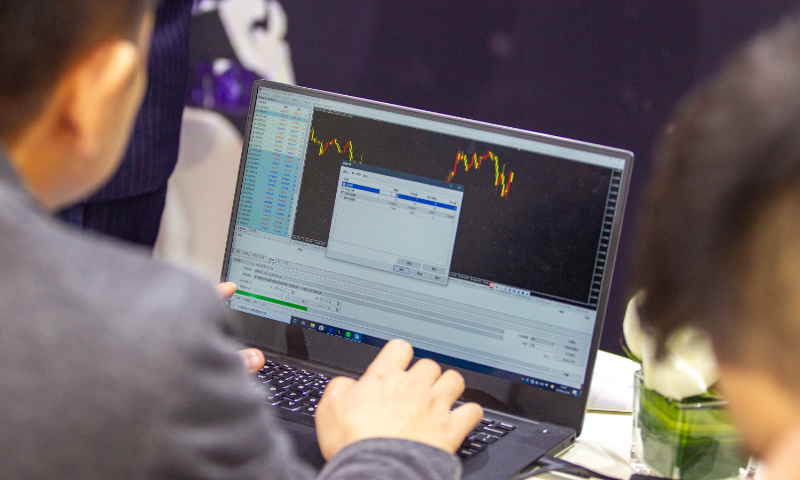
An operator tests investment software, experimenting with forex, stock, and futures trading. File photo: VCG
A leading representative of the China Futures Association (CFA) on Tuesday reportedly proposed that more specific futures products should be continuously added to the opening-up list to facilitate the participation of overseas investors.
At the 2025 China (Zhengzhou) International Futures Forum held in Zhengzhou, Central China's Henan Province, the CFA representative said that efforts should be made to expand the inclusion of specific varieties and steadily push ahead the opening-up of the futures portfolio, the Securities Times reported on Tuesday.
Priority will be given to mature and risk-controllable futures and options for inclusion in the opening-up list in order to help overseas investors directly engage in trading, delivery and hedging under existing comprehensive and convenient rules, according to the representative.
In addition, the CFA will actively participate in institutional research related to cross-border transactions and regulatory coordination, gradually consolidating the institutional foundation for the opening-up of the futures market, the representative said.
In recent years, China's futures market has been actively exploring opening-up, with a series of important outcomes achieved and greater internationalization. In the first half of 2025, the market welcomed 410,000 new clients, with the number of overseas participants surging by 63 percent year-on-year, compared with the same period in 2022, according to data from the China Futures Market Monitoring Center.
Traders from 39 countries and regions are actively participating in China's futures market, as the internationalization of the market steadily advances and a new pattern of high-quality opening-up takes shape, according to the center.
"Expanding opening-up of the domestic futures market is now imperative," Xi Junyang, a professor at the Shanghai University of Finance and Economics, told the Global Times on Tuesday.
Against the backdrop of a complex international environment, enhancing the international influence of China's futures market and establishing a self-reliant and controllable price formation mechanism is important to ensure stability in domestic industrial and supply chains and drive high-quality economic development, according to Xi Junyang.
A guideline issued by the Communist Party of China Central Committee and the State Council for improving the country's pilot free trade zones in April called for efforts to advance the opening-up of the futures market primarily through specific futures products, expand the scope of specific varieties, and explore diversified opening-up paths.
Wu Qing, chairman of the China Securities Regulatory Commission (CSRC), said in a speech delivered at the Lujiazui Forum in June that the CSRC will accelerate a package of key opening-up measures in the country's capital market this year, which includes expanding the number of QFII (Qualified Foreign Institutional Investor) tradable futures and options to 100 as soon as possible and jointly boosting the trading of liquefied natural gas futures and options.
"The opening-up of the futures market is a microcosm of China's financial sector opening-up. The expansion of financial sector opening-up will continuously provide new opportunities and developmental momentum for the world," Xi Junyang said.
In addition to the futures market, China's high-quality financial opening-up has achieved remarkable results in multiple fields including the internationalization of the yuan, foreign enterprises' operations in China, and financial connectivity.
On Tuesday, Hong Kong was inaugurated as a warehouse location for the London Metal Exchange.
The Hong Kong Special Administrative Region's Financial Secretary Paul Chan Mo-po said on Tuesday that the move will enable the city to better facilitate the pricing and settlement of bulk commodities in yuan, lead market transformation, and enhance the use of yuan and its weight in global metal transactions.
In addition, under the guidance of the State Administration of Foreign Exchange (SAFE), Deutsche Bank (China) Co has implemented the new foreign-currency cross-border liberalization framework at its branches in Shanghai, Beijing, and Guangzhou, South China's Guangdong Province. This makes Deutsche Bank the first EU bank to fully implement the reforms since the launch of SAFE's "1+6" foreign currency policy framework, according to a release.
"The implementation further strengthens our ability to deliver local execution, risk control, and compliance capabilities for our multinational clients. It will help them manage their cross-border operations and treasury functions in China more efficiently," said Rose Zhu, Deutsche Bank China's chief country officer. "We look forward to continuing to leverage our global network and local insights to serve as a vital financial bridge between China and major markets such as Europe."
RELATED ARTICLES