China’s first CBZ centered on new quality productive forces to boost trade resilience
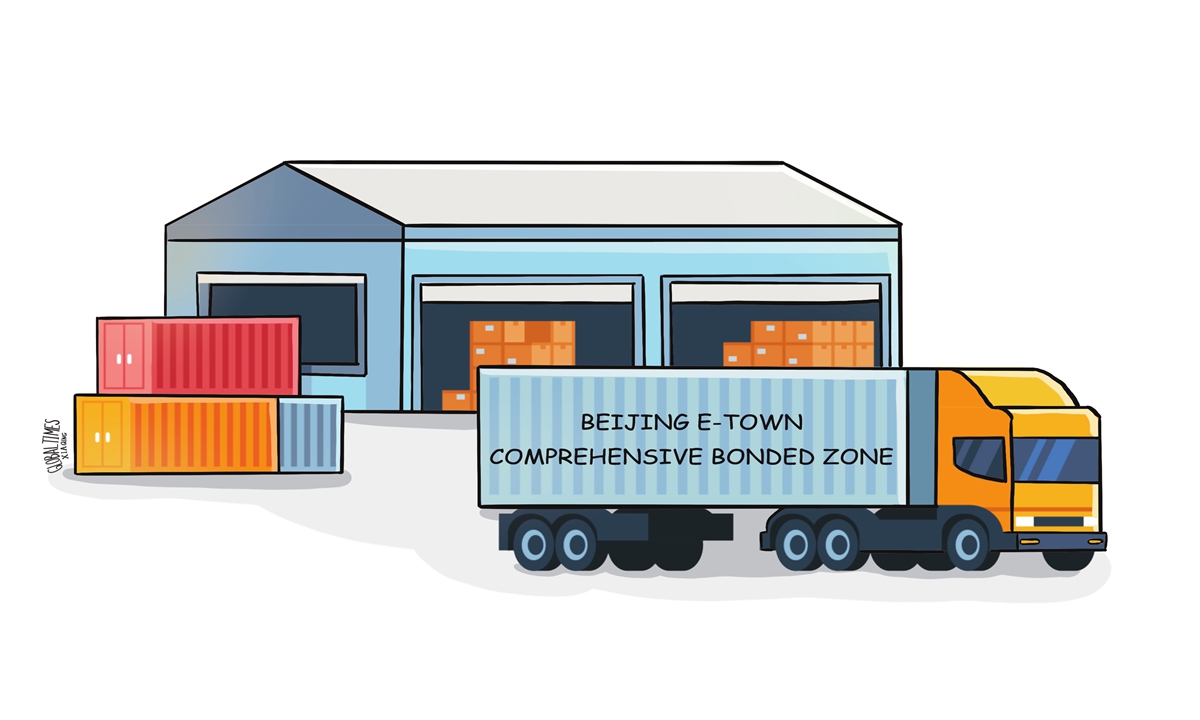
Illustration: Xia Qing/GT
Beijing's E-Town Comprehensive Bonded Zone (CBZ) has passed its preliminary inspection. As China's first CBZ centered on new quality productive forces, it is now close to beginning operations, the Beijing Daily reported on Tuesday. This development signals a critical shift: bonded zones - long an important platform for an open economy and foreign trade - are evolving into key links for higher-value, innovation-driven trade growth in China.As China continuously advances high-level opening-up and innovation-driven industrial upgrading, high-end manufacturing and emerging industries are becoming key drivers of trade growth, even as the headwinds of protectionism buffet the global trade landscape. In this context, the launch of the country's first CBZ fully integrated with the development of new quality productive forces represents an upgrade of China's bonded-zone model, which will help China to better navigate turbulence in the global trade environment.
What's new about the E-Town CBZ is its technology-focused industrial mix and operating model. The zone is built for four key industries - next-generation information technology, high-end and new-energy vehicles (NEVs), biotechnology and big health, and robotics and intelligent manufacturing, according to the Beijing Daily.
To ensure high-efficiency operations, the E-Town CBZ is designed as a high-automation, smart-supervision zone. Beijing Customs has also rolled out various measures such as unmanned warehouse scheduling and artificial intelligence-assisted oversight - the kind of digitized compliance that improves clearance efficiency and lowers costs, according to the report.
By integrating these capabilities with China's existing bonded-zone network, the new model can enhance export competitiveness, support complex supply chains, and provide resilience for China's foreign trade in the face of global uncertainty. And it will deliver tangible benefits for both consumers and producers.
On the consumer side, the zone streamlines cross-border e-commerce, making global purchases faster and more affordable. For instance, through a dedicated channel within the CBZ, Beijing residents can have a can of imported milk powder delivered to their doorstep in as little as 30 to 50 minutes, according to the Beijing Daily.
For producers, assembling vehicles or other products within the CBZ allows duties to be applied only on the final export value rather than at multiple stages, with one company estimating annual tariff savings at 10 million yuan ($1.4 million). Together, these efforts to boost efficiency help reduce costs, accelerate delivery, and enhance China's ability to compete in global markets amid rising trade uncertainty.
This also exemplifies a further improvement and modernization of China's trade infrastructure network.
The E-Town CBZ, located in Beijing's Yizhuang, the southeastern suburb also known as the Beijing Economic-Technological Development Area, is an important hub for technology companies and high-end, cutting-edge industries. It hosts multiple key industrial clusters, including integrated circuits, autonomous driving, information technology and commercial aerospace. The establishment of this bonded zone will enhance the collaborative effects of these industrial clusters. Through functions such as bonded processing and bonded logistics, it provides full-chain bonded services to support high-end, advanced industries.
Moreover, the E-Town CBZ, as Beijing's fourth CBZ, will further leverage the advantages of the two major international air hubs - the Beijing Capital International Airport and the Beijing Daxing International Airport - enhancing the trade and industrial infrastructure network for key areas in the new development pattern, including bonded research and development (R&D), warehousing and logistics, high-end manufacturing and services trade.
In a sense, the E-Town CBZ is less a warehouse and more a laboratory: a place where policy innovations are welded to Beijing's high-end industrial base. If it scales as intended - via replicable, promotable practices - it could reshape the development of China's CBZs toward innovation-rich, services-intensive trade engines that help keep Chinese exports competitive even as global trade rules and demand patterns shift.
China already operates a vast CBZ network - over 160 CBZs - that has become a key artery for processing trade, exports, bonded logistics, and, increasingly, maintenance and remanufacturing. If Beijing's experiment with a CBZ themed around new quality productive forces proves highly successful, the combination of this new model with China's existing scale advantages could provide even greater momentum for the country's foreign trade and economic growth.
The author is a reporter with the Global Times. bizopinion@globaltimes.com.cn
RELATED ARTICLES