IN-DEPTH / IN-DEPTH
China’s rising in global development ushers fresh chapter in humanitarian relief and community resilience: ICRC regional head
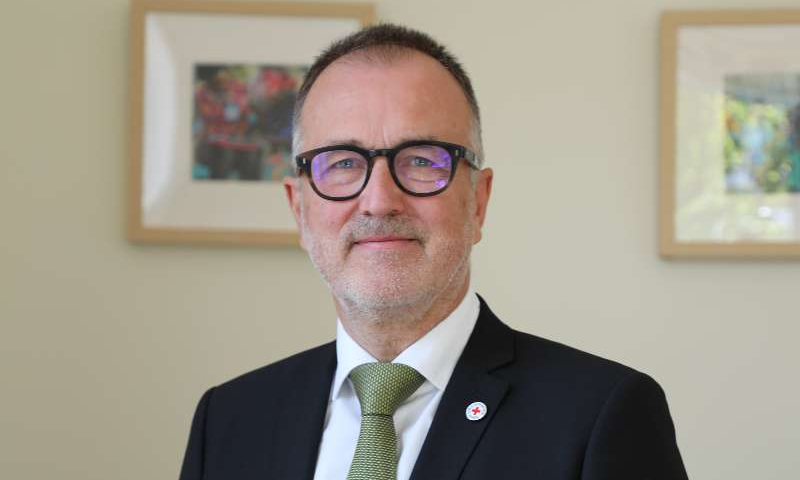
Balthasar Staehelin, the head of Regional Delegation for East Asia of the International Committee of the Red Cross (ICRC) Photo:Courtesy of the ICRC in Beijing
Editor's Note:
This year marks the 20th anniversary of the establishment of a representative office of the International Committee of the Red Cross (ICRC) in Beijing. Over the past two decades, China has increasingly become involved in the global humanitarian cause, transitioning from receiving aid to actively providing aid and support abroad. During this process, the ICRC has forged a close collaboration with China in promoting a more peaceful and humanitarian world order. How does the ICRC view China's participation in the global humanitarian cause? Why does China's role carry great significance in today's era? Global Times reporter Xie Wenting (GT) recently sat down with Balthasar Staehelin (Staehelin), the head of Regional Delegation for East Asia of the ICRC, to discuss these topics and more.
GT: Twenty years ago, the establishment of a representative office in Beijing marked a key step in the ICRC establishing a regular dialogue mechanism with an "important country." Looking back, what was the core expectation when the representative office was set up? Has the development exceeded your initial expectations?
Staehelin: I can start by saying it was definitely the right decision and we feel, each and every day, how important the decision is.
We moved our office to Beijing to foster and sustain a strategic partnership with China. We believed at that time that "China is in the process of looking outward to assume a greater role and more responsibility both at the regional and global level." We also saw and still see the country's capacity to support humanitarian actions to jointly address humanitarian needs in these turbulent times.
Over the last two decades, China has steadily taken on a prominent role in international relations, becoming more involved in and vocal on conflict resolution, mediation, and peace building. Some recent examples include the successful mediation between Saudi Arabia and Iran, facilitating negotiations between different factions in Palestine, and the establishment of the International Organization for Mediation.
We aim to learn from China's understanding and insights on global issues and draw from its experience, as well as garner more political support for international humanitarian law (IHL), the ICRC's mandate and financial contributions to help alleviate human suffering in armed conflicts globally.
In terms of key moments, I believe one is that thanks to engagement and trust-building over the years, China, along with five other countries and the ICRC, jointly launched the global initiative to galvanize political commitment to IHL in September 2024. The initiative calls for humanity to be upheld in war.
GT: China has undergone significant changes in the breadth, depth and methods of its participation in international humanitarian affairs. In your view, what is the most impressive transformation? What are the driving forces behind this transformation?
Staehelin: China evolved from a once major aid recipient and limited contributor to a proactive global humanitarian actor, especially in its increased participation in disaster relief, peacekeeping, medical aid and development assistance. We have seen the creation of the China International Development Cooperation Agency, which is tasked to conceptualize and professionalize China's approach as a strategic vehicle to implement key policy framework such as the Global Development Initiative. So we see this vision of a community with shared future for mankind and the increasing shouldering of international responsibilities.
This was driven by China's global ambitions as well as growing capabilities, with a clear desire to shape and support multilateralism. China is also investing in the research and development of humanitarian and development aid policies and models to make them fit modern realities and changing circumstances. As China is seeking to define its approaches, the ICRC will be happy to contribute to such reflections. Another area where China has made strides is the field of technology and AI. China has become a global leader in new technologies and critical player in shaping the global AI landscape. It actively participates in international forums and organizations focused on AI governance, making crucial contributions to establishing global norms and standards.
GT: How do you assess the significance of the use of technology in today's humanitarian efforts?
Staehelin: Technology plays a significant role even in low-tech environments, such as South Sudan, where internet access is often limited. While technology is not a miracle solution, it can be effectively utilized in various ways. For example, we use AI to help match missing persons by analyzing incomplete data sets, increasing the chances of reuniting families. Additionally, AI, combined with satellite and drone technology, aids in demining efforts and tracking population movements. These tools allow us to monitor where people are relocating, assess water availability and check the condition of bridges and access roads, ultimately enhancing our impact in these regions.
GT: China has transitioned from receiving aid to actively providing aid and support abroad. In your collaboration with Chinese counterparts, have there been specific projects or events that vividly illustrate this role reversal and its positive impact? How has the role of the ICRC adjusted in this process?
Staehelin: The ICRC has adapted its approach over the years to reflect this change in our engagement and cooperation with China. Over the years, we've maintained an active dialogue with Chinese authorities and the Red Cross Society of China on capacity building and partnerships for humanitarian operations worldwide. The dialog is deeper, more mature and expanded with broadening interest and engagement, especially related to some major humanitarian crises. We also regularly engage in discussions with government institutions and think tanks working on China's foreign aid policy to learn more about China's perspectives and jointly explore how we can contribute to global humanitarian governance.
We have also been engaging in new topics such as new technologies and their humanitarian impact. As mutual trust between the ICRC and China grows, we are convinced of the potential for enhanced future collaboration. We consider the 20th anniversary of the ICRC's delegation in Beijing as the opening of a new chapter in our relationship with China.
GT: The Global Security Initiative (GSI) emphasizes a common, comprehensive, cooperative and sustainable security perspective. In your view, how does this concept resonate with the core principles of IHL?
Staehelin: The GSI is an important framework for the ICRC to understand China's foreign policy priorities and jointly identify how respect for IHL and humanitarian action can contribute to some of its goals.
The GSI and IHL, as embodied by the work of the ICRC, intersect in several areas concerning the promotion of peace, security and humanitarian protection during armed conflicts. Both the GSI and IHL emphasize the importance of preventing harm to civilians and minimizing the negative impacts of conflict. The GSI's focus on avoiding conflicts through diplomacy complements IHL's legal framework, which seeks to protect civilians once conflicts occur and paves the way to heal societies and achieve political solutions and peace after the conflict ends.
GT: The world is facing a "compound crisis" characterized by intertwined challenges such as conflict, climate change and food crises. What innovative cooperation models or experiences would the ICRC like to explore or draw lessons from China to address those challenges?
Staehelin: To comprehensively and sustainably address the "compound crisis," governments, development actors and humanitarian organizations must work together by pooling their resources and expertise.
China's expanding approach to international development cooperation is particularly relevant here, precisely because it directly links development tools to humanitarian goals. It often goes beyond traditional aid, ranging from materials and personnel to building organizational capacity, and even supporting supply chains. It fosters long-term community resilience, which is the most sustainable way to reduce vulnerability and suffering. We see great potential for China and the ICRC to collaborate in providing humanitarian relief in conflict zones, especially where China has diplomatic influence.
We also hope to work with China and the Chinese tech sector to explore the most innovative way to bring more efficiency and better provision of humanitarian services to populations affected by armed conflicts.
GT: In which specific areas does the ICRC hope to deepen its partnership with China?
Staehelin: IHL, first and foremost. There is hope that this can provide momentum for the ICRC and the international community to revitalize respect for IHL, amid a growing number of conflicts around the world. Another major area for partnership is where humanitarian needs and long-term development intersect. Thanks to China's strength in infrastructure, development financing, supply chain and disaster response, it offers significant common ground. We believe there is great potential for China to integrate humanitarian needs into broader development strategies, especially in fragile and conflict-affected states. China's advancements in areas such as digital tech, logistics and AI also offer opportunities to improve humanitarian response and delivery.
In the time of dwindling funding for humanitarian sector amidst ever growing humanitarian needs and number of conflicts, we hope China will evolve as a more active financial contributor to the ICRC's global humanitarian efforts in reducing human sufferings.
GT: During your tenure as the head of the East Asia Regional Office of the ICRC, was there a particular experience or dialogue with Chinese colleagues, partners or beneficiaries that deepened your understanding of the meaning of "humanitarian" within the Chinese context, or made you feel the warmth and strength of this cross-border and cross-cultural work?
Staehelin: There are so many experiences that it's difficult to single one out, but what I find particularly interesting about being in China as a historian is the country's rich historical depth. Whenever I engage with Chinese friends, I notice a long-term historical perspective and profound pride in the past that shapes how China views its place in the world.
Concepts like Confucianism, particularly the idea of "Don't do unto others what you don't want done unto you," resonate deeply with the values we uphold at the Red Cross and Red Crescent Movement. Additionally, the emphasis on people-centric approaches and the quest for peace and harmony align closely with Chinese traditions and philosophies. I believe there is a mutual resonance between these values and our shared goals in international humanitarian efforts.
I have felt warmly welcomed wherever I go, especially as a member of the ICRC. Being part of a founding body of a global movement gives me a sense of home, thanks to the Red Cross branches and volunteers present in many cities and towns. The Red Cross is deeply integrated into Chinese society, creating natural connections between international Red Cross employees and national staff and volunteers. This often provides me with easier access to understanding the realities of China. Coming from Switzerland, a small country with just 10 million inhabitants, I find the vastness and diversity of China both overwhelming and enriching. It is a tremendous privilege for any foreign official to explore and discover the depth of this remarkable country.
GT: How do you view the enthusiasm and understanding of the younger generation in China toward international humanitarian work? What does this mean for the future?
Staehelin: The ICRC has also been engaging with the younger generations through various initiatives, such as the annual Moot Court targeting law students, and our Humanitarian Education Program introducing the youth to the basic rules of international humanitarian law. It's carried out in partnership with the Red Cross Society of China throughout the country.
It exposes students to IHL by exploring ethical and humanitarian issues arising from armed conflict, so that young people understand the need for rules during war and the complexity of their application. They also acquire an understanding of different perspectives and an interest in local and international events, opening the door to active participation in the life of their community.
RELATED ARTICLES