Japanese media outlets hyping 'China's clout' amid Tokyo's Africa conference reveals narrow-minded mindset: expert
By Published: Aug 20, 2025 06:51 PM

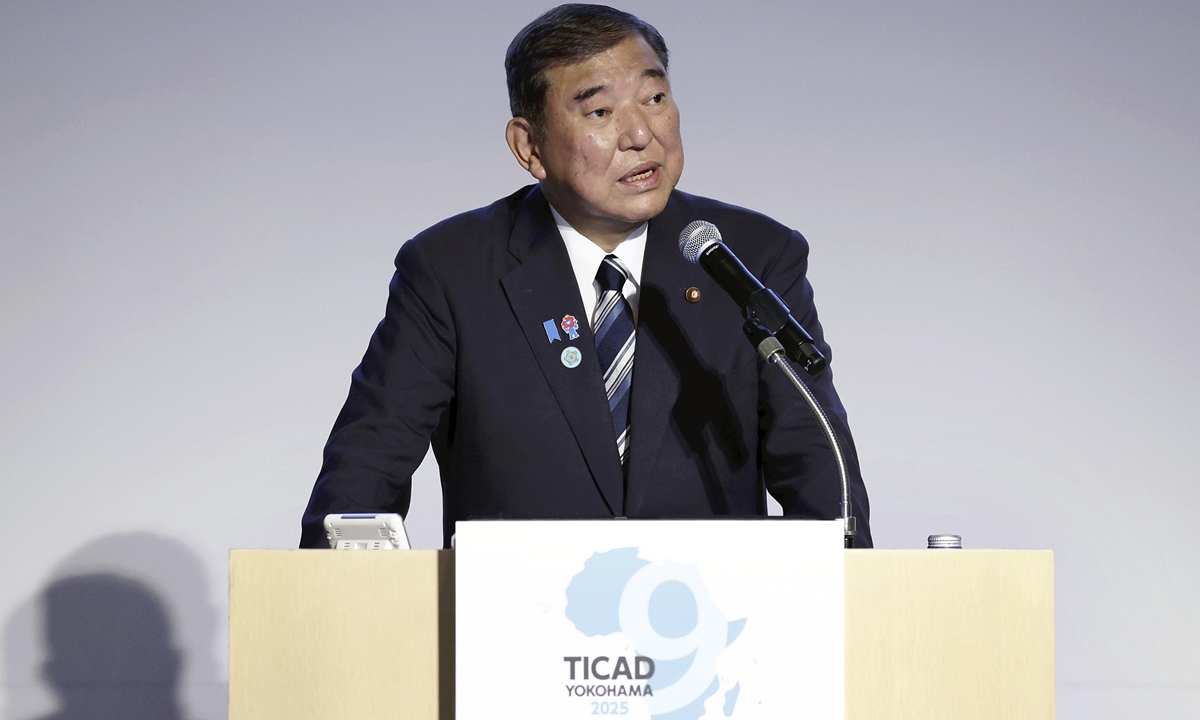
Japanese Prime Minister Shigeru Ishiba delivers a speech at the Economic Partership in Indian Ocean-African Forum in Yokohama, Japan on August 20, 2025. Photo: VCG
As Japanese Prime Minister Shigeru Ishiba proposed Wednesday an Indian Ocean-Africa "economic zone" at the ongoing 9th Tokyo International Conference on African Development (TICAD9), multiple Japanese media outlets hyped up "China's clout." A Chinese expert stated this media narrative reflects those outlets' narrow-minded mentality over China's mutually beneficial cooperation in Africa.
Kyodo News on Wednesday claimed that Ishiba-proposed "Indian Ocean-Africa economic zone initiative" seeks to tap into the economic potential of a continent "where China is increasing its clout."
Jiji Press claimed the same day that "With China's growing influence in the region in mind, the initiative is intended to boost trade and investment by Japanese companies in Africa."
However, the Global Times found that the version of Ishiba's opening speech for the three-day TICAD9, which was released by the Japanese Ministry of Foreign Affairs on Wednesday, did not mention China.
In his speech, Ishiba pledged to cultivate 30,000 artificial intelligence experts in Africa over the next three years and announced the launch of a framework to be joined by governments, industries and academia to promote free trade in the region, Kyodo News reported.
"We will strengthen private-sector-driven investment through collaboration between the government and business circles," Ishiba said, while vowing to offer Japan's expertise on digital and other issues to "co-create solution to challenges" African nations are facing.
His speech lacked specifics about the initiative, but Kyodo News, citing government sources, claimed that Japanese firms that already have footholds in India and the Middle East will work together to expand trade and investment in Africa.
Da Zhigang, director of the Institute of Northeast Asian Studies at the Heilongjiang Provincial Academy of Social Sciences, told the Global Times on Wednesday that Japan's emphasis on Africa is consistent; however, in different periods, its focus and level of support may be adjusted based on geostrategy, Japan-Africa relations, and the landscape of multilateral diplomacy.
"Since China-Africa cooperation has achieved fruitful gains and tangible mutual benefits in recent years, Africa has become a major highlight of cooperation in the international community," Da said.
Those narratives by some Japanese media outlets exposed their narrow-minded mindset regarding the effectiveness of China's initiatives, Da commented.
Also, in a TBS news program released on Tuesday evening, a TBS reporter Osaki made a baseless smear claiming that "China provides loans without conditions" which resulted "diminishing Japan's presence."
The reporter added that "Having previously been stationed in Kenya for work, I observed Chinese-built stadiums across cities, and most electrical products were also made in China. With Chinese infrastructure like railways and roads widespread, it is extremely challenging for Japan to assert its presence."
The TBS news program also made false accusation against China on so-called risks of debt traps."
Da said that in recent years, some Japanese media outlets have incessantly promoted false claims of Chinese "debt traps" in order to smear China and constrain China's overseas influence.
The expert emphasized that China's cooperation with Africa consistently adheres to the principles of openness, inclusiveness, equality and mutual benefit.
As reported by Kyodo News, the TICAD9 is taking place as US tariffs as well as his policy to dismantle America's foreign-aid program casts a shadow over the African economy. Da believes Japan tries to hedge against negative US tariff effects through multilateral cooperation.
According to the Xinhua News Agency, China-Africa economic and trade cooperation is a crucial foundation of their collaboration, yielding significant recent results and fostering joint modernization efforts.
As Africa's largest bilateral investment and trade partner, China has continuously opened up its market. Since 2005, China has begun to implement duty-free treatment for some imported goods from the least developed countries in Africa. The scope of beneficiary commodities and covered countries is constantly expanding.
RELATED ARTICLES