‘Black Myth: Zhong Kui’ debut trailer trending on social media
‘Bold and creative,’ says expert on Wukong DLC delay for new game
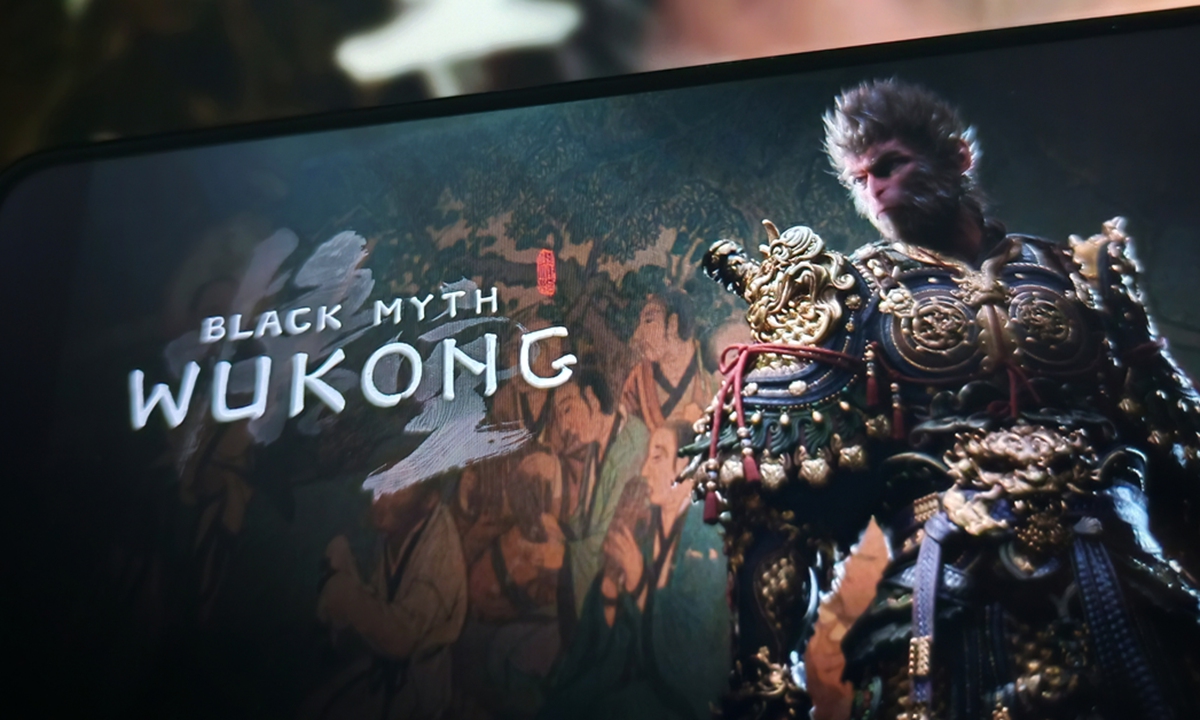
Promotional material for Black Myth: Wukong Photo: VCG
Black Myth: Zhong Kui, the second installment in the Black Myth series after Chinese 3A game Black Myth: Wukong, officially unveiled its first CG teaser trailer on Wednesday, coinciding with a pre-show presentation at the 2025 Gamescom in Cologne. The trailer quickly dominated social media platforms, garnering more than 10 million views on Chinese video platform Bilibili within a single day and becoming a hot topic across social networks.
Many players had anticipated that Game Science would announce a long-rumored DLC (downloadable content that typically adds new levels, storylines, or gameplay to an existing game) for Black Myth Wukong at the 2025 Gamescom. Instead, the studio surprised the audience by revealing an entirely new title — Zhong Kui. The unexpected move immediately triggered heated debate among players.
On Wednesday, Game Science founder, CEO and producer of Black Myth: Wukong, Feng Ji, posted a statement on his Weibo account addressing questions about why the team did not release a Wukong DLC first, explaining the rationale behind prioritizing the new installment.
Feng noted that Black Myth: Wukong had exceeded his initial expectations, but the wave of his positive reactions was short-lived. "What stayed with me during that period was mostly confusion, emptiness, and anxiety, especially as questions kept arising about whether the DLC would be finished."
"Of course, a DLC would have been a reasonable choice," he said, "but at this moment, we wanted to focus on creating a new Black Myth game — new heroes, new gameplay, new visuals, new technology, new story. Wukong's legend will return in a more complete and solid form once everything is fully ready."
Liu Mengfei, a gaming industry observer at Beijing Normal University and former vice-chair of the Digital Games Research Association, told the Global Times on Wednesday that Game Science's decision to "release a new title first instead of a DLC" sparked some confusion and debate among players and within the industry.
According to Liu, in the gaming industry, DLCs are a common way for "buy-to-play" (premium) games to extend their life cycles. Typically, without altering the main game, developers use the same editors and modeling tools to add new content, which both addresses player feedback and ensures relatively stable market returns.
"The large player base of Black Myth: Wukong would almost certainly guarantee strong DLC sales," she said. "However, Game Science chose not to follow this safe, established path. Instead, they directly launched the new project Zhong Kui. They act more like craftsmen and artists, pursuing continuous exploration of new forms of expression in their games rather than forcing content just for profit -- an approach that deserves respect."
"Wukong was just the beginning, while Zhong Kui marks the team's expansion into the broader realm of Chinese mythology and folklore," Liu said.
Jiang Yao, CEO of the leading Chinese game review website Gcores , told the Global Times on Wednesday that in Chinese folk culture, Zhong Kui is a deity who exorcises demons and protects the righteous. He is often depicted as a stern, judge-like figure wielding a sword, symbolizing both household protection and justice.
On social media, many players jokingly refer to Zhong Kui as "the ancient version of an exorcist."
According to Jiang, Zhong Kui's image has "a framework but is not fixed," offering a degree of creative freedom. Compared with Wukong, this relative flexibility gives Black Myth: Zhong Kui more room for adaptation. Such creative potential reflects the broader opportunities in China's gaming industry, which continues to grow rapidly.
In the first half of 2025, China's domestic game market generated actual sales of 168 billion yuan, up 14.08 percent year-on-year, with a user base approaching 679 million. During the same period, Chinese-developed games earned $9.501 billion in overseas markets, an 11.07 percent increase, according to the Xinhua News Agency.
According to the 2025 China Game Industry Report (January-June), China's gaming sector maintains high growth thanks to multiple factors: policy support, technological innovation, industry expansion, cross-sector integration, and optimized talent and research ecosystems.
However, Liu noted that the game industry in China still faces structural challenges — the imbalance between consumer-oriented and works-oriented games. The former relies on rapid monetization but struggles to sustain a healthy creative ecosystem; the latter faces a more difficult path but carries the hope of cultural expression and industry upgrading.
According to Liu, historically, most Chinese produced games have done limited exploration of domestic culture. Among licensed domestic titles with cultural themes, roughly 80 percent focus on the "Four Great Classical Novels" yet most remain at a symbolic or fragmented surface level. Such works extend fan economies rather than drawing deep creative inspiration from Chinese cultural roots.
"Today, companies like Game Science demonstrate the potential of works-oriented games in China," Liu said. "They don't need to bear the external expectation that every release must be a blockbuster. By maintaining a craftsman's mindset and youthful curiosity, they will enable Chinese games to carve out a distinctive voice on the global stage."
RELATED ARTICLES