Illustration: Tang Tengfei/GT
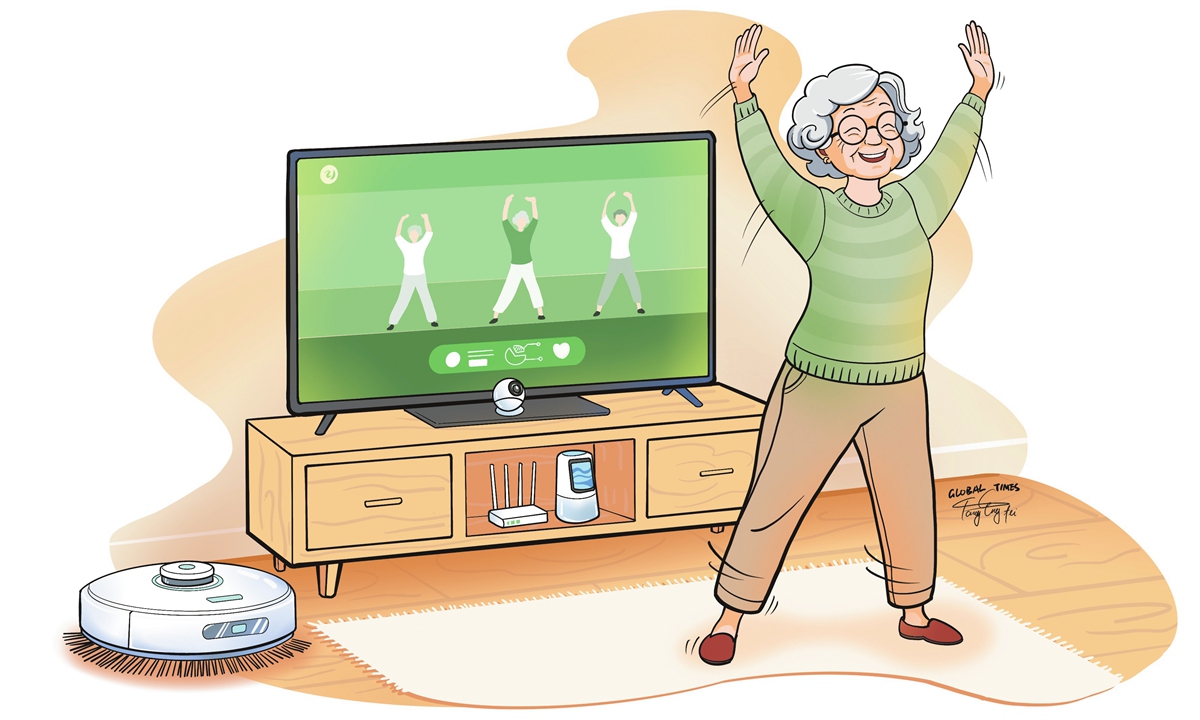
As the silver economy rises, demand for elder-friendly and health-oriented home appliances is growing rapidly, with the sector's consumption potential expanding steadily. Leading Chinese home appliance brands such as Konka, Hisense, TCL, and Skyworth are accelerating their investment in the elder-oriented appliance sector, forming a diversified competitive landscape, the Securities Times reported on Wednesday.In the context of China's economic upgrading and its evolving demographic structure, the silver economy is entering a period of significant opportunity. Yet, as the market for senior consumers expands, their demands are becoming increasingly diverse and sophisticated. This trend places higher expectations on Chinese businesses, which need to adapt and innovate if they are to fully capture the dividends of the silver economy.
The China Research Center on Aging predicts that by 2035, the silver economy, which refers to industries and services driven by the elderly population, could expand to about 30 trillion yuan ($4.2 trillion), highlighting its enormous growth potential, vast market opportunities, and rising importance for China's social and economic development.
At the same time, older consumers' needs are no longer limited to basic necessities. With supportive government policies and shifting market conditions, both the quality and quantity of senior-oriented products and services are steadily improving, creating both opportunities and new challenges for businesses.
At a press conference in January explaining the "Opinions on Deepening the Reform and Development of Elderly Care Services," Liu Ming, director of the Department of Social Development under the National Development and Reform Commission (NDRC), spoke about developing the silver economy, stating the need to accelerate the cultivation of leading enterprises in this sector; improve product quality; guide businesses to match segmented markets; and establish standards and norms for products and services to enhance both quality and elder-friendliness, according to the Xinhua News Agency.
In a rapidly changing market environment and under government support, business models are constantly adapting and evolving. Many companies are analyzing the evolving market demand to uncover the underlying needs of older consumers, from convenience and safety to aesthetics and personalization. In this space, low-cost mass models no longer suffice. Elder-friendly products must deliver on multiple fronts - safety, health, usability, and design - if they are to succeed in the marketplace.
The silver economy is more than a consumer trend; it signals broader structural shifts for China. China's population of people aged 60 and above has surpassed the 300 million mark, according to data released by the National Bureau of Statistics in January. Seniors' spending power and lifestyle preferences are reshaping markets, industrial strategies, and policy priorities.
According to a 2024 report by the Chinese Academy of International Trade and Economic Cooperation, a think tank under the Ministry of Commerce, China's silver economy market is still in its early stages, with the quantity and quality of products and services needing improvement, while the consumption upgrading and personalized demands of the older population have yet to be fully met. This indicates enormous room for growth in the silver economy.
The notion that older consumers prefer only frugality is increasingly outdated. The so-called "new elderly," particularly those aged 60 to 70, are better educated and more digitally connected than earlier generations. This indicates both a willingness and ability to spend on quality goods and services. This makes seniors' consumption not a downgrade, but a differentiated and upgraded form of demand, spanning healthcare, housing, tourism, and beyond.
For businesses, this requires innovation across design, technology, and service delivery. Appliance makers are embedding health-monitoring features into devices, property developers are creating age-friendly living spaces and services providers are experimenting with smart healthcare integration and robotics. Such innovation not only caters to seniors but also drives cross-industry collaboration and supports China's broader push toward high-quality growth.
The moves by leading appliance makers into elder-friendly products are just a small part of a broader trend. As businesses keep pace with evolving senior demands, the silver economy will not only cushion the challenges of demographic aging but also become a pivot of China's ongoing economic transformation. And this offers a golden opportunity for businesses both in China and abroad.
The author is a reporter with the Global Times. bizopinion@globaltimes.com.cn
RELATED ARTICLES