Xi to attend grand gathering to celebrate Xizang Autonomous Region's 60th founding anniversary
By and Li Yawei Published: Aug 20, 2025 11:58 PM

Chinese President Xi Jinping on Wednesday urged concerted efforts to write a splendid chapter of Chinese modernization in Xizang Autonomous Region when he met with representatives from all ethnic groups and all walks of life in the plateau region, Xinhua reported.
Xi is also general secretary of the Communist Party of China (CPC) Central Committee and chairman of the Central Military Commission (CMC). On behalf of the CPC Central Committee, he extended sincere greetings and heartfelt wishes to the people of all ethnic groups in Xizang.
Xi led a central delegation to arrive in the regional capital, Lhasa, earlier in the day to attend activities marking the region's 60th founding anniversary. Xi and the delegation received a warm welcome from people of various ethnic groups in Xizang at the airport and in Lhasa city proper, according to Xinhua News Agency.
Also on Wednesday afternoon, Xi held separate meetings with representatives of cadres who come to work in Xizang from other parts of the country, local officials at various levels and from various departments, judicial workers and police officers, as well as patriotic members of the religious circles, among others, according to Xinhua.
Xi also met with military officers ranked colonel and above, along with representatives of grassroots role models and civilian personnel from troops stationed in Lhasa. He conveyed his greetings to all military personnel in Xizang on behalf of the CPC Central Committee and the CMC.
Over the past 60 years since the founding of the Xizang Autonomous Region, remarkable achievements have been made under the leadership of the CPC. In particular, since the 18th National Congress of the CPC, the CPC Central Committee has, with profound vision, formulated CPC guidelines for governing Xizang in the new era. This framework has guided the region's strong economic and social development, advanced long-term stability and high-quality growth, and ushered Xizang into a new stage of modernization, Li Decheng, deputy director-general of and a research fellow with the China Tibetology Research Center, told the Global Times on Wednesday.
Strong vitality
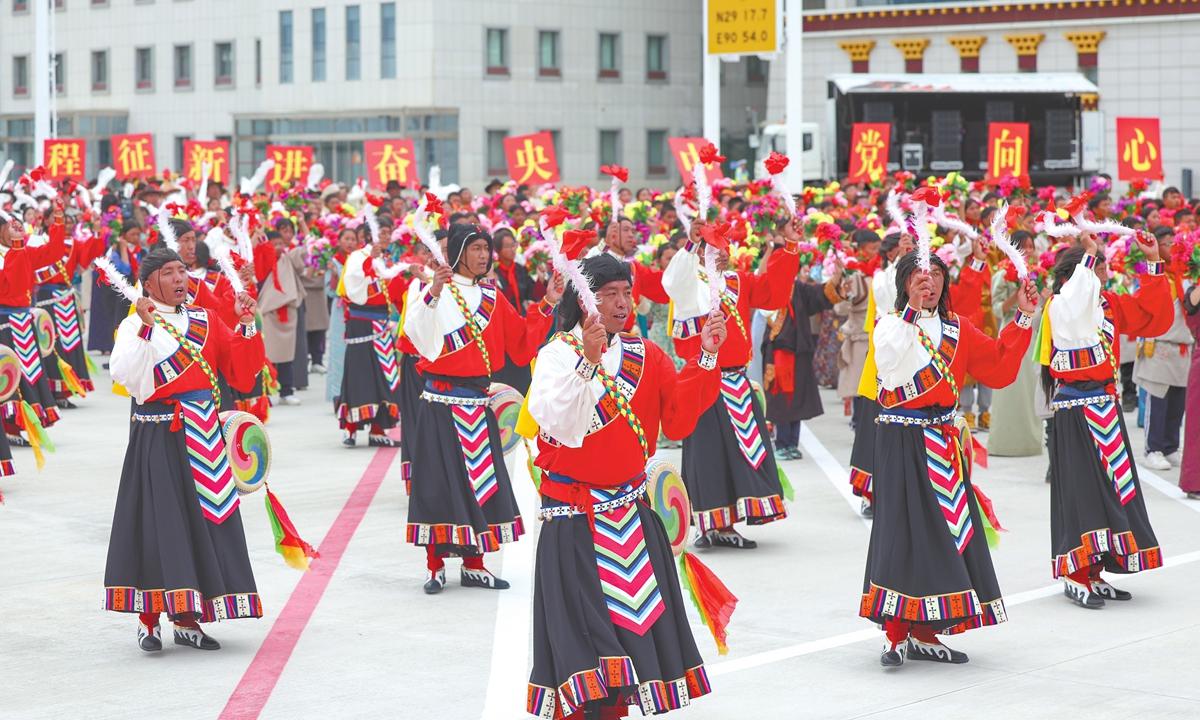
Amid the region's 60th founding anniversary celebration, a festive atmosphere has filled the city of Lhasa, with streets adorned with lanterns and decorations, radiating an air of harmony and jubilation, according to China News. It said on the main roads of the city, national flags and colorful banners were neatly arranged on lampposts.
Figures highlight the historic progress in economic and social undertakings in Xizang. The region's GDP reached 276.5 billion yuan ($38.7 billion) in 2024, 155 times its level in 1965. Xizang's average life expectancy has reached 72.5 years, compared with 35.5 years in the 1950s.
Notably, the region has eliminated millennia-old absolute poverty and realized a moderately prosperous society in all respects alongside the rest of the nation, Xinhua reported.
During a press conference on August 5, Wang Junzheng, secretary of the Communist Party of China Xizang Autonomous Regional Committee said modern industries, including clean energy, cultural tourism and plateau light industry, are thriving, laying the foundation for a modern industrial system.
The region continues to enhance its self-sustaining development capacity, with key economic indicators consistently ranking among the highest growth rates in the country for several consecutive years.
For Xizang, high-quality development is mainly reflected in the continuous optimization of the economic and industrial structure and the growing prominence of local competitive industries. It is also evident in the increase in people's incomes and the improvement of living standards, said Li Chang'an, a professor at the Academy of China Open Economy Studies at the University of International Business and Economics, on Wednesday.
Human rights protected
In March this year, the State Council Information Office released a white paper titled "Human Rights in Xizang in the New Era," at a press conference held in Lhasa.
By the end of 2019, all 628,000 registered impoverished people in Xizang had risen from poverty. In 2024, the per capita net income of those lifted out of poverty in Xizang increased by over 12.5 percent.
Xizang's medical and health service network has now also achieved full coverage. By 2024, Xizang had 7,231 medical and health institutions (including 5,222 village clinics), with 21,551 hospital beds and 29,379 healthcare professionals.
Meanwhile, religious activities are also carried out in accordance with the law in Xizang. Tibetan Buddhism, Islam and Catholicism have coexisted with other religions in Xizang for generations. The region is home to over 1,700 sites for the practice of Tibetan Buddhism and approximately 46,000 Buddhist monks and nuns.
The central government and governments at all levels in Xizang fully respect the tradition of reincarnation of living Buddhas of Tibetan Buddhism, the white paper said, adding that they strictly follow the Measures on the Management of the Reincarnation of Living Buddhas of Tibetan Buddhism and manage the process in accordance with the law.
Adhering to the principle of religions in China must be Chinese in orientation, the freedom of religious belief of the people in Xizang has been fully protected over the past 60 years, according to a document sent to the Global Times by Xizang local government. Education on "enhanced national consciousness, civil awareness, awareness of the rule of law" has been widely and deeply carried out, ensuring religious harmony and temple stability in Xizang.
Xi is also general secretary of the Communist Party of China (CPC) Central Committee and chairman of the Central Military Commission (CMC). On behalf of the CPC Central Committee, he extended sincere greetings and heartfelt wishes to the people of all ethnic groups in Xizang.
Xi led a central delegation to arrive in the regional capital, Lhasa, earlier in the day to attend activities marking the region's 60th founding anniversary. Xi and the delegation received a warm welcome from people of various ethnic groups in Xizang at the airport and in Lhasa city proper, according to Xinhua News Agency.
Also on Wednesday afternoon, Xi held separate meetings with representatives of cadres who come to work in Xizang from other parts of the country, local officials at various levels and from various departments, judicial workers and police officers, as well as patriotic members of the religious circles, among others, according to Xinhua.
Xi also met with military officers ranked colonel and above, along with representatives of grassroots role models and civilian personnel from troops stationed in Lhasa. He conveyed his greetings to all military personnel in Xizang on behalf of the CPC Central Committee and the CMC.
Over the past 60 years since the founding of the Xizang Autonomous Region, remarkable achievements have been made under the leadership of the CPC. In particular, since the 18th National Congress of the CPC, the CPC Central Committee has, with profound vision, formulated CPC guidelines for governing Xizang in the new era. This framework has guided the region's strong economic and social development, advanced long-term stability and high-quality growth, and ushered Xizang into a new stage of modernization, Li Decheng, deputy director-general of and a research fellow with the China Tibetology Research Center, told the Global Times on Wednesday.
Chinese President Xi Jinping arrives in Lhasa, Xizang Autonomous Region on August 20, 2025. Xi and the delegation received a warm welcome from people of various ethnic groups in Xizang at the airport and in Lhasa city proper. Photo: cnsphoto
Strong vitality
Amid the region's 60th founding anniversary celebration, a festive atmosphere has filled the city of Lhasa, with streets adorned with lanterns and decorations, radiating an air of harmony and jubilation, according to China News. It said on the main roads of the city, national flags and colorful banners were neatly arranged on lampposts.
Figures highlight the historic progress in economic and social undertakings in Xizang. The region's GDP reached 276.5 billion yuan ($38.7 billion) in 2024, 155 times its level in 1965. Xizang's average life expectancy has reached 72.5 years, compared with 35.5 years in the 1950s.
Notably, the region has eliminated millennia-old absolute poverty and realized a moderately prosperous society in all respects alongside the rest of the nation, Xinhua reported.
During a press conference on August 5, Wang Junzheng, secretary of the Communist Party of China Xizang Autonomous Regional Committee said modern industries, including clean energy, cultural tourism and plateau light industry, are thriving, laying the foundation for a modern industrial system.
The region continues to enhance its self-sustaining development capacity, with key economic indicators consistently ranking among the highest growth rates in the country for several consecutive years.
For Xizang, high-quality development is mainly reflected in the continuous optimization of the economic and industrial structure and the growing prominence of local competitive industries. It is also evident in the increase in people's incomes and the improvement of living standards, said Li Chang'an, a professor at the Academy of China Open Economy Studies at the University of International Business and Economics, on Wednesday.
Human rights protected
In March this year, the State Council Information Office released a white paper titled "Human Rights in Xizang in the New Era," at a press conference held in Lhasa.
By the end of 2019, all 628,000 registered impoverished people in Xizang had risen from poverty. In 2024, the per capita net income of those lifted out of poverty in Xizang increased by over 12.5 percent.
Xizang's medical and health service network has now also achieved full coverage. By 2024, Xizang had 7,231 medical and health institutions (including 5,222 village clinics), with 21,551 hospital beds and 29,379 healthcare professionals.
Meanwhile, religious activities are also carried out in accordance with the law in Xizang. Tibetan Buddhism, Islam and Catholicism have coexisted with other religions in Xizang for generations. The region is home to over 1,700 sites for the practice of Tibetan Buddhism and approximately 46,000 Buddhist monks and nuns.
The central government and governments at all levels in Xizang fully respect the tradition of reincarnation of living Buddhas of Tibetan Buddhism, the white paper said, adding that they strictly follow the Measures on the Management of the Reincarnation of Living Buddhas of Tibetan Buddhism and manage the process in accordance with the law.
Adhering to the principle of religions in China must be Chinese in orientation, the freedom of religious belief of the people in Xizang has been fully protected over the past 60 years, according to a document sent to the Global Times by Xizang local government. Education on "enhanced national consciousness, civil awareness, awareness of the rule of law" has been widely and deeply carried out, ensuring religious harmony and temple stability in Xizang.
RELATED ARTICLES