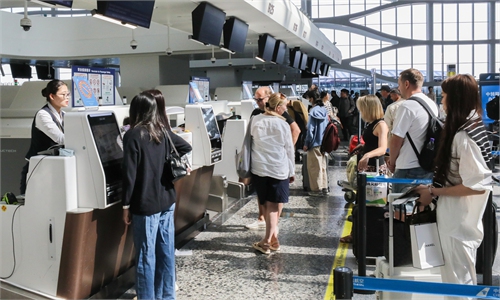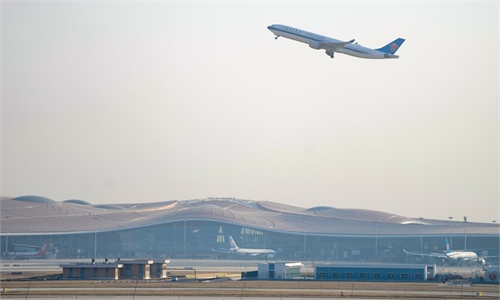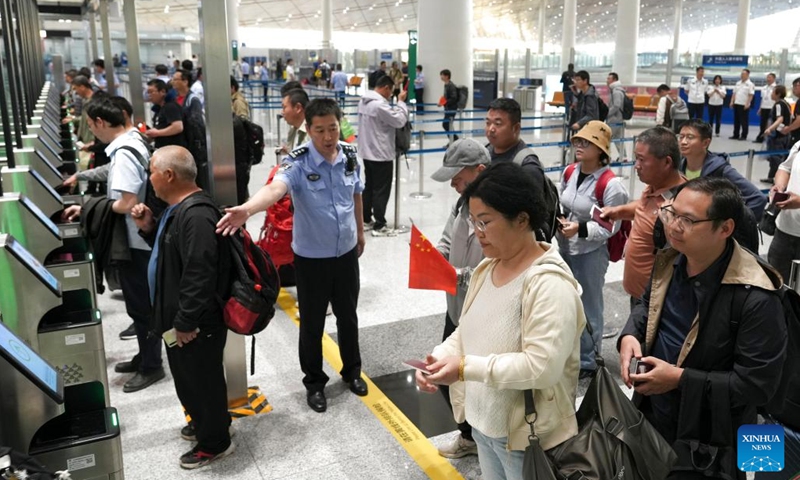
A police officer of the Beijing General Station of Exit and Entry Frontier Inspection assists Chinese nationals with their entry procedures at Beijing Capital International Airport, in Beijing, capital of China, June 20, 2025. (Photo: Xinhua)
Airlines are gearing up efforts to win more high-end customers amid a fast recovery of the global travel market, and the latest example is that Cathay Pacific has unveiled its newly redesigned flagship lounge at Beijing Capital International Airport (BCIA), part of its continued investment in the Chinese mainland.
The move comes amid a rapid recovery of BCIA's function as an international flight hub and a notable return of high-end passenger traffic, as latest data showed that the airport's international and regional passenger volume has now exceeded 10 million, with a full-year estimate of 17 million.
Statistics from the North China Regional Administration of the Civil Aviation Administration of China (CAAC) showed a 41 percent year-on-year rise in cross-border passenger traffic in the first half of this year, with business travel recovering to 85 percent of pre-pandemic levels, according to 21jingji.com on Tuesday.
Against this backdrop, Cathay Pacific is accelerating expansion into the Chinese mainland. As a group, they are operating more than 300 return flights per week to 23 destinations during summer peak.
"The Beijing hub reflects our unique positioning of being 'backed by the motherland' and has always been a key focus for development in recent years," said Cathay Group CEO Ronald Lam.
Mainland passenger traffic has significantly boosted Cathay Pacific's performance. In the first half of 2025, the group reported growth in both passenger and cargo revenue. Passenger service revenue reached HK$34.208 billion, a 14 percent year-on-year increase, with 13.6 million passengers carried, up 27.8 percent year-on-year.
The group plans to invest over HK$100 billion in the coming years to update its fleet, upgrade cabin products, and renovate global lounge network. This includes significant investments in lounge upgrades at 12 airports worldwide.
To capture the massive passenger flow in Beijing, many airlines invest in establishing VIP lounges at the airport. For instance, China Southern Airlines operates First Class/Business Class lounges, Pearl Gold/Silver Member lounges, and an A380 lounge in Terminal 2 of BCIA. Hainan Airlines boasts its VIP lounges at the airport. As the dominant carrier with the highest market share at the airport, Air China operates nearly 10 VIP lounges, according to the jiemian.com on Tuesday.
Such move in Beijing coincides with a strong rebound in international passenger traffic at BCIA. Official statistics show that cross-border passenger traffic at the airport reached 15.2 million in the first half of 2025, a 41 percent increase year on year. This includes approximately 7.5 million inbound passengers and 7.7 million outbound passengers.
As of August 6, the airport's international and regional passenger volume had exceeded 10 million, with a full-year estimate of 17 million, a 21 percent increase from 2024. By the end of 2025, the number of international and regional destinations will exceed 100, further enhancing the airport's route network and appeal to domestic and international travelers.
China continued to expand international flights in July, CAAC data showed on Wednesday, highlighting a fast growth of travel market. The transported volume in July of the international flights was 7.09 million trips, an increase of 15.7 percent compared to the same period of last year, CAAC said.
China has implemented unilateral visa exemptions or mutual visa-free policies with 75 countries during the 14th Five-Year Plan period (2021-25), Wang Zhizhong, head of the National Immigration Administration (NIA) said in July.
Wang noted that the number of countries covered by China's visa-free transit policy has expanded to 55, the number of entry ports has increased to 60, and the length of transit stay in China has been extended to 240 hours, which has facilitated foreign nationals' tourism and business visits to China.
Global Times
RELATED ARTICLES