ARTS / CULTURE & LEISURE
‘Military officer’ family tomb from 1,400 years ago unearthed in Shaanxi
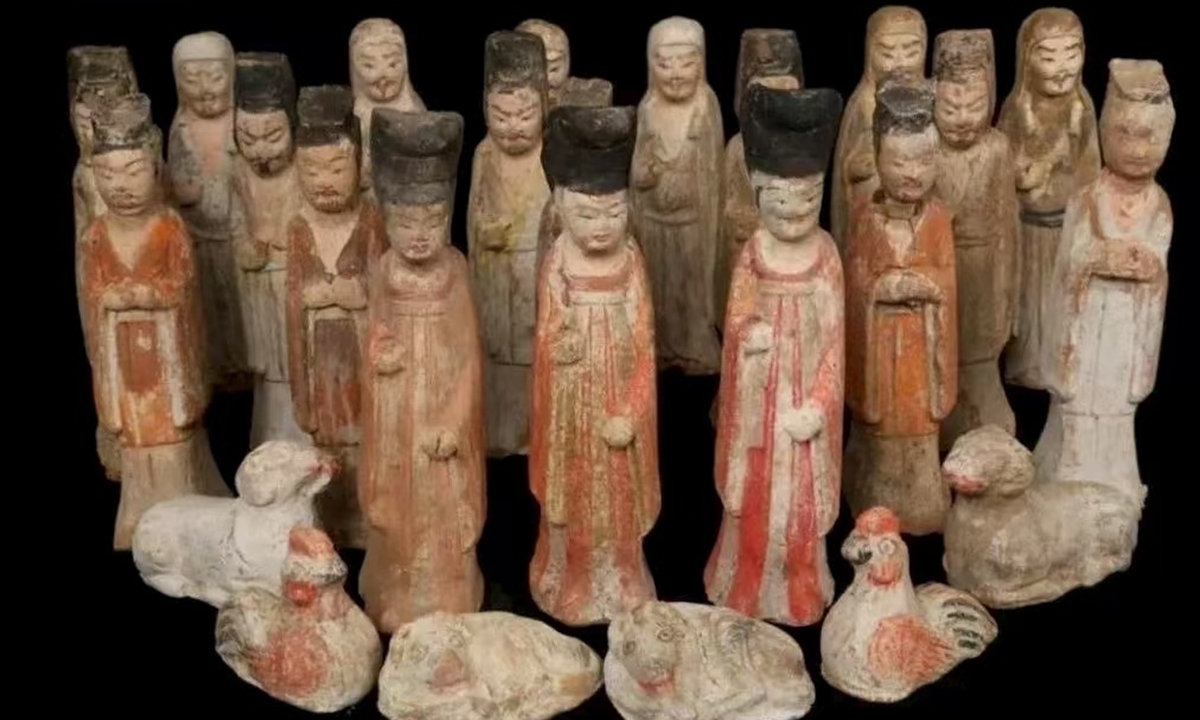
Pottery figurines unearthed from Duan Wenzhen's tomb Photo: Screenshot from CCTV
Archaeologists in Northwest China's Shaanxi Province have uncovered the family tomb complex of a military officer dating back to Sui Dynasty (581-618), a major discovery that may include calligraphy by the famed Tang Dynasty (618-907) master Ouyang Xun, state broadcaster CCTV reported on Friday, citing the Shaanxi Provincial Archaeological Research Institute.
The site was first discovered in August 2022 during construction work in Taojia village, Weicheng district of Xianyang. Epitaphs found at the site indicate the tombs belonged to the family of Duan Wenzhen, who served as minister of war during the late Sui Dynasty.
Research shows that Duan's tomb is well preserved and rich in artifacts, marking it one of the most significant high-ranking Sui burials discovered near Chang'an (the current Xi'an). It is the highest-status Sui tomb ever unearthed in the Xianyang region, according to CCTV.
A review of 15 epitaphs spanning five generations of the Duan family, along with related historical texts, evidence shows that Duan served under both the Northern Zhou (557-581) and Sui dynasties and was celebrated for his military achievements. Known by the courtesy name Yuanqi, he was recognized as a leading general of his time, with biographies recorded in the historical books.
Although the Duan family tomb complex was looted in antiquity, its structure and surviving relics, including epitaphs, stone gates, murals, jade, glassware and groups of pottery figurines, still provide valuable material for studying the rituals, official ranks, culture and economy of the Northern Zhou and Sui period, as well as the dynastic transitions, social changes, and hereditary aristocratic system of the era, said the report.
Excavations at Duan's tomb uncovered 144 pottery figurines, including guardian warriors, beasts, horsemen and animals. Found in wall niches and the burial chamber, the gray-clay figures are mostly hollow with painted surfaces. Their diversity and vivid detail reflect the distinct characteristics of late Sui funerary art.
Duan's epitaph is noted for its ornate language and frequent classical allusions, with clear features of "Ouyang Xun-style" calligraphy that blends regular and semi-cursive scripts. Experts speculate it may have been written by Ouyang Xun, one of the most celebrated calligraphers of the early Tang Dynasty.
Historical records and other inscriptions indicate that Ouyang wrote epitaphs and tombstones for several high-ranking officials of the era, so archaeologists tentatively regard the Duan epitaph as one of his works from the Sui-Tang transition, according to the CCTV report.
Global Times
RELATED ARTICLES