High-tech empowers soccer carnival
New quality productive forces set to shore up China’s economic strength in the world: expert
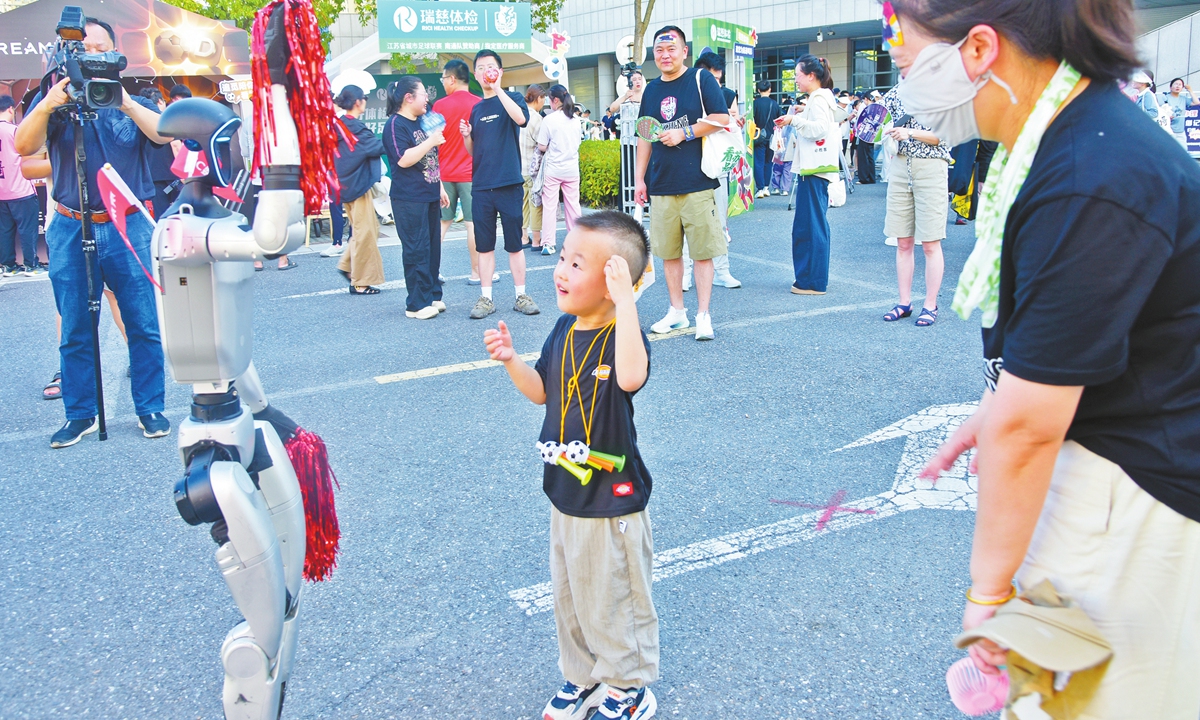
A boy interacts with a humanoid robot outside Nantong's new stadium during the seventh round of Suchao on July 19, 2025. Photo: VCG
This summer, the Jiangsu Football City League, also known as "Suchao", became a sporting and cultural phenomenon in China, winning local pride while drawing nationwide attention.
The amateur soccer event has repeatedly shattered attendance records, as the match between Nanjing and Yancheng on August 17 in Nanjing, East China's Jiangsu Province drew an unprecedented 60,633 spectators.
How to ensure patrolling, guiding, cleaning and other services for such a large audience? A variety of cutting-edge technologies are used to play an important role in ensuring the smooth running of the soccer extravaganza.
Entering the iconic Olympic Sports Center Stadium in Nanjing, a blue robot appeared in sight - an E100 robot produced by Nanjing-based Yijiahe Technology Co could be seen patrolling the venue.
Smarter robots
The first application scenario of the patrolling robots is in security check areas, where they guide and monitor spectators to detect prohibited items. Another application scenario focuses on audience seating zones, where the robots monitor the surroundings for potential safety hazards, said Liu Shengjin, a manager with the company.
Robots are also used to help ensure electricity supply during the event. For example, "Tiankui No 1" from Nanjing TetraBOT Electronic Technology Co - the world's first humanoid robot certified with IIC T6 explosion-proof rating for operation in industrial hazardous environments. It moves with steady steps and its four-wheel, eight-drive chassis flexibly steers through narrow passages. The lifting structure at its waist slowly unfolds, extending a long mechanical arm to accurately scan the instruments in the power distribution cabinet.
"It's like a 'general practitioner' for power distribution rooms and is handling the important task of electricity supply for a major event for the first time," Zhu Dewei, head of product innovation at TetraBOT, told Global Times. "The robot's single arm has load capacity of 25 kilograms, which enables it to quickly handle any emergencies, ensuring the safe operation of power equipment during an event."
As the first 5G-A covered smart stadium in Jiangsu, Nanjing Olympic Sports Center Stadium demonstrated strong network capacity on the day of the match. The Nanjing branch of China Mobile completed base station expansion and network optimization about 48 hours before the match.
It adopted AI intelligent scheduling, 16×16 rectangular beam forming antennas, and D-MIMO technology to precisely control signal beams, significantly enhancing signal quality in the arena, according to a release sent to Global Times.
During the match, more than 60,000 fans simultaneously streamed high-definition video, social media interactions, and QR code payments, and the 5G-A network remained stable and smoothly operational.
In addition, Suzhou-based audio solutions provider Audfly Technology's "AI+acoustics" smart venue sound visualization system debuted at another Suchao match on August 16.
Relying on the spatial sound positioning technology Audfly Spatial Audio, and through the AI intelligent acoustic terminals deployed in a multi-point distributed manner, it collects real-time sound wave data from the stadium, generates colorful sound images that are displayed on the large on-site screen, according to an article posted on the WeChat account of Suzhou High-Tech Zone.
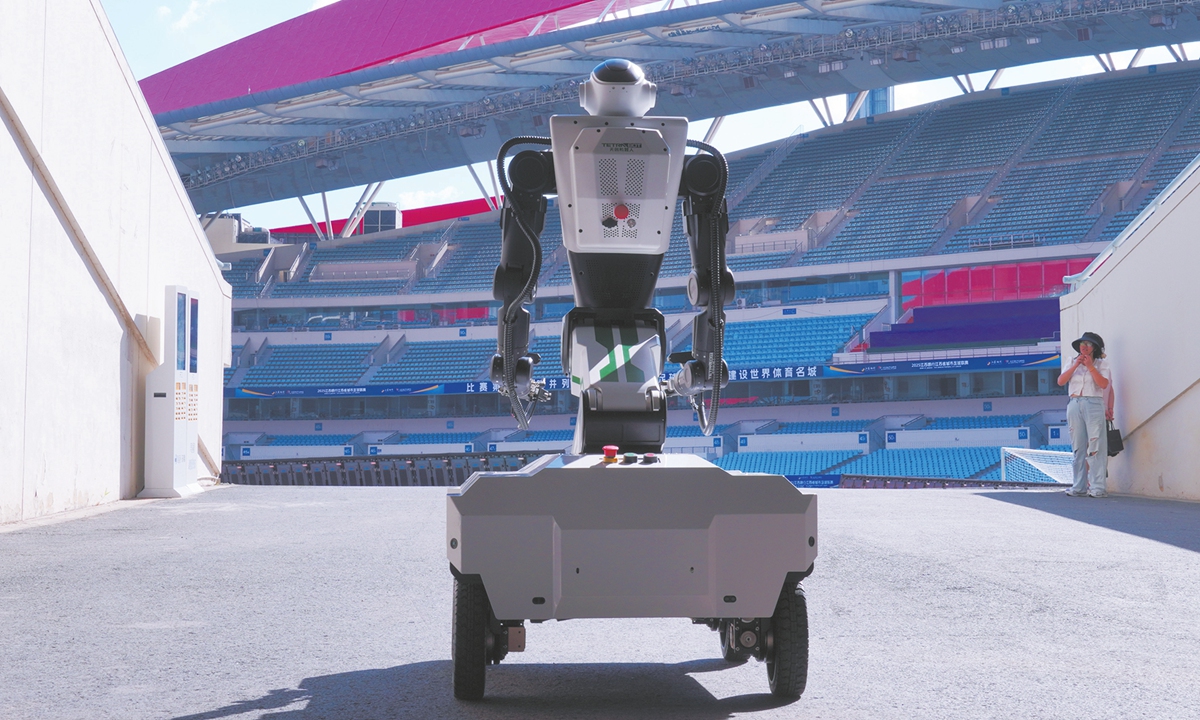
The "Tiankui No 1" robot Photo: Courtesy of Nanjing TetraBOT Electronic Technology Co
High-tech growth
"The large-scale event not only opens up opportunities for the application of new tech innovations, but also provides a window to observe the development of the new quality productive forces in China," Xiang Ligang, director-general of the Beijing-based Information Consumption Alliance, told Global Times in a recent interview.
The application of technological innovation in large-scale sports events is not just a technical application. Instead, high demands, strong pressure, and wide exposure of new technologies in event scenarios will in turn propel iteration and breakthroughs of tech innovations, Xiang said.
"These new technologies applied at Suchao are largely driven by the rapid development of artificial intelligence (AI) which is one of the core technologies contributing to new quality productive forces. Along with the improvement of AI general capability and its penetration in various sectors, the development of new quality productive forces will accelerate further," Liu Gang, chief economist at the Chinese Institute of New Generation AI Development Strategies, told Global Times.
According to the National Data Bureau on August 14, the country has made breakthroughs in a number of key core technologies in the digital field after years of sustained efforts. China's comprehensive strength in AI has achieved systemic and holistic advancements, with AI patent applications accounting for 60 percent of the global total. Breakthroughs have also been realized in areas such as humanoid robots and smart terminals.
At its July 30 meeting, the Political Bureau of the Communist Party of China Central Committee called for intensified efforts to foster new quality productive forces based on local conditions.
Currently, China's AI industry is developing rapidly, as the country seizes the opportunity brought by a new round of technological revolution and industrial transformation in the world, and advancing toward realizing high-end, intelligent, and green development, Liu noted.
Moreover, China has an abundant talent pool, with more than 5 million STEM (science, technology, engineering, and mathematics) graduates annually. By promoting the integrated development of education, technology, and talent, the country is set to unlock the full potential of talent dividends, fueling even greater innovation momentum, according to Liu.
Despite a spate of global economic uncertainties, China's economy made steady progress in the first half of 2025, showcasing robust vitality and resilience. The country's GDP expanded by 5.3 percent year-on-year over the period, ranking among the top major economies in the world.
Against the backdrop of a sluggish global economy, China's economy stands out as a bright spot. The new quality productive forces have driven the structural upgrading and strengthened the foundations of China's real economy, strengthened the country's leading position among the world's major economies, and this positive growth momentum will continue with expected sustained expansion during the 15th Five-Year Plan period (2026-30), Cao Heping, an economist from Peking University, told Global Times.
RELATED ARTICLES