China vows to intensify unified national market building push
Commitment follows regulatory progress in curbing unfair practices under 14th Five-Year Plan
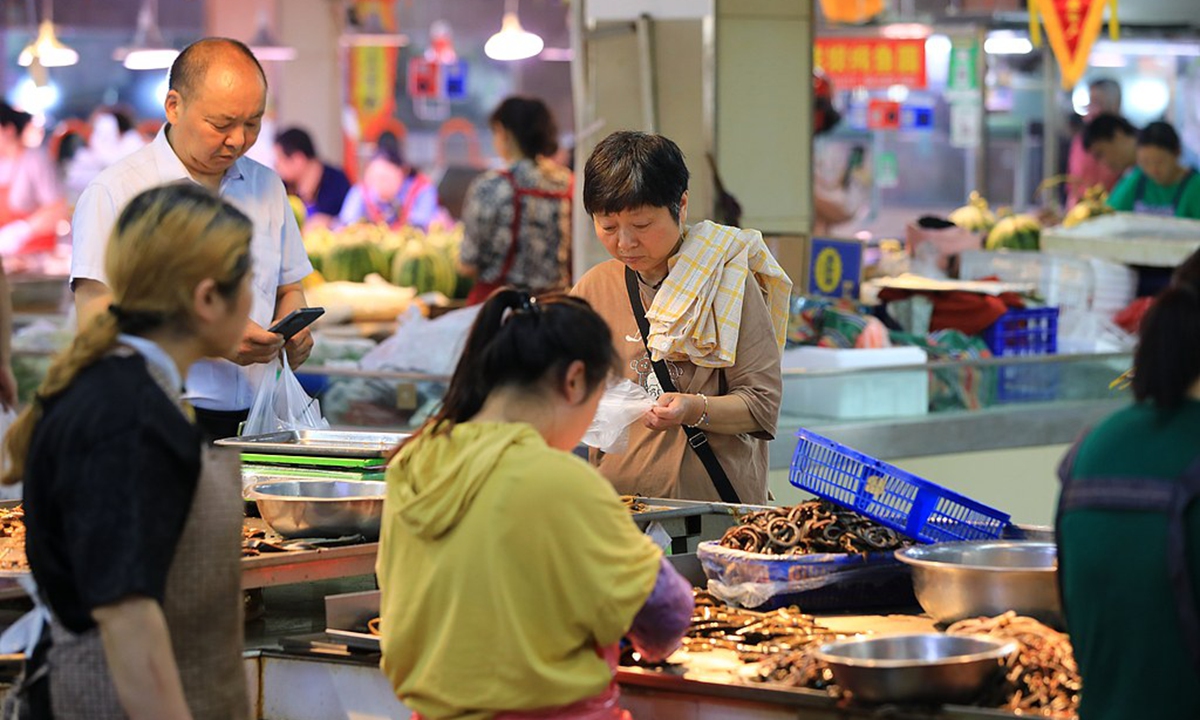
People shop at a farmers' market in Huai'an, East China's Jiangsu Province, on June 8, 2025. Jiangsu recently rolled out a set of implementation measures featuring 62 targeted actions across six key areas to boost consumer demand and support the continued recovery of the consumption market. Photo: VCG
China's market regulator on Friday highlighted notable progress in fostering a fair market environment during the 14th Five-Year Plan period (2021-25), including efforts to curb "irrational" competition and regulate excessively low prices, while vowing to intensify actions to eliminate local protectionism and advance the building of a unified national market.
Deputy Minister of the State Administration for Market Regulation (SAMR) Luo Wen made the remarks at a press conference on Friday to review the development of market regulation during the 14th Five-Year Plan period.
During this period, the nationwide market regulation system has worked to foster a more dynamic and equitable market environment, providing strong support for high-quality economic and social development, Luo said.
The business environment has been continuously optimized, Luo noted, supported by efforts such as the implementation of a unified negative list for market access, as well as enhanced protection of intellectual property and trade secrets, which helped to boost companies' motivation to be innovative.
Since the start of the 14th Five-Year Plan period, the number of enterprises in China has increased by a net total of 19.999 million, while the number of self-employed businesses has risen by a net total of 33.946 million, data revealed on Friday showed.
Luo stressed that rigid institutional constraints had been established to regulate "vicious competition" in investment promotion, irregular fiscal subsidies, and restrictions on business relocation.
The SAMR also intensified efforts to address "irrational" competition, strengthened guidance to avoid excessively low prices, and addressed prominent issues such as local protectionism and market segmentation.
"China's vast market size and broad development space are standout advantages of our economic development. To leverage these advantages, we must vigorously break down local protectionism, promptly prevent and curb market monopolization, and maintain and develop a unified national market," the official said.
To achieve this goal, the market regulator enhanced various measures, including more robust efforts to prevent monopolistic practices. For instance, it strengthened monitoring and assessment of monopoly risks in key sectors and reinforced routine supervision of the platform economy.
Over the past five years, a total of 3,400 cases of concentration of undertakings were reviewed in key areas, with 145 illegal cases investigated and penalized, effectively upholding fair competition in the market, according to official data.
"The drive to build a unified national market is ultimately about leveling the playing field and strengthening confidence in China's long-term economic prospects," Li Changan, a professor at the Academy of China Open Economy Studies at the University of International Business and Economics, told the Global Times on Friday.
"Unfair and disorderly competition is a key reason why some market players lack growth momentum," Li said, adding that stronger regulation and improved institutional frameworks can effectively boost corporate vitality, unleash broader social demand, and support sustained, healthy economic development.
China's top economic planner, the National Development and Reform Commission, released a guideline in January aimed at building a unified national market, breaking down market barriers and boosting domestic demand while enhancing openness, according to Xinhua News Agency.
The relatively weak domestic demand, especially in consumption, is a key bottleneck for economic circulation, an official from the Research Office of the State Council noted at the time, saying that building a unified national market is essential for unleashing domestic demand potential, and fully harnessing the market's industrial and demand advantages.
During the 14th Five-Year Plan period, China's market regulator organized special campaigns against abuses of administrative power to exclude or restrict competition, filing and investigating 239 administrative monopoly cases, and reviewing over 8,000 local standards.
Efforts to crack down on unfair competition have led to nearly 50,000 cases being addressed, including 4,296 instances of online violations, helping to steadily improve the competitive landscape in both offline and digital markets, according to Luo.
China has made notable progress in improving its market environment during the 14th Five-Year Plan period, with positive changes seen not only in the eastern coastal regions but also in some inland and western provinces, Tian Yun, a veteran economist based in Beijing, told the Global Times on Friday.
Looking ahead to the next five-year plan, the SAMR official vowed efforts to continuously focus on advancing the key reforms, with stronger measures to break local protectionism and market segmentation, and concrete steps to ensure fair competition, making the market a level playing field for all businesses.
Further progress is expected in creating a unified market in the service sector and facilitating the flow of resources such as household registration, healthcare, and social security, Tian said, adding that these reforms are set to enhance people's well-being, stimulate social consumption, and provide fresh momentum for economic growth.
RELATED ARTICLES