Ahead of US-S.Korea summit, Lee and Ishiba unveil 1st joint statement in 17 yrs
By Published: Aug 24, 2025 11:00 AM Updated: Aug 24, 2025 12:55 PM

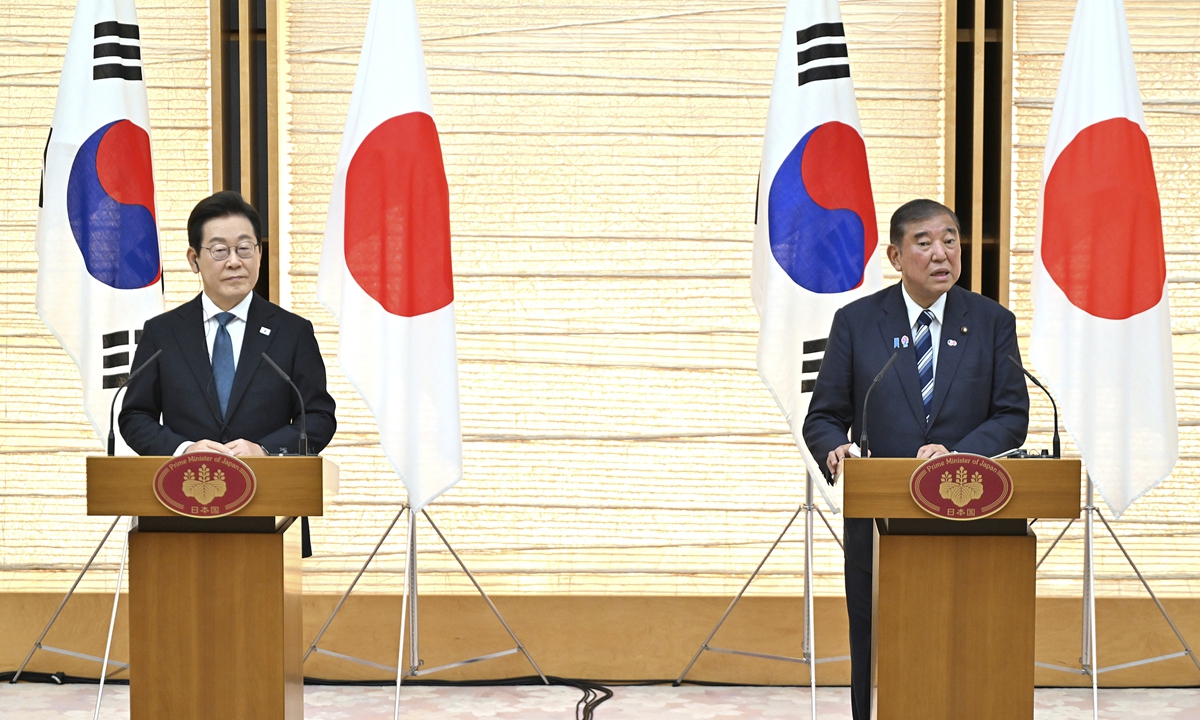
South Korean President Lee Jae Myung (L) and Japanese Prime Minister Shigeru Ishiba hold a joint press conference at the Prime Minister's Office in Chiyoda Ward, Tokyo, on August 23, 2025. Photo: VCG
Japanese Prime Minister Shigeru Ishiba and South Korean President Lee Jae-myung announced their countries' first joint statement in 17 years on Saturday, reaffirming security cooperation between the two neighbors, according to media reports. The announcement came ahead of a summit between US and South Korean leaders scheduled for Monday, media reported.
The Korea Herald reported Saturday that the South Korean president stopped by Japan on the way to the US in a move to resume the lapsed "shuttle diplomacy."
Lee's visit to Japan may help him prepare for his crucial first summit in Washington on Monday with US President Donald Trump, mainly on trade and defense issues, AP reported Sunday.
The Korea Herald claimed that Tokyo is Lee's first destination on a presidential trip for a bilateral meeting with a leader since his inauguration in early June. Lee also became the first South Korean president to make Japan the first such visit in his term.
The two leaders agreed that, in addressing "various challenges facing the international community," Japan and South Korea, "as partners, must work together to advance future-oriented and mutually beneficial common interests," according to the joint statement released by the leaders, the Japan Times reported Saturday.
AP reported Sunday that Lee, in his first summit with Ishiba on Saturday, stressed the importance of setting aside their past differences as they face common challenges from the US, their mutual ally.
According to AP, Lee said they agreed to pursue "a virtuous cycle" in which their improved relations enhance their trilateral cooperation with the US.
"We shared a recognition that in the face of a rapidly changing international situation, unwavering cooperation of South Korea-Japan and South Korea-US-Japan is more important than ever," Lee said, according to AP.
Ishiba said they agreed to step up strategic dialogue in the areas of defense and economic security, AP reported. Ishiba, who met Trump in Washington in February and held talks with him at the June G7 summit, has settled a tariffs deal ahead of South Korea.
"As the strategic environment surrounding both our countries grows increasingly severe, the importance of our relations, as well as trilateral cooperation with the United States, continues to grow," Ishiba said in the joint announcement with Lee after their meeting, Reuters reported Saturday. The leaders agreed to resume shuttle diplomacy, expand exchanges such as working holiday programs, and step up cooperation in defence, economic security, artificial intelligence and other areas, according to the report.
Da Zhigang, director of the Institute of Northeast Asian Studies at the Heilongjiang Provincial Academy of Social Sciences, told the Global Times on Sunday that before Lee took office, many had predicted that he would maintain an Japan-lashing stance. However, reality has shown that not only has he refrained from undermining bilateral ties, but he has also advanced cooperation with Japan, demonstrating a cautious and pragmatic approach.
The expert believes, by prominently highlighting bilateral security cooperation, Lee intends to send a signal to the US in preparation for his upcoming meeting with Donald Trump on Monday. "Lee tries to provide reassurance to the US by promoting trilateral integration among Washington, Tokyo, and Seoul. Ultimately, he seeks to leverage this development into a favorable asset for South Korea in its talks with the US," Da told the Global Times.
According to the expert, the US has long been committed to promoting reconciliation between Japan and South Korea, urging the two countries to reach agreements on historical issues and ongoing territorial disputes. For the US, the continued friction and confrontation between Tokyo and Seoul would undermine US efforts to consolidate its strategic resources in the Asia-Pacific region, Da said
"The US relies on these two core allies to advance its strategic engagements in the so-called Indo-Pacific, the South China Sea, the East China Sea, and the Taiwan Straits," Da analyzed.
Although both Japan and South Korea made a gesture for a reconciliation, they still face significant uncertainties and potentially intractable challenges, Da emphasized.
AP reported Sunday that the joint statement said the two leaders agreed to look toward the future as Tokyo reiterates its "deep remorse and heartfelt apology" over Japan's brutal colonial rule.
In his address last week marking the liberation from Japan's 1910-1945 colonization of the Korean Peninsula, Lee called for the two sides to overcome past grievances while also urging Tokyo to face unresolved issues and strive to maintain trust, according to AP.
Even if Japan makes certain gestures on historical issues, the deep-rooted bilateral rifts stemming from historical and territorial disputes involve core national interests and domestic public sentiment, making them highly sensitive, Da said.
Historical and territorial issues will continue to impair diplomatic coordination, influence media bias and public opinion, and even affect societal attitudes, Da noted.
RELATED ARTICLES