South Korean president says US investment demands would spark a financial crisis: media report
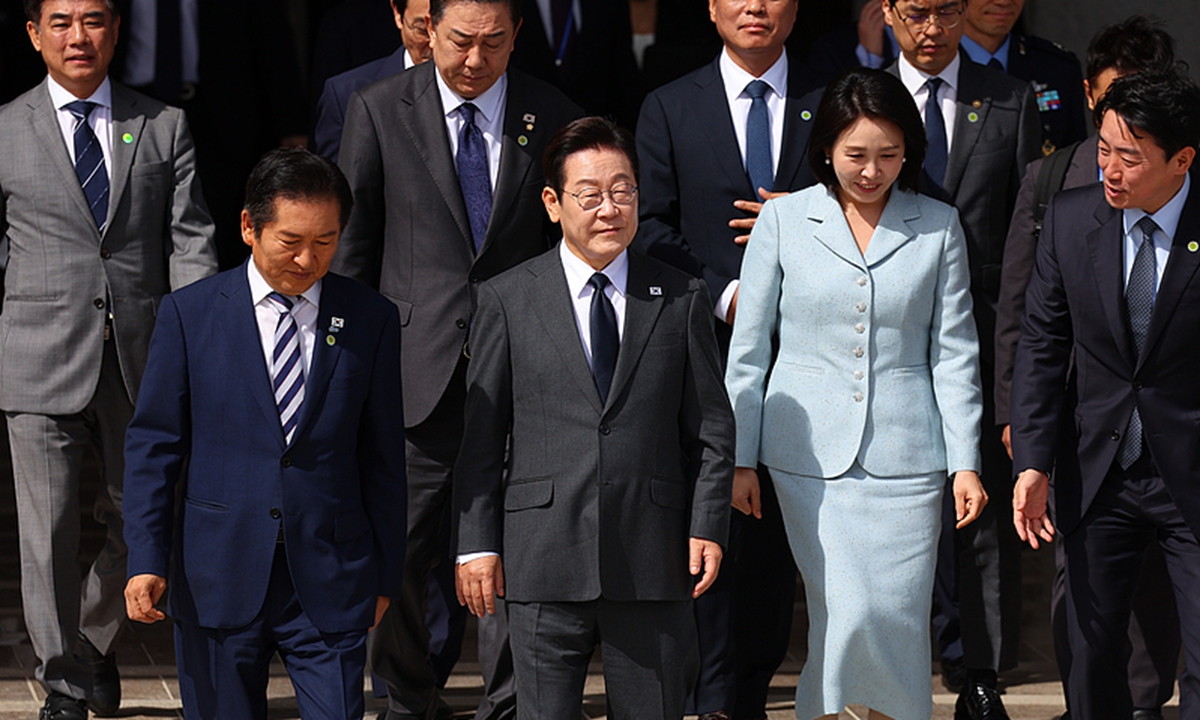
South Korean President Lee Jae-myung heads to US to attend United Nations General Assembly on September 22, 2025. Photo: VCG
South Korea's economy could fall into crisis rivaling its 1997 meltdown if the government accepts current US demands in stalled trade talks without safeguards, said South Korean President Lee Jae-myung, Reuters reported on Monday. An expert noted that while South Korea has limited room for a hardline stance, Lee's statement underscores the predicament that US economic bullying against South Korea has created for the country.
Lee will make a trip from Monday to New York, where he will address the United Nations General Assembly and be the first South Korean president to chair a meeting of the Security Council, per Reuters. However, the report said that trade and defense talks with the US, South Korea's military ally and a top economic partner, are overshadowing the trip.
Ahead of his trip, Lee said that Seoul and Washington verbally agreed to a trade deal in July in which the US would lower US President Donald Trump's tariffs on South Korean goods in exchange for $350 billion in investment from South Korea, among other measures. Lee said, however, they have yet to put the agreement to paper because of disputes over how the investments would be handled.
"Without a currency swap, if we were to withdraw $350 billion in the manner that the US is demanding and to invest this all in cash in the US, South Korea would face a situation as it had in the 1997 financial crisis," he said through a translator.
Economic and trade issues constitute the most pivotal factor in South Korea-US relations, Xiang Haoyu, a research fellow at the China Institute of International Studies, told the Global Times on Monday.
Lee's statement is more of a political posturing—it serves to convey South Korea's concerns and the worries of South Korean enterprises, in an attempt to garner a certain degree of attention from the US, Xiang added.
This month Trump's administration rocked South Korea with the arrest of more than 300 South Korean workers at a Hyundai Motor battery plant in Georgia, with federal officials accusing them of immigration violations.
Commenting on that, Lee said "I do not believe this was intentional, and the US has apologized for this incident, and we have agreed to seek reasonable measures in this regard, and we are working on them," per the report.
Such a stance is intended to assuage US concerns, thereby securing a relatively favorable outcome for South Korea in the upcoming bilateral trade negotiations, Xiang said. The crux of the matter, however, lies in that South Korea possesses limited bargaining leverage in its relations with the US, said Xiang, adding that as such, South Korea has to exercise restraint to avoid undermining the South Korea-US alliance.
RELATED ARTICLES