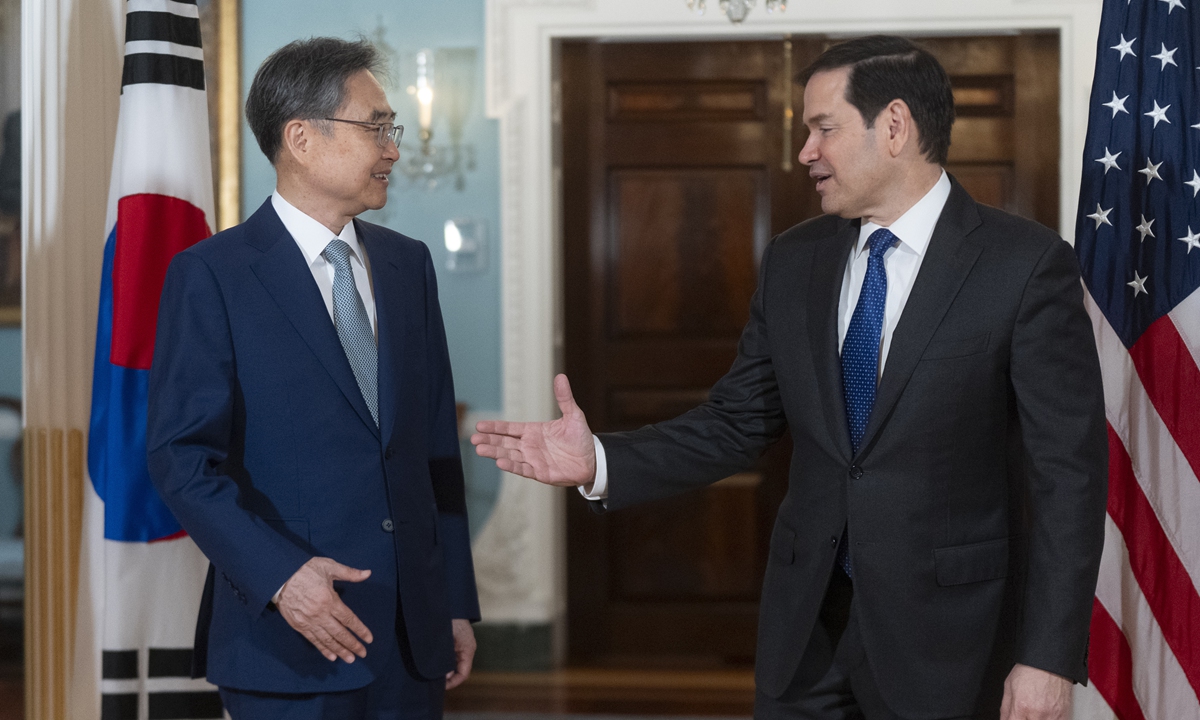
US Secretary of State Marco Rubio, right, reaches to shake hands with South Korea's Foreign Minister Cho Hyun in the Treaty Room at the US State Department in Washington, US, on July 31, 2025. Photo: VCG
South Korean Foreign Minister Cho Hyun claimed the Seoul has become "rather alert to China's rise and its challenges," while expressing desires to maintain a good relationship with China, during a recent interview with the Washington Post. The remarks came at what the outlet described as "a delicate moment" in US-South Korea relations as Cho journeyed to Washington last week.A Chinese analyst noted that Cho's remarks reflect Seoul's ambivalence - seeking to preserve relations with China while worrying backlash from the US and its allies.
In the interview published Sunday, Cho responded to a range of questions from the Washington Post, including trade negotiations with the US, the deployment of US troops on the Korean Peninsula, and South Korea's relations with neighboring countries such as China, Japan, and the DPRK, as well as Seoul's policy on Palestine. However, it was his remarks on China that made the headlines in several South Korean media outlets.
When asked what the correct approach to China should be, Cho told the Washington Post, "We will try to send a message to China: 'We want to maintain a good relationship, and [see] you abide by international law in not only bilateral, but in regional affairs.'"
Multiple South Korean outlets, including News 1, Jayu Press, and Nate News, featured Cho's statements on China prominently in their coverage, interpreting the remarks as reflective of the current administration's predicament. News 1 cited experts as saying, "This is not merely the minister's personal opinion… it signals the strong pressure from the US."
"The current South Korean administration is seeking to shift from its predecessor's one-sided approach, but still treads carefully so as not to provoke the US," Lü Chao, a Korean Peninsula affairs expert at the Liaoning Academy of Social Sciences, told the Global Times. "Cho's language reflects a cautious, tightrope diplomacy. But improving ties with China requires more than rhetoric. Seoul must act with consistency and sincerity rather than being used as leverage by a third party."
In the interview, Cho also mentioned to "cooperate with Japan" and noting this was why he had visited Japan en route to the US. He said he had discussed "the new challenges we are facing in the region" with Japan's foreign minister and prime minister, but added, "I noted the need for engaging China, because simply trying to block China will not be as effective as we want."
South Korean media outlets interpreted Cho's statements as evidence of the intense pressure the US is exerting on Seoul to participate in its efforts to contain China. News 1 cited experts suggesting that Cho's unusually phrased remarks as an indication of the considerable pressure from the United States for Seoul to join its efforts to contain China.
During the interview, Cho also claimed China had become "somewhat problematic with its neighbors," citing the South China Sea and the Yellow Sea, and asserted that China had become a "competitor" due to its rapid economic development.
Lü warned that echoing US rhetoric about the "China threat" and stirring up the South China Sea issue—especially as a non-regional actor—would do nothing to improve China-South Korea ties. "We understand the pressures South Korea faces—from tariffs, political maneuvering, and US military demands—but Seoul should not lend legitimacy to such misguided narratives. What's needed now are decisive steps to improve its relationship with China."
Trump said on Wednesday the US will charge a 15 percent tariff on imports from South Korea. South Korea also agreed to invest $350 billion in the US in projects selected by Trump and to purchase energy products worth $100 billion, according to Reuters.
Amid US economic coercion through tariffs - of which South Korea is also a victim - the international community should focus on cooperation rather than appeasing Washington. While China remains open to improving ties with South Korea, this requires Seoul to act with consistency and sincerity, said Lü.
Bilateral relations should not be influenced by third parties or used as leverage. A stable, constructive China-South Korea relationship depends on mutual respect and clear, consistent policies, said the expert.
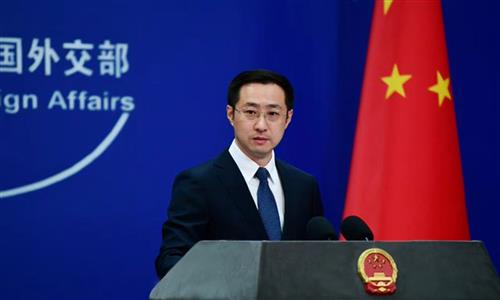
During a press conference in June, Chinese Foreign Ministry spokesperson Lin Jian said that China-South Korea relations are propelled fundamentally by the two countries' common interests. The relations do not target any third party, and should not be disrupted by any third-party factor.
"We stand ready to work with the ROK to pursue sound and steady bilateral ties to the benefit of the two peoples, and play a positive role in making our region more peaceful, stable and prosperous," said Lin.
RELATED ARTICLES