ARTS / CULTURE & LEISURE
New fossil discovery identified as the oldest sauropod in South China
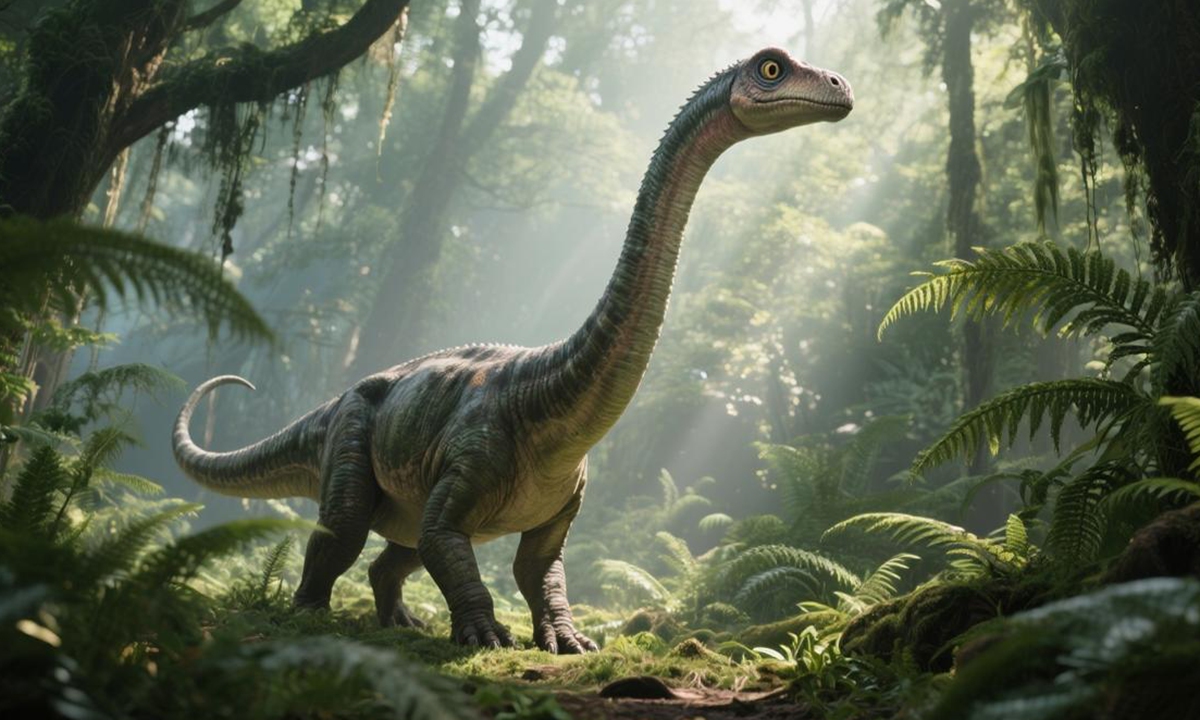
A restoration image of the Huashanosaurus qini dinosaur Photo: Xinhua News Agency
The latest research shows that the Huashanosaurus qini dinosaur fossil, discovered in Ningming County, Southwest China's Guangxi Zhuang Autonomous Region, dates to the early to middle Jurassic, making it the oldest sauropod dinosaur found so far in South China, according to a report by the Xinhua News Agency on Sunday.
The research was jointly conducted by a research team composed of the Guangxi Museum of Natural History, the Cultural Relics Administration of Ningming County, and the Institute of Vertebrate Paleontology and Paleoanthropology of the Chinese Academy of Sciences. The study, titled "A New Eusauropod Dinosaur from the Lower and Middle Jurassic Wangmen Formation of Ningming County, Guangxi, South China," has been published in domestic academic journal Acta Geologica Sinica (English Edition).
According to Mo Jinyou, a member of the research team and deputy director of the Guangxi Museum of Natural History, Huashanosaurus qini lived during the early to mid-Jurassic period. This discovery provides new fossil evidence for the study of the evolution and distribution of Jurassic sauropod dinosaurs in China and worldwide, suggesting that the South China region may have harbored a diverse range of sauropod dinosaurs during the Jurassic, according to the Xinhua report.
The fossils were accidentally discovered in 2007 at a quarry near a local hydropower station. Researchers collected more than 30 incomplete dinosaur bones, including vertebrae, tail vertebrae, humeri, ulnae, fibulae, and phalanges.
Mo explained that the identification of the Huashanosaurus qini was based on several unique skeletal features. Based on the size of its bones, it is estimated to have been about 12 meters long, making it a medium-sized, herbivorous sauropod that walked on all fours and lived in wooded areas along river and lake shores.
Its skeletal fossils were buried in the Wangmen Formation of the Shiwandashan Basin. During the Mesozoic, the basin was a terrestrial sedimentary environment. The river- and lake-deposited layers of the Wangmen Formation also contain fossils of fish scales, turtle bones, and plesiosaur teeth, among other vertebrates, suggesting that the region had a humid climate and a complex ecosystem at the time, providing suitable conditions for the reproduction of sauropod dinosaurs, according to the report.
"The discovery fills a gap in the fossil record of early- to mid-Jurassic true sauropods in South China," Mo said. "Its unique features provide new insights into the early diversification of this dinosaur group."
In the future, further field investigations at the fossil site and the Shiwandashan Basin should reveal more secrets about the radiation and evolution of sauropod dinosaurs in South China, added Mo.
Global Times
RELATED ARTICLES