Exclusive Insight: Why it’s necessary for China to summon Nvidia over ‘backdoor’ security risks
Why it’s necessary for China to summon Nvidia over ‘backdoor’ security risks
Photo: VCG
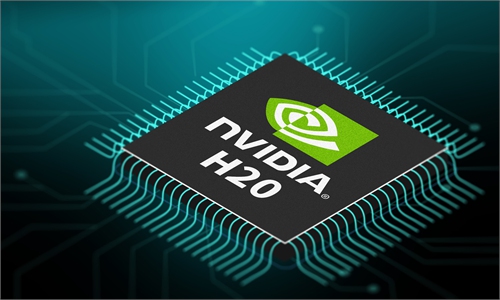
Nvidia is reportedly developing a new artificial intelligence (AI) chip for China based on its latest Blackwell architecture, with performance expected to surpass that of its H20 chip, Reuters reported. The news comes amid lingering concerns about security risks of Nvidia chips.
Whether Nvidia's new chip will indeed prove "more powerful" remains to be seen, but concerns over its "security" are drawing greater scrutiny. The Cyberspace Administration of China (CAC)'s recent decision to summon the company sparked speculation over the reasons for the move. To understand this, one must first look at recent developments in the US.
Policy requirements
In recent months, the US has been making frequent moves, explicitly stating in policy documents that it requires that high-end AI chips exported be implanted with "location verification" to enable remote tracking. Washington's decision to so brazenly call for such "backdoor" measures is nothing short of astonishing.
In May 2025, US lawmakers from both parties introduced the Chip Security Act, seeking to require any covered integrated circuit product to be outfitted with chip security mechanisms that implement location verification.
In July, the White House released its so-called AI action plan, which recommended that US authorities, in collaboration with industry, "explore leveraging new and existing location verification features on advanced AI compute to ensure that the chips are not in countries of concern."
In August, Michael Kratsios, one of the architects of a White House action plan on AI that calls for exploring chip-tracking technologies, told Bloomberg Television that officials are discussing the use of software or physical changes to better track restricted chips. "That is something we explicitly included in the plan," he said.
In the face of these moves by the US government, doubts remain over whether Nvidia can withstand the mounting pressure. China's request that the company clarify the potential "backdoor security risks" of its chips and provide supporting documentation should be viewed as a responsible step to safeguard cybersecurity and data security.
Experts note that US AI export policy is evolving. On May 13, 2025, the US Department of Commerce formally rescinded the Biden-era AI Diffusion Rule, a policy that had been criticized for over-restricting chip exports and ceding market share to other countries.
The US' newly released AI race action plan emphasized that US authorities "will partner with industry to deliver secure, full-stack AI export packages." In other words, Washington aims to sell more AI products, maximize profits, and bind the world to its own AI ecosystem.
US efforts to boost AI exports do not imply looser restrictions. On the contrary, export controls may become stricter, with measures such as mandatory embedded "location verification" features to enable remote monitoring and control of exported chips, a move aimed at consolidating Washington's leadership in global AI.
Technical capacity
How technically feasible is it to remotely access or remotely control "exported" chips? Experts say the feasibility of remotely accessing or controlling exported chips is relatively high. Backdoors can be embedded either through hardware or software, and Nvidia has the technical capacity to do so.
The US once designed an "on-chip governance mechanism," capable of functions such as tracking and location verification. A report released by the Center for a New American Security on this mechanism noted that many of the required functions are already widely embedded in various chips, including advanced AI processors. "Chips sold by leading firms AMD, Apple, Intel, and NVIDIA have many of the features needed to enable the policies described above," the report said.
The rapid global growth of the AI industry has fueled demand for advanced chips and spurred the emergence of new technologies. This pace of innovation has also lowered the barriers to installing "backdoors." Nvidia, as a leading producer of high-performance AI chips, has the full capability to deploy such technologies. In this context, China's decision to summon the company for talks is fully justified and necessary. China provides an important sales market for US chips, but it will also firmly keep unsafe chips out.
Nvidia has claimed that its chips don't have backdoors, so it should be able to prove it with facts. Since Chinese regulators have already asked the company to explain the potential security risks of its H20 chips and submit supporting evidence, it is now up to Nvidia to substantiate its claims. For the moment, we will have to wait and see what the results of this review reveal.
Problematic record
Given reports of security concerns with US computing chips, it is reasonable to remain cautious about potential backdoor risks until these doubts are fully addressed. Such vigilance is warranted, especially in light of Washington's long track record of embedding backdoors in high-tech products.
In the 1990s, US telecom company AT&T was required to install the "Clipper Chip" in its devices. The chip generated an extra encryption key that was held by the government, allowing agencies such as the FBI to conduct surveillance with court approval. The project sparked major controversy and was eventually terminated, according to media reports.
In 2013 Edward Snowden revealed that the US National Security Agency had intercepted hardware during transport and implanted backdoors in servers and routers, based on leaked agency documents, according to BBC.
In 2014, the book How America Monitors China - Records of the US Global Surveillance Operation revealed that Chinese cybersecurity authorities had detected serious pre-installed backdoors in Cisco routers, according to an article on the CAC's website.
According to German media reports earlier this year, the F-35A Lightning II fighter jets, scheduled to enter service with the German Air Force in 2026, may face the risk of being remotely grounded by the US with a single command. The revelation quickly fueled concerns across several countries that had procured the aircraft, heightening speculation that the F-35 may contain built-in "backdoors."
The US government has long faced criticism for embedding "backdoors" in high-tech products, leaving a problematic record. With technological competition intensifying, it has become even more important to sharpen scrutiny of such security risks. This vigilance is not about targeting US tech firms, nor is it an attempt to create obstacles for them.
Today, China remains the world's largest semiconductor consumer market, providing a vital sales destination for multinational chipmakers, including those from the US. But compared with China's openness, how has the US behaved?
Chip hegemony
The US Department of Commerce recently issued guidelines seeking to enforce a global ban on certain advanced Chinese computing chips — including Huawei's Ascend series — citing alleged violations of US export controls.
The US crackdown on China's advanced chips violates international law and basic norms of international relations, undermines the legitimate rights of Chinese enterprises, and constitutes unilateral bullying and protectionism that threatens the stability of the global semiconductor supply chain.
Confronted with China's rapid progress and other countries in chip technology, the US has shown a conflicted stance. On one hand, it seeks to suppress competitors and deprive others of the right to develop advanced computing and AI industries. On the other, Washington is eager to expand overseas applications of US AI technologies while tightening export controls through measures such as "backdoors," in a bid to cement its chip dominance.
China's AI chip sector has adopted an open approach, advancing industry development and market access in parallel. Officials have repeatedly stressed that foreign firms, including US chipmakers, are welcome to deepen cooperation in China. The hope is that they convey these opportunities to Washington, resist political pressure, and help rebuild confidence in US chips when policy shifts.
In recent years, facing relentless pressure from Washington, China has accelerated breakthroughs in chip technology and industry upgrades. With both capability and confidence, China is prepared to reject any chip that is insecure, regardless of its computing power.
Global Times
RELATED ARTICLES