South Korea’s Lee to meet Trump; ‘visits to US, Japan reflect pragmatic diplomacy, aim to shore up domestic political base’
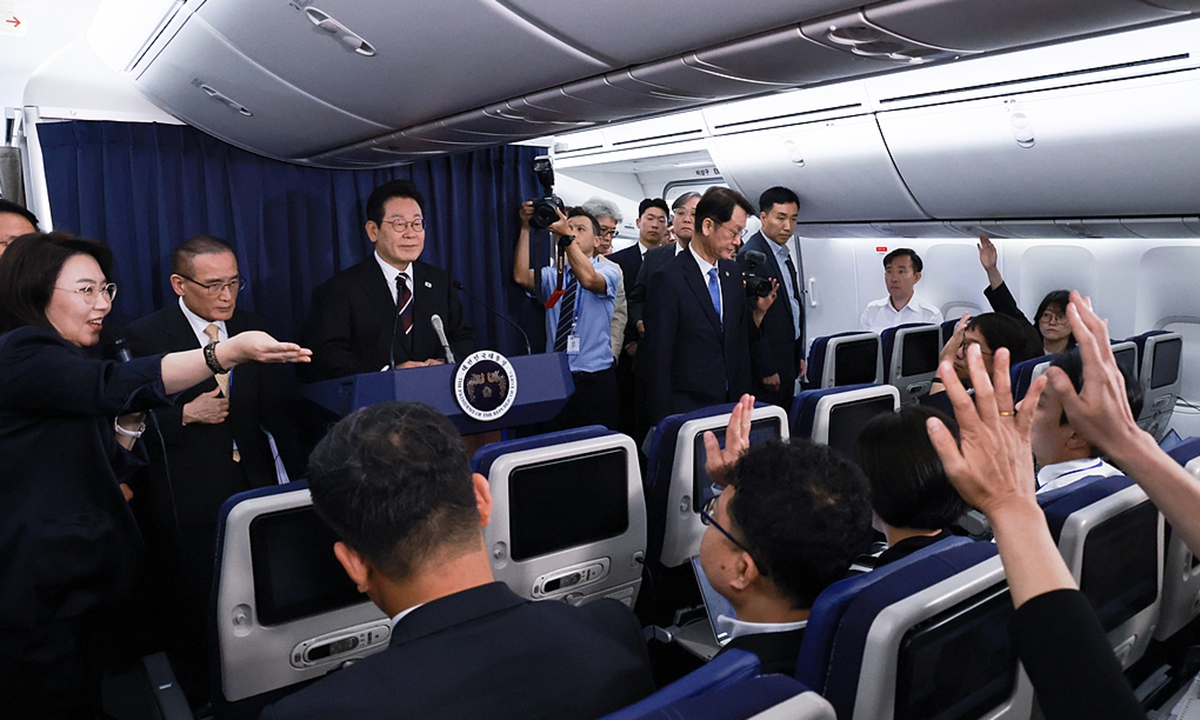
South Korean President Lee Jae-myung (center) holds a press conference aboard the presidential plane as he heads to Washington, DC, on August 24, 2025, to attend his first summit with US President Donald Trump at the White House. Photo: VCG
South Korean President Lee Jae-myung is set to meet with US President Donald Trump on Monday during his visit to the US. With media reporting potential discussions on security and tariffs, a Chinese observer said that Lee's visits to the US and Japan demonstrate a pragmatic approach to foreign policy, aiming to shore up his domestic political base by catering to the demands of South Korea's conservative forces.Lee arrived in Washington, DC, on Sunday ahead of an official working-level meeting at the White House with Trump, Al Jazeera reported.
Speaking to reporters aboard his flight from Tokyo to Washington after Lee's meeting with Japanese Prime Minister Shigeru Ishiba, Lee said he plans to discuss a wide range of issues, with security, defense cost-sharing and tariff negotiations expected to top the agenda, Yonhap News Agency reported Monday.
Da Zhigang, director of the Institute of Northeast Asian Studies at the Heilongjiang Provincial Academy of Social Sciences, told the Global Times that following his recent meeting with Ishiba, Lee's visit to the US seeks, from a diplomatic protocol perspective, to foster strategic trust within its security alliances with the US and Japan.
Among the sensitive issues is the role of the 28,500 US troops stationed in South Korea, according to Yonhap.
Lee told reporters that "it is true" the US has demanded "flexibility" of the US forces in South Korea, but "this is not an issue we can easily agree with." "Instead, discussions on a future-oriented strategic transformation of US Forces Korea are necessary from our perspective as well," Lee said.
Trump is expected to pressure Lee to commit to more spending on defense, including potentially billions of dollars more toward the upkeep of American troops stationed in South Korea, Reuters reported.
Da said that the push to modernize the US-South Korea alliance may require South Korea to participate in US strategies in regions such as the South China Sea and the East China Sea, potentially forcing it to take sides, but given Lee's attitude, taking sides may be difficult for South Korea to accept.
Yonhap reported that Lee also expected trade and economic issues to feature prominently during his talks with Trump, the first since Seoul and Washington reached a deal in July that lowered tariffs from 25 percent to 15 percent in return for a $350 billion investment pledge and other commitments.
Regarding tariff and investment cooperation with the US in energy, agricultural products, and the shipbuilding industry, both sides would need to finalize specific trade-related details during this visit that has not been dealt with before, the expert noted.
Details remain unclear over Seoul's $350 billion investment pledge, with differences lingering between South Korean and US officials on sensitive issues, including expanded access to South Korea's farm and livestock markets, Yonhap reported.
Lee told reporters it would be difficult to revisit agreements already announced by both leaders, though he acknowledged there are voices within the US government pushing for greater access to South Korea's farm and livestock markets.
According to Yonhap, Lee also described revision of the bilateral nuclear accord as an "important task" in foreign policy but declined to elaborate further, citing the ongoing negotiations.
Amid high-level diplomatic engagements with both the US and Japan, South Korea also dispatched a delegation of envoy to China on Sunday, which underscores Seoul's commitment to pragmatic diplomacy as it seeks a delicate balance between major powers, Da added.
Xiang Haoyu, a research fellow at the China Institute of International Studies, told the Global Times that Lee's visits to the US and Japan demonstrate a pragmatic approach to foreign policy, aiming to shore up his domestic political base by catering to the demands of South Korea's conservative forces through maintaining the US-South Korea alliance and trilateral cooperation with the US and Japan.
At the same time, Lee is also making overtures to countries including China to achieve a diversified and balanced foreign policy that maximizes South Korea's national interests.
RELATED ARTICLES