ARTS / CULTURE & LEISURE
With digital and interdisciplinary spirits, new university labs turn oracle bones into a global cultural IP
Writing millennia
By Li Yuche and Published: Aug 25, 2025 10:41 PM

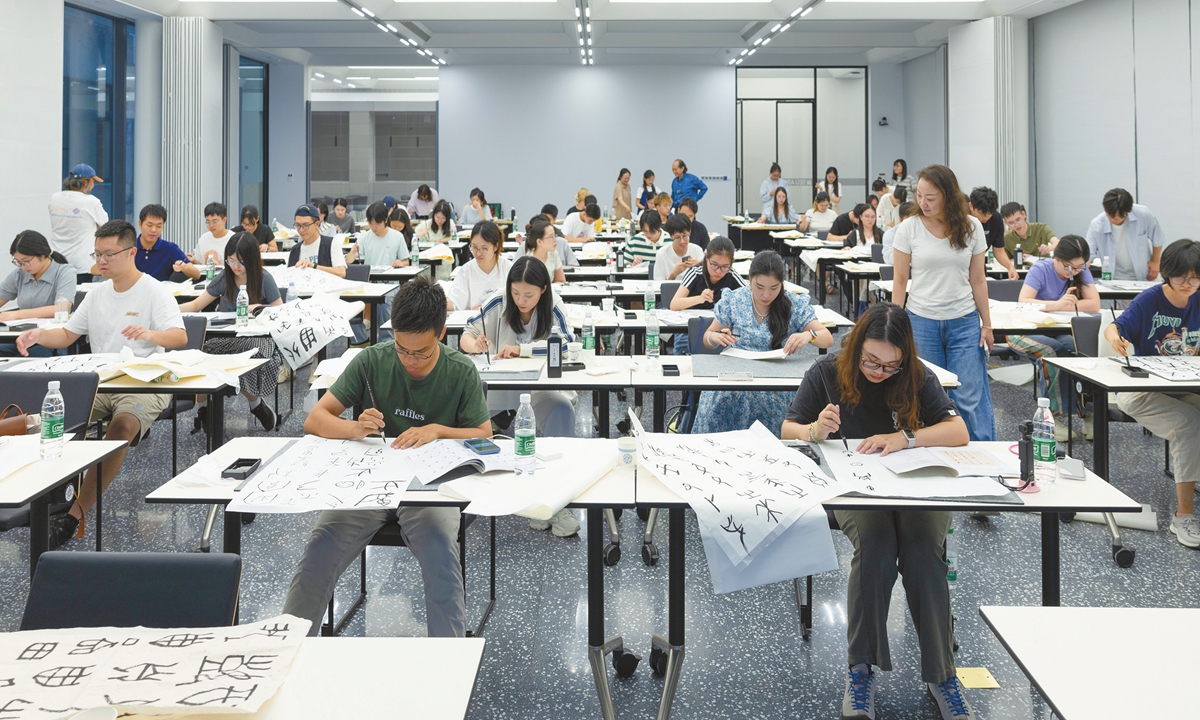
Students experience the calligraphy of oracle bone inscription. Photo: Courtesy of the Southeast University
With more than 3,000 years of history, the oracle bone inscription is the earliest mature writing system ever discovered in China. By examining it through microscopes or exploring it in ancient books, oracle bone inscription, as a history-witnessing subject, has been widely studied across nationwide institutions. Yet, a newly established research center at Southeast University in East China's Jiangsu Province, has blazed a new trail toward the subject.
Instead of equating oracle bone inscription to a resource of the past, the new center focuses on what's emerging through launching interdisciplinary projects like the "oracle bone inscription smartphone input method" and "cultural tourism and oracle bones." Noting the 3,000-year-old legacy as being a cultural IP with modern vitality, Liu Jing, the center's deputy director, told the Global Times that in the future, the "oracle bone inscription" will also be used as a bridge for international exchange.
Relevant to today
After nearly six months of preparation, the Chinese Research Center for Oracle Bone Script Cultural Arts & International Exchange was officially inaugurated in mid-August, at a special academic forum held as its first related event.
Unlike forums dominated by social science experts, this event featured scholars from the fields of biology, computer science, economic management, and more. They shared the unique, yet often overlooked knowledge of oracle bone inscription within their respective disciplines.
Analyzing various oracle bone inscriptions, researcher Ge Hufei discovered and shared how these ancient bone plates documented ancient people's credit systems and how they conducted risk assessment related to economic management. Meanwhile, Wu Tianxing, a computer science expert, shared how AI technology is being integrated with oracle bone inscription studies to improve the recognition rate of faint markings on bone plates to over 90 percent.
The university's strength in engineering and natural science disciplines has provided fertile ground for these innovative projects to emerge. Yet, Liu told the Global Times that behind these interdisciplinary initiatives lies a mindset shift in oracle bone inscription studies.
'Reconnecting with my origin'
Focusing on the interaction between ancient script and today's societal needs not only academic research, but also engagement between people with the legacy of oracle bone inscription, especially among the young generation.
Despite having been established for less than a week and with many plans still in the drafting stage, Liu has spearheaded a visit on August 17 by a group of 49 young students to the oracle bone inscription's cradle at the Yinxu Ruins in Anyang in Central China's Henan Province. These young people are from Hong Kong and Macao special administrative regions (SARs), as well as China's Taiwan island.
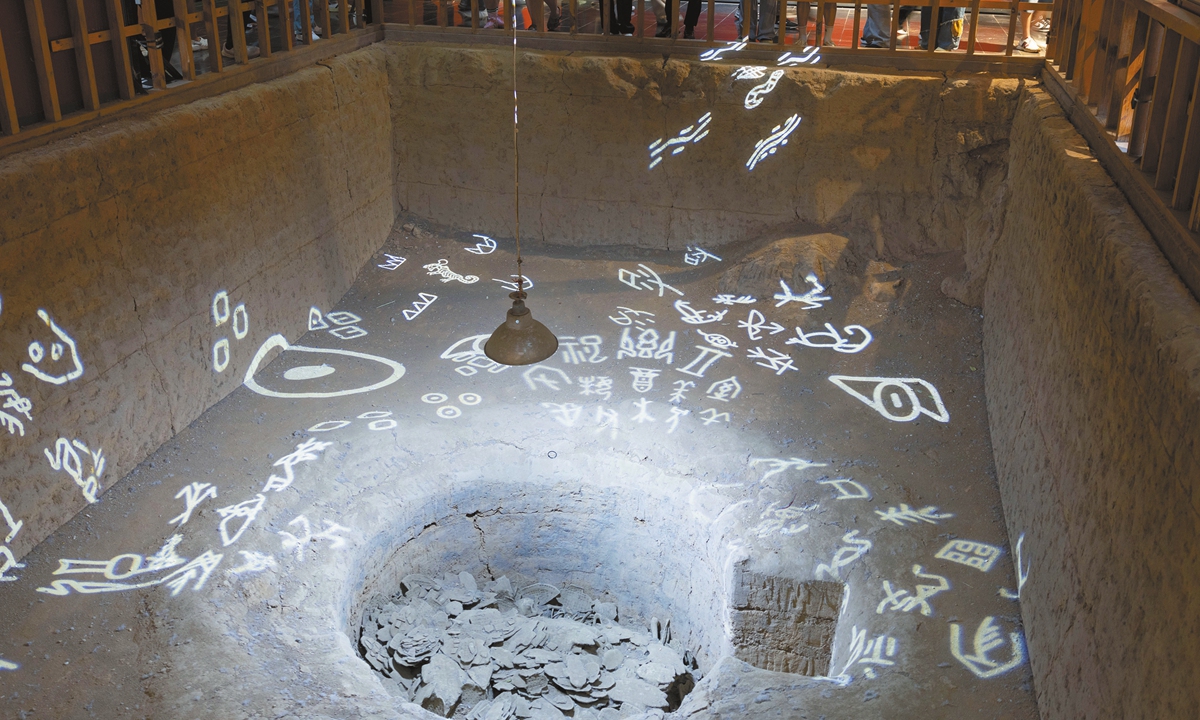
Yinxu ruins' palaces and ancestral temples Photo: Courtesy of the Southeast University
Born in Hong Kong, Ronald Rong was among the students who went on the educational trip. Curious and armed with his camera, he experienced the unique Chinese aesthetics of brushstroke composition in oracle bone inscription calligraphy during the trip. Standing before display cases, the young man came face-to-face with ritual bronze vessels from the Shang Dynasty (c.1600BC-1046BC), while also learning how digital preservation is helping to perpetuate the country's millennia-old cultural heritage.
He told the Global Times that his experience in Anyang has "topped" all his previous cultural exchange visits in countries like the US and the UK. "At here, I felt the most confidently grounded to my cultural roots, and I felt I was reconnecting with my origin, one created by my ancestors," Rong noted.
"We aim to make China's oracle bone inscription a cultural IP that can nurture more international exchanges," said Liu.
A global cultural IP
The research center in Jiangsu is not the only one that recognizes the value of international exchange in oracle bone inscription studies. At Anyang Normal University in Henan, a key laboratory dedicated to the legacy's information processing has also been established, focusing on repatriating oracle bone inscription resources currently held overseas.
China is the one and only birthplace of oracle bone inscriptions, but due to historical circumstances, a significant number of oracle bone inscriptions have been dispersed overseas. Germany, for example, currently holds approximately 850 pieces of the cultural artifact, according to Henan Daily.
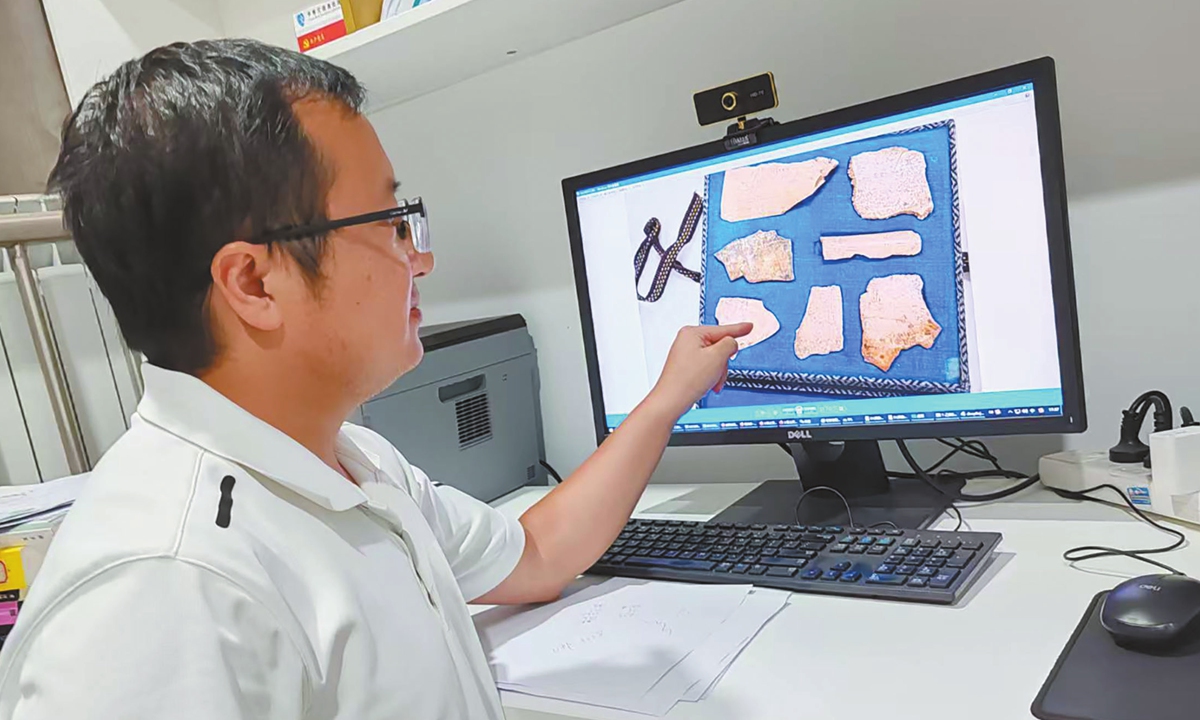
Zhang Zhan researches a photo of oracle bones held in South Korea. Photo: Courtesy of Zhang Zhan
The Anyang research lab has recently completed a high-resolution digital archive of 542 oracle bone pieces in France and Germany.
Zhang Zhan, director of the oracle bone inscription recognition and analysis research office in the lab, told Global Times that the laboratory has now preliminarily completed data collection for approximately 600 oracle bone artifacts housed in South Korea, Germany, and France, accounting for less than one-thirtieth of all oracle bones held overseas.
Other than merely archiving, the lab also plans to upload analyzed data to a big data platform called "Yinqi Wenyuan," to provide access to researchers and enthusiasts worldwide. The platform has been open to global scholars since 2019. Integrating a database of oracle bone inscriptions, catalog database, and literature database, the platform currently features 153 oracle bone catalogues and over 33,000 scholarly works on oracle bones.
"China's intelligent refitting, intelligent collating, structure matching of oracle bone inscriptions, and micro-trace analysis of oracle bones can offer a Chinese model for the collection and organization of global cultural heritage data, providing technological support for mutual learning and sharing among world civilizations," said Zhang while adding that Chinese researchers have applied digital technology to "all aspects of the decipherment, restoration, and study of oracle bone inscriptions," providing valuable models for overseas scholars.
RELATED ARTICLES