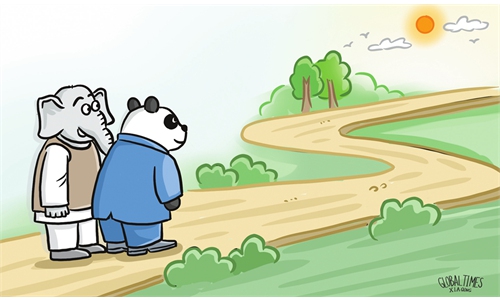
IN-DEPTH / IN-DEPTH
GT investigates: Expecting direct flights to break the impasse, China and India citizens share hopes for people exchanges
Weaving severed connections
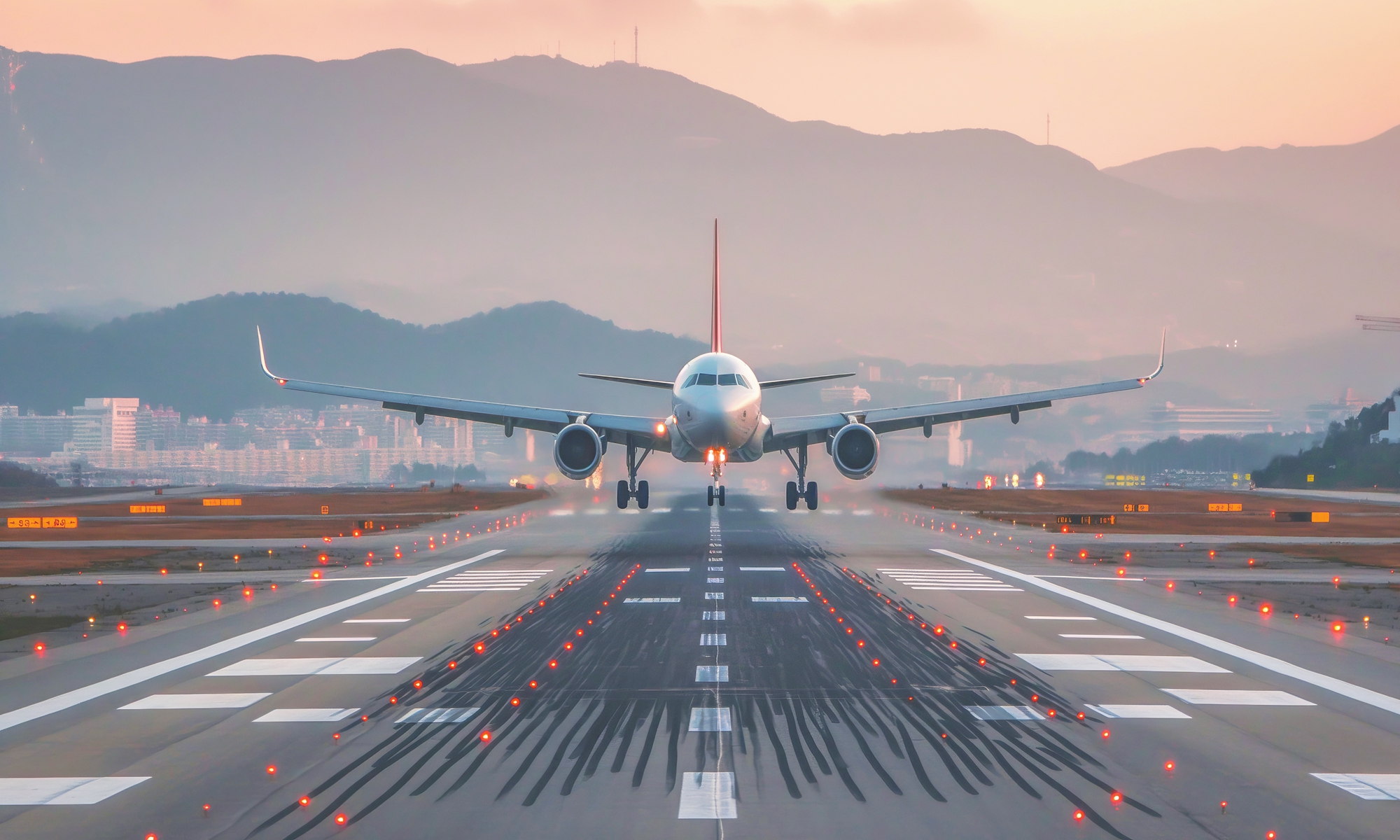
Photo: VCG
For nearly five years, Chen Fengqiong, honorary president of the Chinese Women's Association in India, has done much the same thing on her phone almost every day: Scrolling through news apps and industry chat groups, all in search of one key phrase: "Chinese Mainland-India Direct Flights."To her, these routes transcend mere convenience; they are a barometer of the ebb and flow of China-India relations. "The status of direct flights reflects the true trajectory of China-India ties," she told the Global Times. For entrepreneurs, students, and families sustaining cross-border connections, she noted that these flights symbolize both a critical signal of diplomatic thaw and a dynamic indicator of engagement.
Chen is not alone. Millions across both nations have awaited tangible progress. And this summer, their hopes brightened.
On August 20, Chinese Foreign Minister Wang Yi wrapped up a visit to India, during which the two nations reached breakthroughs in border management, direct flights, and trade. They agreed to "resume direct flights between the Chinese mainland and India at the earliest possible moment and finalize an updated air services agreement," while also facilitating visas to tourists, businesses, the media, and other visitors in both directions.
The momentum extends beyond aviation. From the 10 outcomes achieved from the China-India foreign ministers' meeting, to the 10-point consensus reached during the China-India boundary meeting, and with Indian Prime Minister Narendra Modi set to attend the upcoming Shanghai Cooperation Organisation (SCO) summit in North China's Tianjin Municipality, this flurry of diplomatic breakthroughs carries added significance in 2025 - a year that marks the 75th anniversary of China-India diplomatic relations.
For ordinary people on both sides, the shift feels more personal. In recent interviews with the Global Times, several ordinary Chinese and Indian citizens expressed cautious optimism. As diplomatic dialogues translate into tangible policies, and as phrases like "resuming flights" and "easier visas" evolve from headlines into real-life possibilities, the pent-up desire for exchange, stifled for nearly five years, is gradually awakening.
The frayed threads of connection

Indian social media influencer Ram Niranjan Sharma tries on local costumes in Southwest China's Yunnan Province, in July 2025. Photo: Courtesy of Sharma
Ram Niranjan Sharma, an Indian social media influencer and educator, calls the impending resumption of direct flights between the Chinese mainland and India "a long-awaited decision," one that's been overdue for far too long."I first spotted reports on a news site, and within days, it was confirmed across social media and other platforms. Relief just washed over me," he told the Global Times. He thought immediately of a friend: A student at a Chinese university who'd returned to India early during the COVID-19 pandemic, only to be stranded for months when direct flights vanished. "When he finally got permission to go back, he had to take three connecting flights - costly, exhausting, and mentally draining. It shouldn't have been that hard," Sharma recalled.
His frustration is rooted in five years of stagnation. Direct flights between the two nations were suspended in early 2020 as the COVID-19 pandemic took hold; later, India halted tourist visa issuance to Chinese citizens. The combined impact was stark: Over the subsequent five years, channels for non-governmental cultural exchanges between China and India were severely restricted.
Chen carries similar scars. Since December 2020, she has spent half a decade remotely managing her India-based ventures, her days tangled in the logistics of cross-border work without the ease of a direct flight. "So many of my association members talk about that feeling, like your life and work are slipping out of control," she said.
Chen noted that the transit process meant dealing with different countries' procedural requirements, which was not only time-consuming and costly, but also risky due to sudden policy changes. Even after 2023, when Hong Kong became a transit option, it remained a poor substitute for the simplicity of a direct flight.
"Several acquaintances of mine who regularly traveled to China for business had to cancel their plans repeatedly," Sharma added. "Even small delays or cancellations in connecting flights due to weather or other reasons often resulted in missed meetings, changed hotel bookings, and altered visa timelines - causing major disruption."
Aside from personal travel, Sharma further pointed out that in recent years, due to limited travel between the two countries, academic, business, and cultural exchanges were also significantly affected.
Gloria Yu, who runs a Shanghai-based art and publishing platform collaborating with Asian creators, also saw it firsthand. She used to frequent a zine festival in Mumbai, showcasing Chinese culture and forging bonds with local artists. "After direct flights stopped, those trips became impossible. Chinese groups couldn't get there easily," she told the Global Times. "It wasn't just logistics that broke down - it was potential collaborations and friendships between young creators. They just fizzled out."
Let exchanges defuse prejudices
The ancient Chinese proverb "seeing is believing" echoed repeatedly in Global Times interviews with people across both nations in recent time. They expressed hope that the resumption of direct flights will correct the prejudices and bridge divisions that have emerged, or deepened, over years of distance.
"Direct communication, flights, and travel bring two ancient civilizations closer together, not just geographically, but spiritually and culturally as well," Sharma said.
He emphasized his strongly positive attitude toward the resumption of direct flights. "More Chinese tourists visiting India would not only boost the local economy, but also deepen cultural understanding between our two countries."
What troubles him is that the Indian public is now immersed in a great deal of negative news about China, and emotional discourse on social media often promotes misleading or negative narratives about India-China relations.
Chen knows that skewed perception will cuts both ways. She noted that the suspension of flights had turned her and many other Chinese entrepreneurs engaged in India-related trade into "accidental geopoliticians."
Her mornings now start with a ritual: Scanning news reports for updates on China-India ties, tracking the status of regional tensions, and seeking out information on new flight routes between the two countries. "We used to worry about profit margins, but over the past five years, there have been times when we even feared that tomorrow's news might bring reports of our Delhi staffers being taken in for questioning on trumped-up charges," she said.
Yet she refuses to let that fear harden into distrust. "We can't let past frictions or old prejudices shut down exchanges," she said firmly. "Let more Indians come to China to travel, study, do business. Let them walk our streets, see our cities, witness how we've developed. That's how you break stereotypes and ease hostility."
"A thaw has to start with people being able to meet easily again," she added.
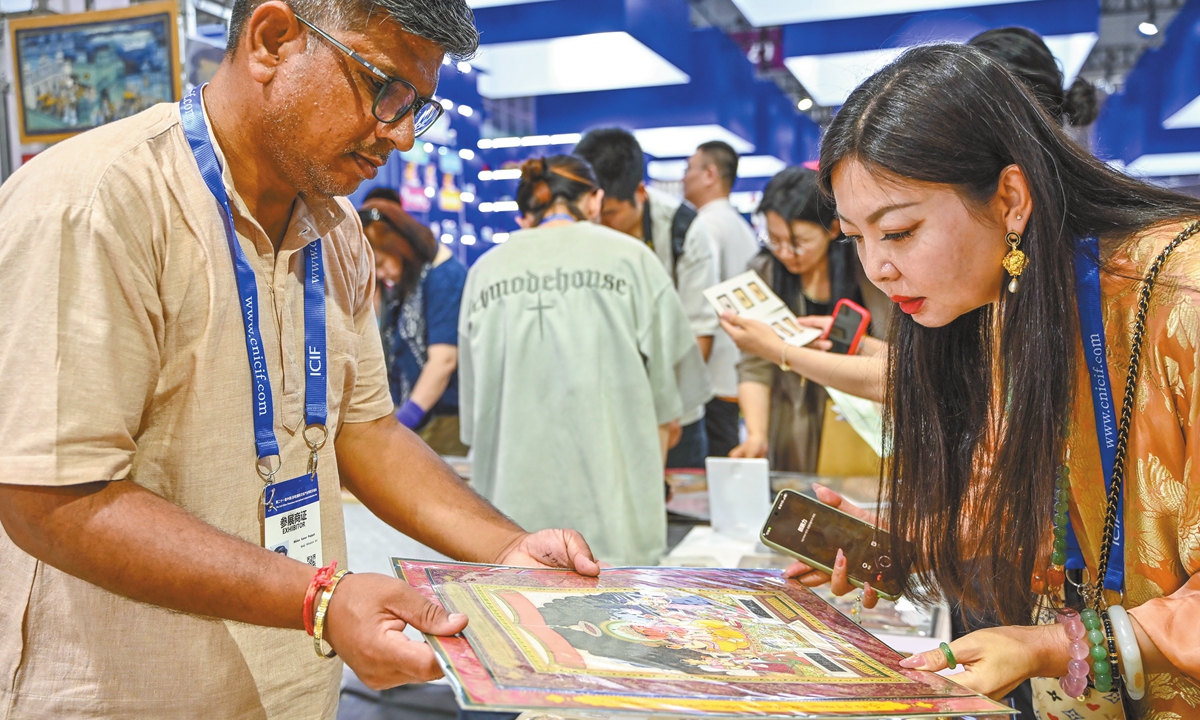
Paintings at the Indian booth at the 21st China (Shenzhen) International Cultural Industries Fair attract visitors on May 22, 2025. Photo: IC
Sharma knows firsthand how powerful that "meeting" can be. He once harbored his own doubts about China, he admitted "When I first came to China, I too felt some fear and hesitation. But after arriving, I realized that China is a safe, developed, and very courteous country. If Chinese tourists visit India, they will similarly gain firsthand understanding of Indian hospitality, diversity, and culture,"he said.It's why he's made it his mission to share that reality. Now based in South China's Guangdong Province, Sharma visited nearly all major tourist destinations in China and shared these experiences with over two million Indian followers via his videos and digital platforms. His followers are particularly interested in China's urban planning, driverless buses, smart cities, and rural revitalization projects, and many hope to visit China themselves.
Hope on the horizon

A view of Mount Kangrinboqe in Southwest China's Xizang Autonomous Region Photo: VCG
For Chen, the pending resumption of China-India direct flights stirs a familiar blend of emotions - one she and many Chinese entrepreneurs with ties to India have grappled with for years. "It's a mix of hope and caution," she said.For much of that time, uncertainty hung heavy: Would flights truly restart? And with India maintaining strict scrutiny of Chinese businesses and personnel, would the operational landscape feel stable enough to act? While "hope to return to the Indian market" burns bright, only hampered by India's policy fluctuations and lingering prejudices toward China, they've hesitated to take tangible steps to expand business lines or dispatching staff.
Yet that cautious optimism is softening, buoyed by fresh momentum. Bilateral mechanisms once frozen are edging back to life, and people-to-people exchanges are thawing as well. Indian pilgrims have resumed journeys to the sacred mountains and lakes in China's Xizang Autonomous Region, while tourist visas for Chinese citizens to India are being restored. For Chen, these developments have crystallized her confidence in the future.
Liang Yaofeng, general manager of Beijing-based Merry Travel, an agency with long standing experience in China-India travel and business visa services, has already seen the shift in real time. "Inquiries about Indian visas and travel have spiked noticeably," he said. "It's like a shot in the arm for the industry."
Liang said his team is reaching out to old clients, updating them on relaxed visa rules and the impending return of direct flights. They have revamped regular travel packages and even started hiring new staff to brace for the rush.
"India's allure hasn't faded. It's a destination rich in traditional culture and unique experiences. And after years of suspended direct flights, demand has been pent up. We fully expect that demand to explode once flights resume," he said.
Sharma recently witnessed another meaningful sign of progress during a visit to Mount Kangrinboqe in Xizang. "This sacred journey has resumed after many years, and the pilgrims were overjoyed," he said. "As an Indian, visiting Mount Kangrinboqe was a truly spiritual and fulfilling experience," Sharma said, noting that he found Xizang to be well developed, with well maintained roads, green mountains even in harsh weather, and cultural relics, but the region's portrayal on some Western social media platforms is entirely different."
In the city of Chennai, India, connections are also quietly being rewoven. Yu shared that a group of young organizers there is planning a zine festival later this year, and they've actively invited Chinese representatives like her.
"India and China are two great ancient civilizations, bound by centuries of Oriental wisdom, trade, religion, and cultural exchanges," Himadrish Suwan, Chairman of the Confederation of Young Leaders of India, told the Global Times. "As the world's two largest developing countries, our fates are intertwined. The more we understand each other, the stronger our partnership can be," he stressed.
Suwan lamented the years of strained ups and downs that have overshadowed those deep-rooted ties. "It is time to break this cycle and move forward hand in hand for a shared future."
To frame that vision, Suwan cited two lines from Rabindranath Tagore that feel fitting for the endeavor as the two nations rebuild their ties: "In front lies the Ocean - into that ocean of peace, my friends, let us launch our boats."
RELATED ARTICLES