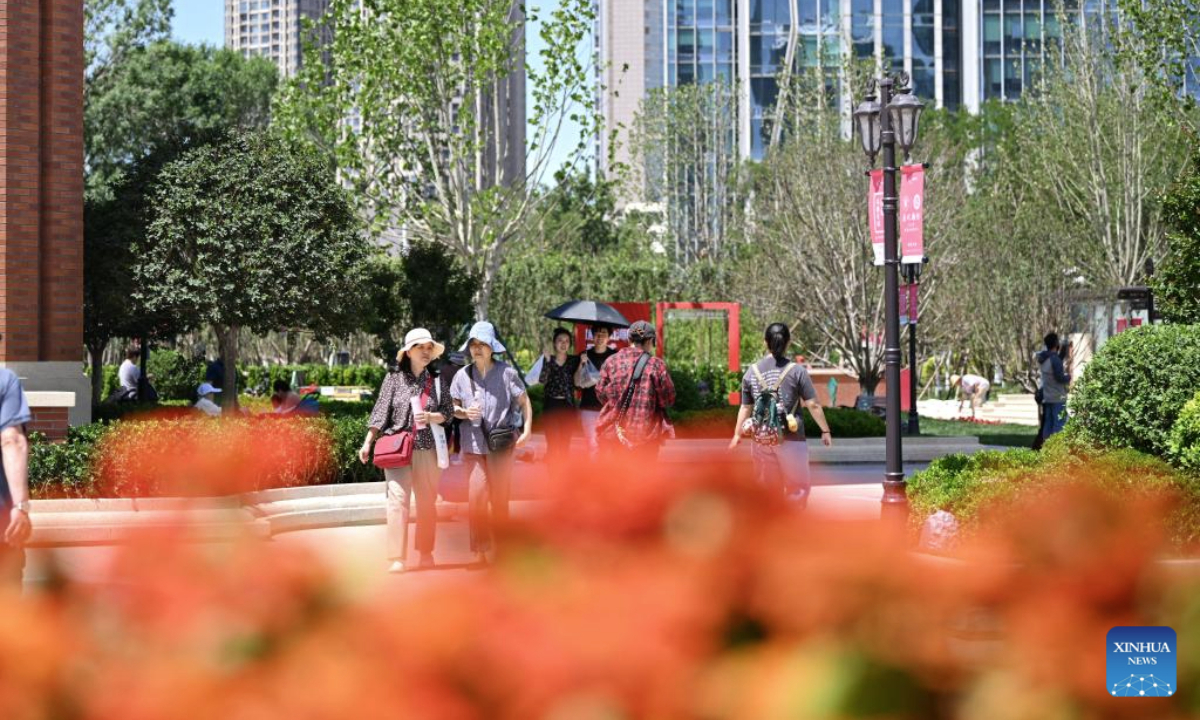
People take a walk at a pocket park in Heping District of Tianjin, north China, June 3, 2025. In recent years, Tianjin, a major city in northern China, has revitalized small urban spaces by building over 300 pocket parks, strategically scattered across residential areas, streets, and commercial districts. These green oases are helping shape a livable urban ecosystem where residents enjoy "green views from windows and easy park access." (Xinhua/Li Ran)
Modern cities are crucial carriers of modernization and beautiful homes for the people's happy life.
In July this year, the Central Urban Work Conference clearly set forth the goal of building modern, people-centered cities.
Centered around the objective of building modern, people-centered cities that are innovative, livable, beautiful, resilient, culturally vibrant, and smart, the conference proposed "one optimization and six constructions": to strive to optimize the modern urban system; to build vibrant cities powered by innovation; to develop comfortable, convenient and livable cities; to build green, low-carbon and beautiful cities; to enhance urban safety and resilience; to build culturally-vibrant cities characterized by high ethical and moral standards; and to build smart cities for greater efficiency and convenience.
Looking back 10 years, the Central Urban Work Conference put forward the principle of "one respect and five coordinations": respecting the laws of urban development; coordinating the three major structures of space, scale, and industry; coordinating the three key stages of planning, construction, and management; coordinating the three driving forces of reform, technology, and culture; coordinating the three layouts of production, living, and ecology; and coordinating the three main stakeholders of government, society, and citizens.
From "one respect and five coordinations" to "one optimization and six constructions," the approach remains consistent yet evolves with the times. These important guidelines provide a scientific roadmap for forging a new path toward China-style urban modernization.
Ideas guide practice
China's urbanization has increased from 53.1 percent in 2012 to 67 percent in 2024.
The total operating mileage of urban rail transit is nearly 11,000 kilometers; water and gas supply coverage and sewage treatment rates are all close to 100 percent.
More than 68 million units of various kinds of affordable and shantytown-renovation housing have been started or built, benefitting 170 million people.
Behind the figures, the original aspiration of placing the people above all else pulses with vitality.
Chinese President Xi Jinping, at the 2015 Central Urban Work Conference, creatively proposed blazing a path of urban development with Chinese characteristics. At this year's Conference, he emphasized forging "a new path will be blazed for urban modernization with Chinese characteristics." These two phrases clearly define the direction of China's urban development and are vivid embodiments of the "two combinations" in urban work.
Regardless of how far industrialization and urbanization advance, rural areas will never disappear. The nation's modernization must organically integrate rural revitalization with urban development.
With a civilization spanning over 5,000 years, cities have long served as a key vessel carrying China's history and culture. While we must draw from useful foreign experience in urban construction, we cannot discard outstanding traditional Chinese culture.
Strategy evolving with the times
Compared with 10 years ago, urban work now faces new opportunities in both the times and momentum.
What are "times"? As we conclude the 14th Five-Year Plan and plan the 15th Five-Year Plan, in just 10 years, we will have basically achieved socialist modernization.
What is "momentum"? International experience shows that when urbanization reaches about 70 percent, it typically enters a phase of slow development, characterized by limited urban population growth, greater differentiation between cities, aging housing and infrastructure, and increased stability risks.
As times and momentum shift, so too must our work requirements and tasks.
In Chongqing's Xiejiawan Street, Jiulongpo district, a once-notorious old and dilapidated community is now transformed in both appearance and function. A community canteen meets residents' needs for downstairs dining; repair shops and tailoring services are centralized; and charming boutique shops brimming with everyday vitality have sprouted, enhancing residents' sense of gain and happiness.
For the people, by the people, and bring benefits to the people - this is the original aspiration of building modern, people-centered cities. Only by responding to the people's expectations for high-quality life and reserving the best resources for them can urban development attain both height and warmth.
Cities are naturally centers of economic development, and developing the economy is self-evident. But if we recklessly expand in a grandeur at all costs, layer upon layer of farmland, vegetable plots and green space will be swallowed by concrete, spawning incurable "big-city diseases."
To offload non-capital functions, Beijing has closed more than 3,000 general manufacturing enterprises and reduced urban and rural construction land by 150 square kilometers over the past 10 years, shifting from "big and all-encompassing" to "high-precision, cutting-edge". Tianjin revitalized its "old base" by converting old factories into smart manufacturing parks and cultural-creative incubation bases. In Chengdu, pocket parks now number over 600, turning street corners green and vibrant. Activating existing stock while expanding potential is vital: tailoring strategies city by city enhances urban high-quality development.
The "one respect and five coordinations" and the "one optimization and six constructions" are united in the goal of building modern, people-centered cities.
What will modern people-centered cities look like, and how should they be built? The Central Urban Work Conference has provided a clear roadmap - from "five transformations and five improvements" to "one optimization and six constructions" - offering both "vision" and "execution."
The key is effective implementation, which demands enhanced capacity from cadres at all levels to fulfill diverse assigned tasks.
Though the grand goal of modern, people-centered cities is consistent, it must never produce "monotonous cities." Urban development must emphasize individual characteristics and leverage each city's strengths.
Building modern, people-centered cities aligns with the broader endeavor of building a modern socialist country in all respects.
From now until 2035 - another 10 years - we need a sense that time won't wait, enduring perseverance, and the resilience to pursue what we've committed to. We must translate historical perspective and strategic thinking into concrete action.
This is compiled based on an article originally published on the front page of the People's Daily on August 25, 2025.