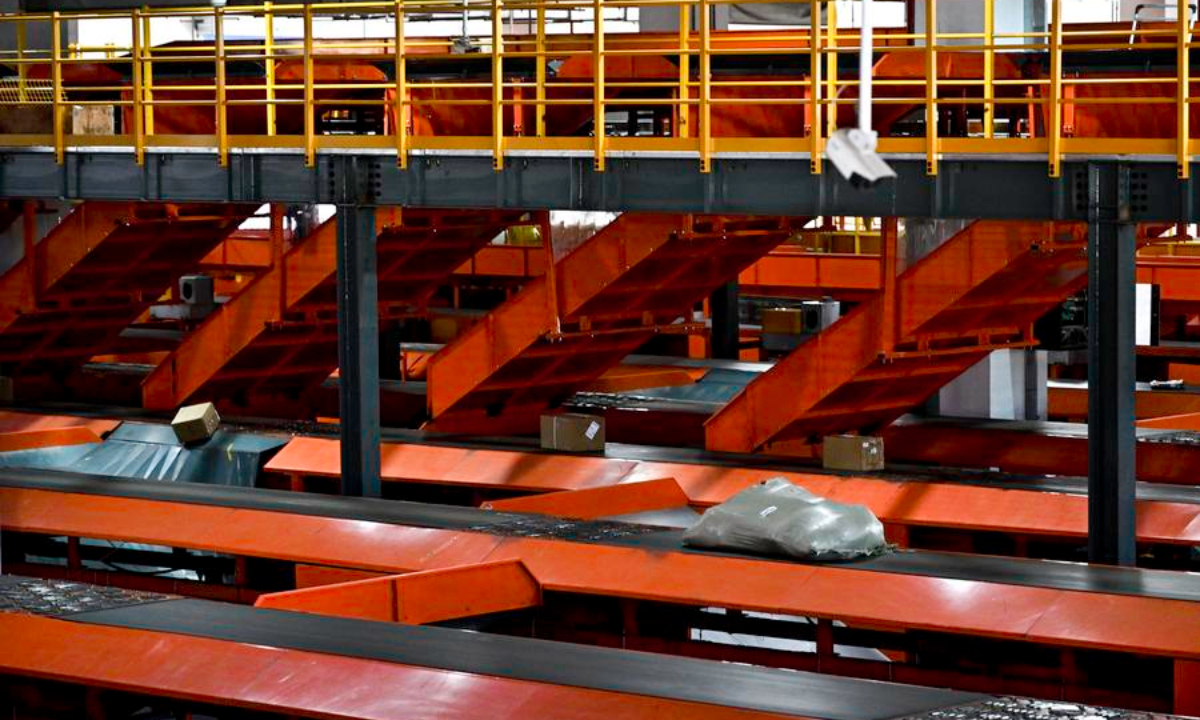
A drone photo taken on July 11, 2025 shows an interior view of a logistics transfer center in Hengfeng County, Shangrao City, east China's Jiangxi Province. (Xinhua/Liu Jinhai)
During the 14th Five-Year Plan period (2021-2025), China has made significant achievements in modern logistics development. The logistics market scale has maintained its position as the world’s largest, with big progress made in building an advanced logistics system, providing strong support for propelling the economy’s high-quality development, China Media Group (CMG) reported on Tuesday.
During the past five years, China’s total social logistics volume has maintained a steady and upward trend. In 2025, the total social logistics volume is expected to reach 380 trillion yuan, with an increase of approximately 80 trillion yuan over the five years, according to the report.
The total revenue scale of China's logistics industry has continued to expand, growing by about 4 trillion yuan over the past five years, and is projected to exceed 14 trillion yuan in 2025, with the market scale expected to remain the world's largest for 10 consecutive years, the CMG said.
Cai Jin, president of the China Federation of Logistics and Purchasing, said that since the 14th Five-Year Plan period, China's logistics industry has developed effectively. The country’s logistics scale has been the world's largest for nine consecutive years, fully demonstrating the advantages of a super-large-scale market and playing a positive supporting role in the development of the national economy, Cai noted.
Freight logistics demand has also grown rapidly, with the total freight volume expected to exceed 59 billion tons in 2025. Express delivery volume is projected to surpass 200 billion pieces, maintaining its position as the world's largest for 12 consecutive years, per the report.
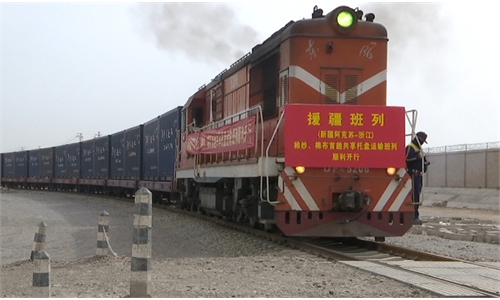
International logistics demand has kept robust, with the international logistics network continuing to expand. The China-Europe Railway Express connects to 229 cities in Europe and over 100 cities in Asia. The international cargo market share of aviation enterprises has reached 44 percent, with the “Air Silk Road” covering 213 cities in 83 countries.
China’s maritime fleet is the largest in the world, establishing shipping connections with over 100 countries and regions, with its maritime connectivity consistently ranking first globally. Moreover, cross-border highway freight volume has doubled, with vehicles achieving direct road transport across the Caspian Sea to Europe for the first time, the report noted.
At the same time, logistics operations have become more efficient. As of now, there are over 3,000 online freight platform enterprises nationwide, supporting efficient matching of supply and demand in the freight market. In the first four years of the 14th Five-Year Plan period, the ratio of total social logistics costs to GDP decreased by 0.6 percentage points, resulting in a cumulative reduction of 890 billion yuan in total logistics cost, the CMG said.
During the 14th Five-Year Plan period, logistics services have become more high-quality, market concentration has steadily increased, and the competitiveness of Chinese logistics enterprises has significantly strengthened.
According to the report, as of June this year, there were 10,797 A-level logistics enterprises in China, including 555 5A-level enterprises representing the highest domestic standards. The top 50 logistics enterprises by revenue generated over 2 trillion yuan, with market concentration steadily rising. A group of leading enterprises have significantly enhanced their international competitiveness, with seven making it onto the Fortune Global 500 list. These leading enterprises are accelerating their transformation from logistics companies to supply chain service providers.
During the period, the deep integration of next-generation information technology with modern logistics organizational methods has given rise to new operational models for operating logistics.
And, “AI + Logistics” is fostering new models and creating new value. Unmanned logistics technologies, such as autonomous trucks, delivery vehicles, warehouses, and ships, are being rapidly adopted, accelerating the industry’s technology-driven upgrade.
The integration of digital technology with infrastructure innovation has led to the release of large-scale logistics models in fields such as express delivery, e-commerce, cold chain, and shipping logistics. Smart logistics parks and hubs are undergoing rapid transformation and upgrading, with approximately 42 percent of logistics parks equipped with automated sorting equipment, the report said.
Additionally, green logistics is increasingly being promoted on a large scale, with the number of new-energy powered vessels exceeding 1,000 and the market penetration rate of new-energy heavy trucks reaching a new high, said the CMG.
Global Times
RELATED ARTICLES