ARTS / CULTURE & LEISURE
GBA exhibits commemorate 80th anniversary of victory in WWII
Historical photos, artifacts mark shared memory
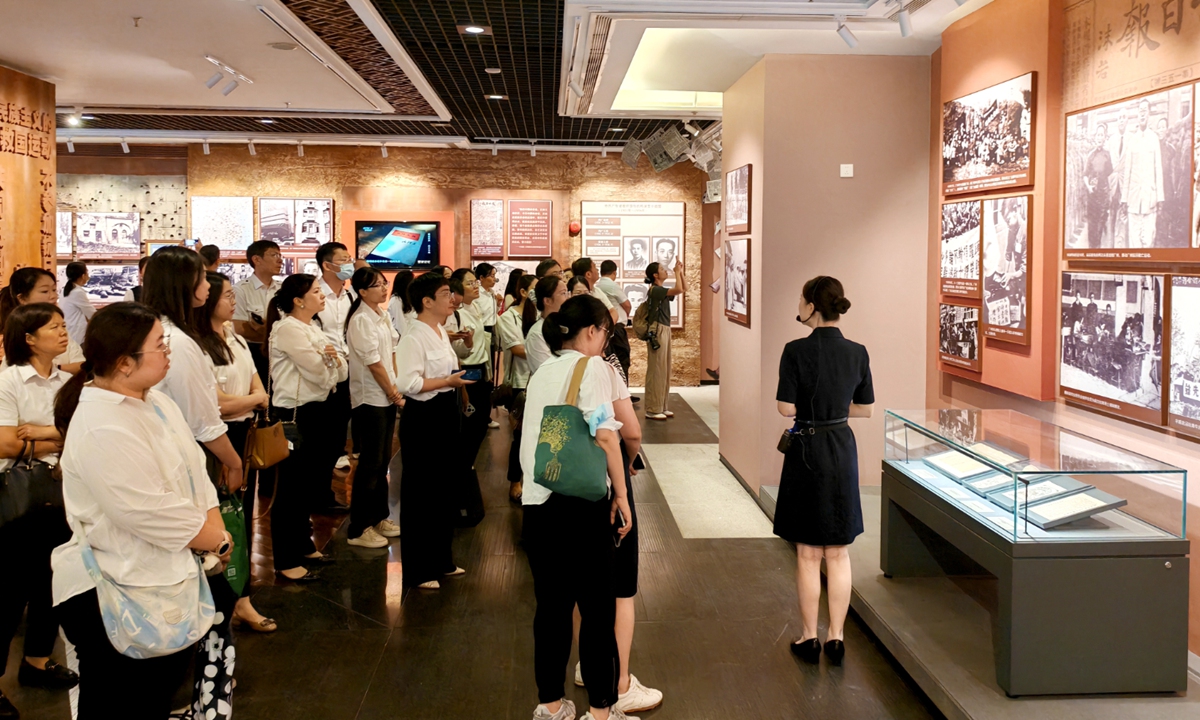
People at the exhibition at at the Guangdong Archives in Guangzhou, South China's Guangdong Province Photo:Courtesy of Guangdong Archives
From wartime letters and books to rare photographs, an exhibition spotlighting the history and contributions of the people of southern Chinese regions like Hong Kong, Macao and the island of Taiwan, and overseas Chinese to the Chinese People's War of Resistance against Japanese Aggression (1931-45) opened on Tuesday at the Guangdong Archives in Guangzhou, South China's Guangdong Province.The event follows a war-themed exhibition that opened on Monday in Macao and another that kicked off on Friday in Hong Kong.
The exhibition by the Guangdong Archives features a special section titled "Hong Kong, Macao, Taiwan and Overseas Chinese: Joining the National Struggle." It is divided into three parts: "Hong Kong, Macao and Taiwan Compatriots Sharing the Nation's Fate," "Overseas Chinese Standing with the Motherland," and "Qiaopi Letters in the War."
"This section mainly highlights the touching history of Hong Kong, Macao and Taiwan compatriots and overseas Chinese breathing as one with the motherland, sharing its fate and supporting the resistance against Japanese aggression," Wang Han, a staff member of the Collection and Arrangement Department of the Guangdong Archives, told Global Times on Tuesday, noting that the exhibition also reflects the region's integration in today's Greater Bay Area.
Covering about 1,500 square meters, the exhibition brings together more than 400 historical photographs and 50 artifacts selected from local archives, museums, and cultural institutions.
Among the standout displays is a 1944 banner commemorating the rescue of US "Flying Tigers" pilot Chester Niles Denney, who crash-landed in Guangdong while escorting a bombing mission. Villagers saved him and helped him return to base. Decades later, Denney reconnected with his rescuer's descendants and gifted them the banner in gratitude.
Immersive multimedia installations recreate key moments of the era. One section uses sound, light and video to capture South China's cultural resistance - from wartime prints and magazines to patriotic music that rallied the public against Japanese aggression.
Historic images of the Dongjiang Guerrilla Force escorting cultural figures are paired with light-and-shadow installations to recreate scenes from the "Great Hong Kong Rescue" at the exhibition. In 1942, the Dongjiang Guerrilla Force, under the direction of the Communist Party of China, rescued more than 800 Chinese cultural and democratic figures from Japanese-occupied Hong Kong.
The 11-month rescue mission successfully evacuated China's intellectual elite, including Mao Dun, a pioneer of modern Chinese literature, and Zou Taofen, a renowned journalist and publisher.
Another section focuses on Qiaopi, which refers to the remittances, letters, reports, account books and remittance receipts resulting from communication in the 19th and 20th centuries between the many who left China's southeastern coast to work overseas and their families and relatives living in southeastern China.
On display are original letters, along with everyday items like bamboo baskets and umbrellas that evoke the lived experience of wartime correspondence.
One featured Qiaopi is a 1945 letter from a Chinese migrant in Singapore, lamenting the suffering caused by Japanese occupation but celebrating the victory over Japanese aggression.
"Guangdong, a major hometown for overseas Chinese and neighbor to the Hong Kong and Macao SARs, has long been known for the patriotic tradition of its people abroad. During the war, compatriots from Hong Kong, Macao and the island of Taiwan and overseas Chinese donated money and supplies and even returned home to fight, making outstanding contributions to victory in the war," noted Wang.
The Guangdong exhibition is part of a series of exhibitions marking the 80th anniversary of the victory in the Chinese People's War of Resistance against Japanese Aggression and the World Anti-Fascist War.
On Monday, in his address, Chief Executive of the Macao SAR Sam Hou Fai said the 80th anniversary commemoration provides an opportunity to promote the national spirit with patriotism at its core.
A series of activities will be held to engage Macao residents, especially the younger generation, in recalling the nation's hardships and glory, honoring the sacrifices of their predecessors, and transforming historical memory into a source of strength, he added.
Through a wealth of historical photographs and video materials, the exhibition highlights the arduous 14-year resistance of the Chinese people from 1931 to 1945, conveying the message of "remembering history, honoring martyrs, cherishing peace, and creating the future."
Earlier, on Friday, a roving exhibition marking the 80th anniversary of victory in the war opened in Hong Kong. After an eight-day run at the Hong Kong Convention and Exhibition Centre, the exhibition will tour local communities and schools.
RELATED ARTICLES