ARTS / CULTURE & LEISURE
Tennis’ China swing a catalyst for domestic boom

Illustration: Chen Xia/GT
Even though the tennis Grand Slam US Open is in full swing, preparations for China's tennis season, which will roughly run from mid-September to early November, has already started. The much-anticipated season, often considered a powerful catalyst for the sport's domestic development, will feature a string of nine high-profile tournaments, including the China Open and the Shanghai Masters.The Chinese Tennis Association (CTA) anticipates that over 1 million spectators will come to watch matches, while more than 2 billion yuan ($280 million) will be generated in related spending on lodging, dining and tourism. This dramatic growth reveals a sport on the cusp of cultural and economic transformation. Domestically, the packed calendar serves as a powerful training ground. Chinese players are no longer isolated from elite competition.
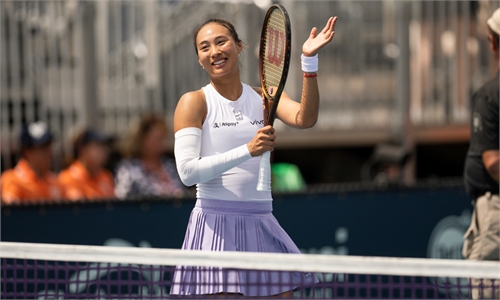
Last season, Zheng Qinwen reached new heights after her Olympics win, not only advancing to the semifinals of the China Open, but also becoming a finalist at the WTA Finals. Wang Xinyu made waves too, reaching her first WTA 1000 semifinal in Wuhan.
On the men's side, Shang Juncheng soared into the top 50 - the first player born in 2005 to do so. Additionally, Zhang Zhizhen became the first Chinese man to reach a Grand Slam doubles semifinal, after which he continued to climb the ATP rankings, reaching his career top of world No.31 by July 2024.
These breakthroughs signal something seismic: Chinese players are not just participating - they're contending and winning on home soil. Bu Yunchaokete, previously ranked outside the top 100, stunned fans by upsetting top-25 and top-10 players en route to the semifinals at the China Open, propelling his ranking significantly higher.
This season's dense schedule - nine tournaments in two months - provides unparalleled opportunities for local talent to test themselves, sharpen their skills, and gain match experience. It's exactly this kind of high-pressure environment that arms players for success on the global stage.
From a broader cultural and market perspective, the impact is equally profound. China's tennis fever is real - and it's measurable. The 2024 China Open drew nearly 300,000 fans, with ticket revenue breaking 80 million yuan - marking a new high for the event. Across the season, venues filled even amid rain. The Shanghai Masters hosted over 220,000 fans during the National Day holidays, with daily merchandise sales exceeding 1 million yuan.
Interest hasn't been limited to ticket buyers. "Tennis fever" has been palpable online: Social-media platforms have witnessed massive spikes in engagement as searches for tennis and tennis instructional videos surged. The 2024 China Open also drove 2.87 million Sina Weibo posts and 46.8 billion views on tennis-related topics.
Moreover, tournaments are becoming a cultural platform, sparking widespread interest in rules, etiquette, and engagement in grassroots programs. The media coverage and electric atmosphere of the stadium expose new audiences to tennis' values of resilience and determination.
Looking forward, the potential for building a robust tennis ecosystem in China is enormous. Last week, the CTA unveiled an ambitious ecosystem plan to cement this momentum. The blueprint calls for cultivating more than 10 top-100 players, over 100 international pro players and coaches, and developing "strong tennis provinces" and "100 strong tennis cities," complete with youth academies and tens of thousands of clubs. The goal is clear: expand infrastructure, decentralize access, and strengthen talent pipelines.
The data supports that infrastructure works. An annual report on Chinese tennis development published in April shows that the number of tennis courts across the country had grown to 53,805 by August 2024 from the estimated 49,767 in 2021, a growth rate of 8.12 percent.
With more events, more stars, more courts, and more fans - all interlinked - a virtuous cycle is taking shape. Cities across China vie for tournament dates to boost visibility and tourism - a synergy between sports and local economic development. Hosting the ATP Masters and WTA 1000 events elevates civic prestige and global attention, tying athletic excellence to cultural branding.
Chinese athletes are no longer fringe participants in the highly professional sport but have become central to tennis' global story. Zheng's rise into the elite tier, Shang and Bu's breakthroughs, and the avalanche of public enthusiasm are proof of the growing influence of the sport.
Of course, effective development demands sustainability. The surge must be backed by long-term investment in coaching, grassroots access and event quality. Ensuring young players beyond the stars have pathways to grow, and expanding tennis beyond affluent urban centers, are key challenges ahead.
The China swing is poised to be more than a sports circuit but a national accelerator for player development, cultural engagement and economic opportunity. Backed by soaring attendance and growing enthusiasm online, it's the kind of ecosystem that can foster generational change. The result? A China where tennis is not just watched, but played, celebrated, and woven into the country's sports DNA, driving both individual achievement and collective passion for years to come.
The author is a reporter with the Global Times. life@globaltimes.com.cn
RELATED ARTICLES