Photo: VCG
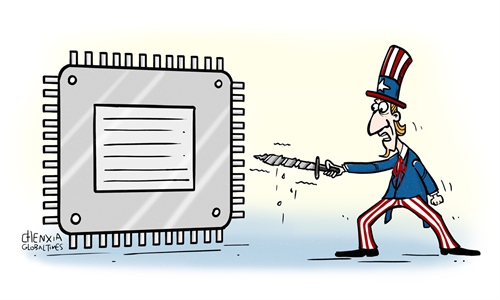
John Moolenaar, chairman of the US House Select Committee on China, recently sent a letter to US Commerce Secretary Howard Lutnick. In this letter, Moolenaar proposed a new framework for exporting artificial intelligence (AI) chips to China, according to a press release published on the committee's website on Tuesday. Although Moolenaar's move might be seen as an exercise in futility, it underscores a critical point - the rapid advancement of China's semiconductor capabilities is prompting some US political elites to reevaluate the country's chip export controls.Moolenaar called for the US to adopt a so-called rolling technical threshold (RTT) approach that provides a marginal improvement over the most advanced chips that China can domestically produce at scale. At the same time, it aims to limit China's aggregate AI computing power to 10 percent of the US in order to "secure enduring US AI dominance." In reality, achieving such a dual objective is quite challenging.
Recent developments have highlighted the dilemma faced by the US. On the one hand, the rapid progress in China's domestic chip technology is making it increasingly difficult for some Americans to achieve their goal of maintaining China's "dependence" on US AI chips. This situation is prompting US politicians to openly discuss exporting technologically advanced AI chips.
On the other hand, the growth of China's chip industry has sparked growing anxiety about how to maintain US dominance in the chip sector, leading to a stronger emphasis on restricting the export of high-end AI chips to China in an attempt to limit China's advanced capabilities. These conflicting objectives present a complex challenge.
Moolenaar's proposal might not effectively address this dilemma. Practically speaking, implementing such a plan would be challenging. First, the approach of continuously updating export controls would require substantial resources to monitor China's chip production capabilities over the long term. It would involve gathering detailed information about "the most advanced chips that China can domestically produce at scale" and then quickly responding by adjusting US export regulations and enforcing compliance among companies. Such a dynamic approach is not only resource-intensive but also difficult to sustain.
Second, the chip industry is highly globalized, characterized by intricate divisions of labor and a high degree of specialization. As a result, the US would need to enlist the participation of multiple countries to enforce export controls that align with US interests. This approach could disrupt the global semiconductor supply chain and impose significant costs on participating nations. Over time, maintaining such a strategy would prove to be unsustainable.
Third, and perhaps most importantly, China's chip industry is advancing rapidly. In recent years, there has been a strong consensus within China's semiconductor sector to focus on independent research and self-reliance. Chinese-made chips are increasingly breaking foreign monopolies. The pace of China's technological progress makes it difficult for US export controls to keep up. Given the lengthy timelines required for chip design and regulatory approval, by the time a chip that offers a slight edge over China's "most advanced chips" is approved for export, China may have already surpassed its previous capabilities, developing domestic chips that outperform the products the US is willing to export.
While the intention behind Moolenaar's proposal is clear, its execution faces hurdles. The dynamic nature of technological advancement, coupled with the complexities of global supply chains and international cooperation, present a formidable challenge.
China has invested massive resources to build its digital infrastructure. According to an industry forecast released at the 2025 China Computing Power Conference, which concluded on Sunday, China's intelligent computing power is expected to grow by more than 40 percent year-on-year in 2025. Driven by strong market demand and a wide range of application scenarios, China's AI computing infrastructure is rapidly advancing. Regardless of whether these developments raise concerns in the US, the notion of curbing China's computing power and AI industry development through chip export controls is unlikely to succeed.
Proposals like the one made by Moolenaar reflect the anxiety among some US politicians regarding the rapid growth of China's chip and AI industries. This anxiety might lead them to push for updates to export controls that are disconnected from industry realities, overly politicizing US chip exports. Such politically driven economic proposals, detached from economic realities, are likely to further disrupt US chip exports and create additional burdens for American chipmakers.
RELATED ARTICLES