ARTS / ART
Ancient tomb complex from 2,000 years ago unearthed in Shaoxing
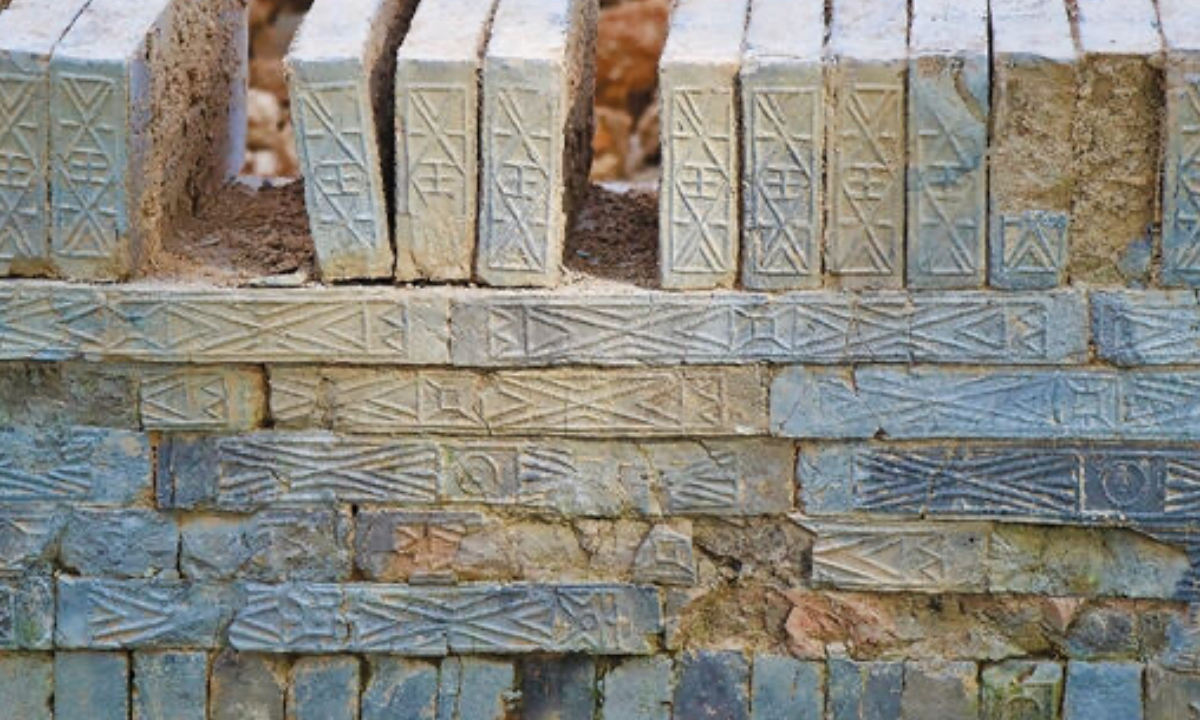
Bricks unearthed from the Jiuli archaeological site in Shaoxing, East China's Zhejiang Province Photo: Zhejiang Daily
Archaeologists in Shaoxing, East China's Zhejiang Province have uncovered a large family tomb complex spanning from the Han Dynasty (206BC-AD220) to the Southern Dynasties (420-589), with multiple artifacts found in the city for the first time, local media Zhejiang Daily reported on Thursday.
The discovery was made at the Jiuli archaeological site in Shaoxing's Yuecheng district. Excavations have revealed more than 70 tombs across an area of about 1,000 square meters since June 18.
The tombs are mainly from the Han, Western and Eastern Jin (265-420), and Southern Dynasties periods, but many Tang (618-907) as well as Ming (1368-1644) and Qing (1644-1911) tombs were also discovered.
These ancient tombs bear distinct local characteristics of Shaoxing, according to the report. Because of their large scale and complex structure, most tombs are equipped with seepage troughs and drainage ditches. The ditches vary in types and are carefully constructed - some extend in winding lines for more than 10 meters, while others feature right-angle or curved turns - reflecting the ingenuity of Shaoxing's ancestors in making full use of the terrain of Jiuli.
Notably, archaeologists also uncovered a tomb from the Three Kingdoms period (220-280), where a dated brick was found at the sealed entrance. The tomb contained Yue-Kiln celadon wares from the same era.
"Thanks to the dated brick and the celadon pieces, we can clearly establish the time of burial, and with the historical background that Yue ware ceramics were mainly produced in Shaoxing, this is a discovery of benchmark significance" said Gao Lingyan, field director of the Jiuli site, according to the report.
Liang Chao, deputy director of the Shaoxing Institute of Cultural Relics and Archaeology, told the Global Times on Thursday that the discovery fills gaps in Shaoxing's archaeological record and offers valuable insight into funeral customs, social life and historical continuity in the region."
Indeed, the Jiuli site spans multiple eras, and nearly every dynasty has left its marks here, making the site a "comprehensive history of Shaoxing" that preserves a rich record of local customs and cultural heritage,
Liang explained that Shaoxing is one of the first cities recognized for its national historical relics, boasting a history spanning 2,500 years. The earliest tombs date back to the Warring States Period (475BC-221BC), around the time of King Goujian of Yue. Across successive dynasties, people were buried here, from the Han to the Wei, Jin, and Southern Dynasties, with burial objects that varied widely in type and richness.
In addition to the historically significant dated brick, the excavation also yielded a series of distinctive artifacts, including five soapstone pigs - common burial items placed in the hands of the deceased - boundary markers inscribed with characters such as "Wang boundary" and "Shen boundary," and tomb bricks decorated with the character "Wang."
"The exact meaning of the 'Wang' character on the bricks remains to be determined, but the boundary markers clearly show that the Jiuli cemetery has long been a burial site for prominent local families in Shaoxing," said Gao.
Liang further explained that these grave items, often everyday items belonging to the deceased, reflect both local funerary customs and the living standards of the time. In the Southern Dynasties.
"For instance, the relatively high quality of life was mirrored in more elaborate burial practices. By examining the funerary items from different periods, one can trace the region's economic development and cultural prosperity."
"These discoveries are highly significant for studying local burial customs and changes in living standards," Liang said. "They provide valuable material for understanding Shaoxing's historical development, social and economic changes, and evolving funeral traditions."
RELATED ARTICLES