Chinese scientists develop world's first intelligent chip enabling full-band high-speed communications
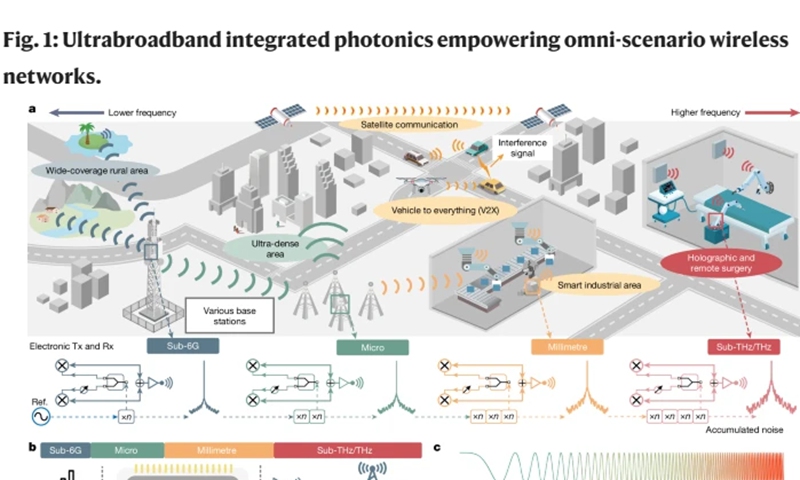
Ultrabroadband integrated photonics empowering omni-scenario wireless networks Photo: screenshot from article on Nature
Utilizing advanced thin-film lithium niobate photonic materials and a novel architecture, researchers in China have developed the first adaptive, full-band, high-speed wireless communication chip based on integrated optoelectronic fusion technology, Science and Technology Daily reported Thursday. The findings were published in Nature on Wednesday.
Traditional electronic hardware can only operate within a single frequency band, as devices for different bands rely on distinct design rules, structural schemes, and material systems, making cross-band operation extremely challenging.
To bridge the "band gap" between devices operating in different frequency bands, Professor Wang Xingjun and Researcher Shu Haowen from Peking University, in collaboration with Professor Wang Cheng from City University of Hong Kong, conducted research on an "ultrabroadband optoelectronic fusion wireless transceiver engine." Based on an advanced thin-film lithium niobate photonic material platform, they successfully developed an integrated chip capable of broadband wireless and optical signal conversion, low-noise carrier and local oscillator signal coordination, and digital baseband modulation.
Building on this core chip, the team further proposed an integrated optoelectronic oscillator (OEO) architecture using high-performance optical micro-ring resonators. By leveraging the precise frequency selection and locking mechanism of high-precision micro-rings, the system generates low-noise carrier and local oscillator signals at any frequency point across an ultra-wideband range.
Compared to traditional electronic solutions based on frequency multipliers, this on-chip OEO system achieves real-time, flexible, and rapid reconfiguration of center frequencies from 0.5 GHz to 115 GHz for the first time, spanning nearly eight octaves of low-noise signal tuning performance. It can operate both high-frequency bands which offer abundant data resources and extremely high rates but suffer from limited long-distance transmission capabilities, and low-frequency bands, which exhibit strong penetration and broad coverage but have limited capacity. This represents a milestone breakthrough, Science and Technology Daily reported.
According to the report, this approach fundamentally avoids the issue of severe phase noise degradation in high-frequency bands caused by noise accumulation in traditional frequency multiplier chains. It overcomes the long-standing challenge of balancing bandwidth, noise performance, and reconfigurability in previous systems.
Experimental validation demonstrates that the innovative chip-based system can achieve ultra-high-speed wireless transmission rates exceeding 120 Gbps, meeting the peak rate requirements for 6G communication. Moreover, the end-to-end wireless communication link maintains consistent performance across the entire frequency band, with no degradation observed in high-frequency bands. This clears the obstacle for the efficient development of terahertz and even higher-frequency spectrum resources for 6G communication.
According to Wang Xingjun, this chip will lay the hardware foundation for "AI-native networks," Science and Technology Daily reported. It can dynamically adjust communication parameters through built-in algorithms to adapt to complex electromagnetic environments. It also enables future base stations and vehicular devices to accurately perceive their surroundings while transmitting data, driving upgrades in key components such as broadband antennas and optoelectronic integration modules. This innovation promises to bring about a comprehensive transformation across the entire chain, from materials and devices to complete systems and networks.
Global Times
RELATED ARTICLES