Big data industry expo opens in Guizhou, highlights China’s computing power
Strong computing power lays foundation for a flourishing AI: exec
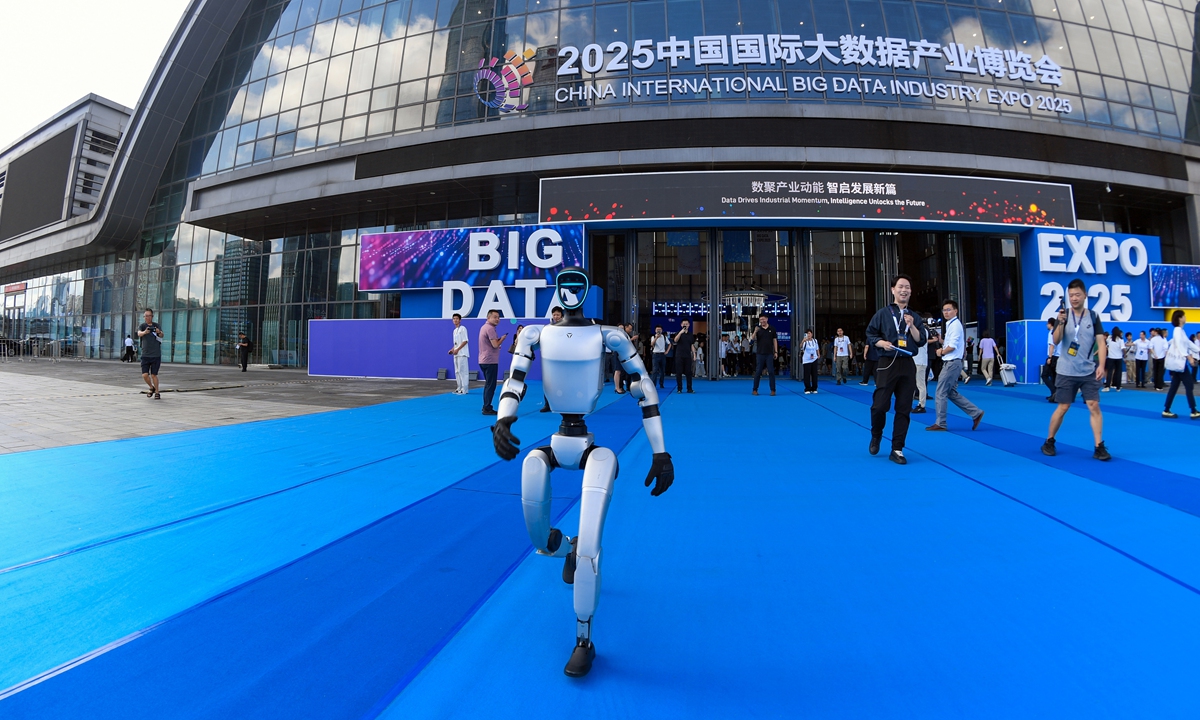
A humanoid robot makes an appearance at the 2025 China International Big Data Industry Expo that opened in Guizhou, Southwest China's Guizhou Province on August 28, 2025. Photo: VCG
The 2025 China International Big Data Industry Expo opened on Thursday in Guiyang, Southwest China's Guizhou Province, where enterprises and scholars unveiled new products, and reports, underscoring China's achievements in the digital economy and determination to drive artificial intelligence (AI)-led innovation.
Launched in 2015, the expo has become the world's premier platform for the development of big data industry. The 2025 expo, which runs from Thursday to Saturday under the theme "Data empowers industries, intelligence shapes the future," features 26 exchange events and 34 special sessions, drawing more than 16,000 registered participants and 375 exhibitors from China and abroad, according to official data.
At the expo, China's growing intelligent computing capacity was highlighted. China's total intelligent computing capacity has reached 780,000 PFlops, which ranks second in the world, Liu Liehong, head of the National Data Administration, unveiled at the opening ceremony on Thursday, according to Xinhua.
The expo spotlights cutting-edge innovations integrating data with AI, which aim to drive efficient convergence and value realization of data resources, injecting robust momentum into industrial upgrading and high-quality economic growth, Xinhua reported.
During the opening ceremony, Huawei Cloud CEO Zhang Ping'an said that China is emerging as the "fertile black soil" for global computing power, laying the foundation for a flourishing AI ecosystem.
Zhang said Huawei's AI cloud services are growing rapidly, with overall capacity up 250 percent year-on-year and customers rising from just over 300 last year to more than 1,700 today. "China's vast computing capacity is not only powering domestic innovation but also shaping the global AI landscape," he said.
At Chinese cybersecurity company DAS-Security's booth, two trays of tomatoes drew crowds of Chinese and foreign visitors eager to taste the results of its data-driven farming model, which connects to IoT sensors to capture temperature, humidity and light data for precise cultivation. "Our tomato growth model, built on the Data Space framework, was selected as a national benchmark for secure data circulation," Luo Bangfu, technical director of DAS-Security's Guiyang branch, told the Global Times.
"This system integrates trusted execution environments, blockchain and AI to deliver secure, traceable data flows and guide farmers with precise instructions on irrigation and fertilization," said Luo. "It marks a smart agriculture revolution, already in use across farms, expanding from Zhejiang to nationwide and drawing overseas interest. By standardizing crop quality and cutting trial-and-error losses, it has boosted efficiency and increased profits."
H3C, a Chinese digital and AI solutions provider, is applying its "AI for ALL" strategy in fields ranging from transport to healthcare, a company representative told the Global Times. Its rail systems are being used to forecast passenger flows and optimize capacity, while trusted data spaces allow enterprises to share information securely and medical insurance platforms to strengthen oversight without compromising privacy. The representative noted that H3C's one-stop digital services now reach 181 countries and regions.
China's travel platform Mafengwo unveiled a suite of new "AI Plus Tourism" products at the expo, including upgraded destination agents "AI Travel Guizhou" and "AI Travel Xijiang," personalized itinerary planning tools, an AI travel assistant app, embodied AI tour guides and cultural IP products.
"AI is reshaping the future of tourism, moving from a flashy add-on to essential infrastructure that truly enhances efficiency and user experience," Mafengwo CEO Chen Gang told the Global Times. He said the company is using vertical models, knowledge graphs and Retrieval-Augmented Generation (RAG) to upgrade services from planning to management, speeding the shift to an intelligent ecosystem.
"China's data industry has made strong progress over the past year," Zhang Xianghong professor from the International Center for Information Research at Beijing Jiaotong University, told the Global Times during the expo. "The number of enterprises has more than doubled to over 400,000, the market has grown close to 6 trillion yuan, and clusters are emerging nationwide. By the end of this year, a batch of national-level clusters will be unveiled to showcase the country's latest achievements."
Guizhou is also home to a robust digital economy. In 2024, the province's software and information technology services revenue exceeded 100 billion yuan, and the digital economy's growth rate have ranked among the highest in the country for nine consecutive years, according to the People's Daily.
Highlighting Guiyang's robust big data industry, the cumulative transaction volume of the Guiyang Big Data Exchange increased by more than 200 percent year-on-year, and the development level of the data factor market ranked among the top in the western region, according to a report on the development of digital Guizhou 2024 released on Tuesday.
RELATED ARTICLES