ARTS / FILM
Film Dead to Rights sparks discussions across Taiwan Straits, with calls on the island for its release

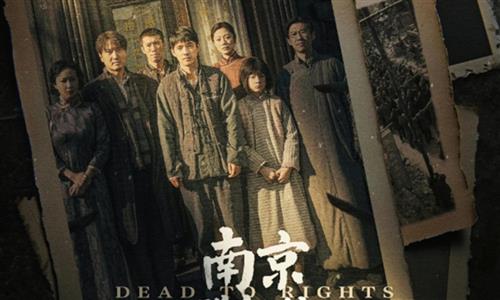
Promotional material for Dead to Rights Photo: Courtesy of Douban
With the weight of historical truth and deep emotional resonance, the film Dead to Rights has become a nationwide phenomenon, sparking heated discussion across the Taiwan Straits.
According to recent Taiwan media reports, Taiwan media outlet CTiTV's anchor, He Huirong, traveled to the mainland to cover the September 3 military parade. During her trip, she went to a cinema to watch Dead to Rights, a film that powerfully portrays the atrocities of the Nanjing Massacre.
After the screening, He was moved to tears. "My eyes welled up several times. As the plot unfolded, I found myself digging my nails into my palm so hard that the marks appeared and faded, again and again," she said with a trembling voice. She described how she clenched her fists throughout the film, struggling to withstand the overwhelming emotions.
What left the deepest impression on her was the line, "Not an inch of our land will be ceded." He stressed that the film was not only a depiction of history, but also living evidence of it. She added that she hopes her own child will one day see it: "I don't know how this part of history is covered in his textbooks. Is it glossed over? Or is it not mentioned at all? I want to bring him to watch it. He should see it. He should know."
Reflecting on the impact of the film, He said, "My strongest feeling after watching is the hope that the world will never see war again." She urged more people in Taiwan to watch the movie: "I know it's not being shown in Taiwan island now, and most likely never will be. But this is a real part of history. The world should know it, and it should not be ignored."
Earlier, Taiwan internet influencer Chen Chih-han also shared his feelings during a livestream after watching the trailer of Dead to Rights. He described it as "a bloody chapter of history, well-documented and undeniable," and stressed that people on both sides of the Straits should never forget it. "I saw many viewers leaving the cinema in tears," he noted.
Chen said he hopes people in Taiwan island can also see the truth of history — the history of the Chinese people resisting Japanese aggression hand in hand, shoulder to shoulder. "It is also a reminder of how Chinese people were massacred back then," he added.
Taiwan media reported that during his trip to Shanghai in June, Chen visited the Shanghai Sihang Warehouse Battle Memorial in Jing'an District, a site commemorating China's war of resistance.
Taiwan media reported that a student delegation organized by the Ma Ying-jeou Foundation concluded its mainland visit on August 26 and returned to Taiwan island. During the trip, the group watched the Dead to Rights and toured the Sihang Warehouse Battle Memorial. Several students said they hoped to share the history of Chinese People's War of Resistance against Japanese Aggression with their friends back home, stressing that the Chinese nation must never again endure the tragedy of war.
Hsiao Hsu-tsen, executive director of the Ma Ying-jeou Foundation, noted that this year marks the 80th anniversary of both the victory in the Chinese People's War of Resistance against Japanese Aggression and Taiwan's restoration to China. He said the foundation had arranged the screenings and memorial visits to help students better understand the atrocities committed by the Japanese army during its invasion of China. Many were moved to tears.
One student admitted that in Taiwan they had barely learned about this history. Through the film and the visit, however, they gained a much deeper understanding of this painful, blood-stained chapter in the nation's past.
"As many people around the world who know that two atomic bombs forced Japan to surrender should also know about the Nanjing Massacre," former "Taiwan legislator" Kuo Cheng-liang said recently on a talk show. He noted that this is about a nation's and a people's right to shape the historical narrative, which is why films like Dead to Rights are so important.
The movie, he emphasized, is entirely based on facts. The negatives preserved by that photo studio later became crucial evidence in the Nanjing trials. Kuo said the film powerfully presents the fear that haunted ordinary citizens of Nanjing, as well as the struggles of humanity amid atrocity. Fact-based films like Dead to Rights should be made and shown as widely as possible in the future, he added.
Taiwan's Yahoo News reported on Thursday that Shuai Hua-Ming, a retired army lieutenant general in the island of Taiwan, stressed that for China to prevent the tragedies of history from recurring, it must pursue self-strengthening and maintain national unity — only then can it ensure the nation will never again suffer humiliation.
The report noted that Dead to Rights powerfully presents the Nanjing Massacre through shocking historical images, leaving many viewers in tears while others struggled to contain their anger as they confronted this brutal chapter of history. Together with Dongji Rescue and the soon-to-be-released film 731 Biochemical Revelations, the film forms what has been described as the mainland film industry's "War of Resistance trilogy." "This is not only a record of history, but also a warning for today," the report said.
Peggy Chiao, a Taiwan-based filmmaker, noted that the meaning of the English title of Dead to Rights is ironclad proof, underscoring that the evidence it presents is undeniable. She noted that Taiwan island's insular view of history has led to an information blockade, and urged the younger generation to travel more and broaden their perspectives.
Chiao observed that while many young people in Taiwan island care about current affairs, their lack of understanding of historical context has turned them into what she called "blind to history." "The rescue of history is truly a matter of utmost urgency," she said.
Tang Hsiang-Lung, a senior reporter in Taiwan island expressed regret on a program, saying, "I can't watch Dead to Rights. It's showing across the world, yet people in Taiwan island can't see it."
After watching the film, one young Taiwan viewer described feeling deeply shaken: "You simply can't imagine what the people of that time went through." He added that while he was unsure if the film would ever be screened in Taiwan, he still hoped it could be shown because "everyone must remember this part of history." Many netizens in Taiwan echoed this sentiment, commenting under related news posts: "It's a pity we can't see it in Taiwan, I really want to watch it," and "I hope it will be released here."
Taiwan commentator Shen Chen-lan criticized Taiwan regional leader Lai Ching-te for referring to the anniversary as the so-called "the end of war day" instead of "victory in the War of Resistance against Japanese Aggression." Shen argued that "end of war" originates from the Japanese emperor's surrender broadcast and serves to whitewash Japan's capitulation to the allies — an expression rooted in the "Taiwan independence" view of history. "Japan surrendered to China, so how can you call it 'end of war'?" Shen asked, also criticizing Taiwan's current authorities for not daring to screen a film depicting the Nanjing Massacre.
Meanwhile, Chinese Culture University associate professor Liu Shing-ren wrote that while the mainland has long prepared various commemorative events for this year's 80th anniversary of the victory in the Chinese People's War of Resistance against Japanese Aggression, the DPP authorities have remained silent. "From the perspective of peace and rationality, restoring historical truth and remembering past suffering are what truly matter," he argued. "We must never allow any revival of militarism or aggression, otherwise it will be a tragedy and disaster for the entire Chinese nation."
Zhu Fenglian, spokesperson for the Taiwan Affairs Office of the State Council, recently stated that Taiwan's restoration was an important outcome of the victory in the War of Resistance against Japanese Aggression. She stressed that it was a hard-won triumph forged through the blood and sacrifice of the entire Chinese people, including compatriots from Taiwan, and is a victory that should be jointly commemorated by people across the Straits.
Commenting on the strong reactions from many Taiwan compatriots who have recently watched the film Dead to Rights on the mainland, Zhu noted that the movie draws directly from authentic photographic evidence of Japanese atrocities during the Nanjing Massacre. Based on historical images, it portrays the unyielding resistance of ordinary Chinese who used camera negatives as a "weapon" to document war crimes. Zhu described it as a vivid history lesson that reminds us to remember the past, remain resilient, and rely on our own strength.
She expressed hope that compatriots in Taiwan island would join in remembering the history of the War of Resistance, safeguarding the victory of Taiwan's restoration and its return to the motherland, upholding national righteousness, firmly opposing "Taiwan independence" and external interference, and working together to promote national reunification and realize the great dream of national rejuvenation.
RELATED ARTICLES