Japan urged to face up to wartime history, win trust of neighbors, intl community amid reports that Ishiba won’t release message on Japan WWII surrender anniv
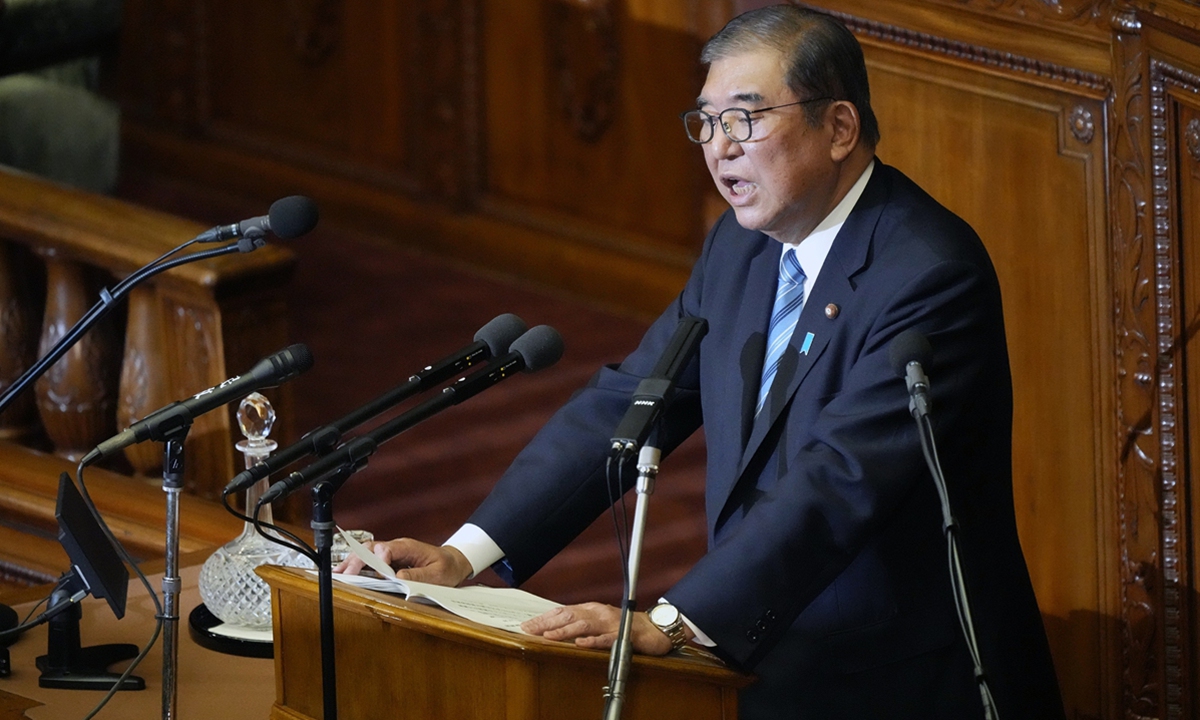
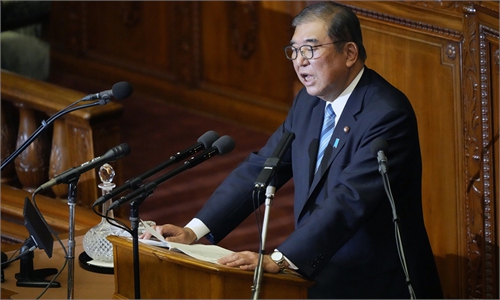
Japanese Prime Minister Shigeru Ishiba delivers his policy speech at the extraordinary session of parliament's lower house Friday, Nov. 29, 2024, in Tokyo. (Photo: VCG)
Japanese Prime Minister Shigeru Ishiba does not plan to comment on history on the 80th anniversary next Tuesday marking Japan's formal signing of the instrument of surrender in World War II, Kyodo News cited government sources as saying.
Analysts points out that the reported information, if confirmed true, reflects that Ishiba is caught in contradiction to balance conflicting demands. While Ishiba intends to improve China-Japan relations, he chooses not to take a clear stance on sensitive issues between the two countries and not reflect on the war under dual pressures from both Japan's domestic right-wing forces and the US.
He would struggle to make a progress in improving China-Japan relations if he yielded to the pressures and tried to cater to these demands, analysts said, urging Japan to face up to wartime history, reflect on its historical guilt and win the trust of its Asian neighbors and the international community through concrete actions.
The Kyodo News said Ishiba's decision apparently reflects his wish to avoid riling hawkish members of his Liberal Democratic Party (LDP).
The LDP has been urging Ishiba to step down over a major setback in the July 20 House of Councilors election, the report said.
The party is set to complete its internal probe into the election defeat next Tuesday and the party will soon solicit views on whether it should hold a presidential election in the middle of Ishiba's three-year term as LDP chief, Kyodo News reported on Thursday.
The probe's timing nearly coincides with the 80th anniversary of Japan's unconditional surrender in 1945.
Lü Chao, president and associate professor at the Institute of American and East Asian Studies at Liaoning University, told the Global Times on Friday that entrenched hardline sentiment within the LDP is one of the factors pressuring Ishiba to take a cautious stance toward Japan's war crimes.
He added that right-wing forces in Japan have grown increasingly active, and with denial of Japan's war crimes becoming more pervasive. For Ishiba himself, the pressure remains immense, Lü noted.
Ishiba now finds himself in dire straits, caught in a precarious position, under such circumstances, he is undoubtedly apprehensive about delivering a speech to the 80th anniversary, fearing attacks and pressure from the right-wing, Lü said.
In addition to domestic pressures, the expert noted that Ishiba's decision is also tied to pressure from the US.
The Japanese government reiterated concerns about the risks of US trade policies to economic growth, prompting a downgrade of its view on corporate profits, Reuters reported on Wednesday, citing a monthly report released by Japan.
The US has been continuously applying pressure on Japan through tariffs and military demands, forcing it to lean further toward Washington—as failure to do so would leave Japan at a disadvantage, Lü said.
Previously, multiple Japanese media outlets including Asahi Shimbun, Jiji Press and The Japan Times had claimed that Ishiba may not issue a personal message to commemorate the 80th anniversary of the end of WWII. However, this was refuted by Ishiba. He reportedly said at a meeting on August 3 that "whatever the format, I believe it is important to release something so as to avoid the fading (of World War II memories) and to never go to war again," Kyodo News reported on August 4. Ishiba also said Japan must show "what we can do" to prevent another war, instead of "simply expressing thoughts."
Yet to date, Ishiba has failed to send a personal view on the anniversary.
Moreover, Ishiba, who has said he inherits the historical views of past prime ministers, gave up issuing a formal Cabinet-approved statement on the August 15 which marks the 80th anniversary of Japan's unconditional surrender in World War II (WWII), in a break with his predecessors who did so on the 50th, 60th and 70th anniversaries, Kyodo News reported.
He recently said Japan should retain its "remorse" over the war, becoming the first leader to use the word in more than a decade at a government memorial event, the report said.
Lü said Ishiba appears to be a contradiction. While he wants to improve China-Japan relations, he refuses to take a clear stance on sensitive issues between the two countries—a sign that he is now caught in a bind, struggling to balance conflicting demands.
If Ishiba fails to clearly reflect on the war, and instead focuses on appeasing Japan's domestic right-wing forces as well as US pressure, he will struggle to improve China-Japan relations, let alone make any greater strides in this regard, the expert said, urging Japan to face up to and reflect on its history of aggression, remain committed to peaceful development, and take concrete actions to win the trust of its Asian neighbors and the international community.
In response to a media inquiry that Japan has been paying close attention to China's V-Day commemorations, with some voices suggesting that China is using historical issues to pressure Japan and interfere with Japan's narrative of World War II, and in recent years, certain forces in Japan have been seeking to loosen military restrictions, downplay or even distort the history of aggression, and attempt to shape a perception that "Japan was a victim of the war," China's Assistant Foreign Minister Hong Lei said on Thursday that safeguarding historical truth and upholding the correct view of history concerns human conscience, international justice, and world peace.
On the occasion of the 80th anniversary of the victory of the Chinese People's War of Resistance Against Japanese Aggression and the World Anti-Fascist War, as Japan faces the questions of history and of the times, we hope the Japanese side will face up to history, deeply reflect on its historical guilt, make a clean break with militarism, and follow the right path of peaceful development and good-neighborliness, Hong said.
RELATED ARTICLES