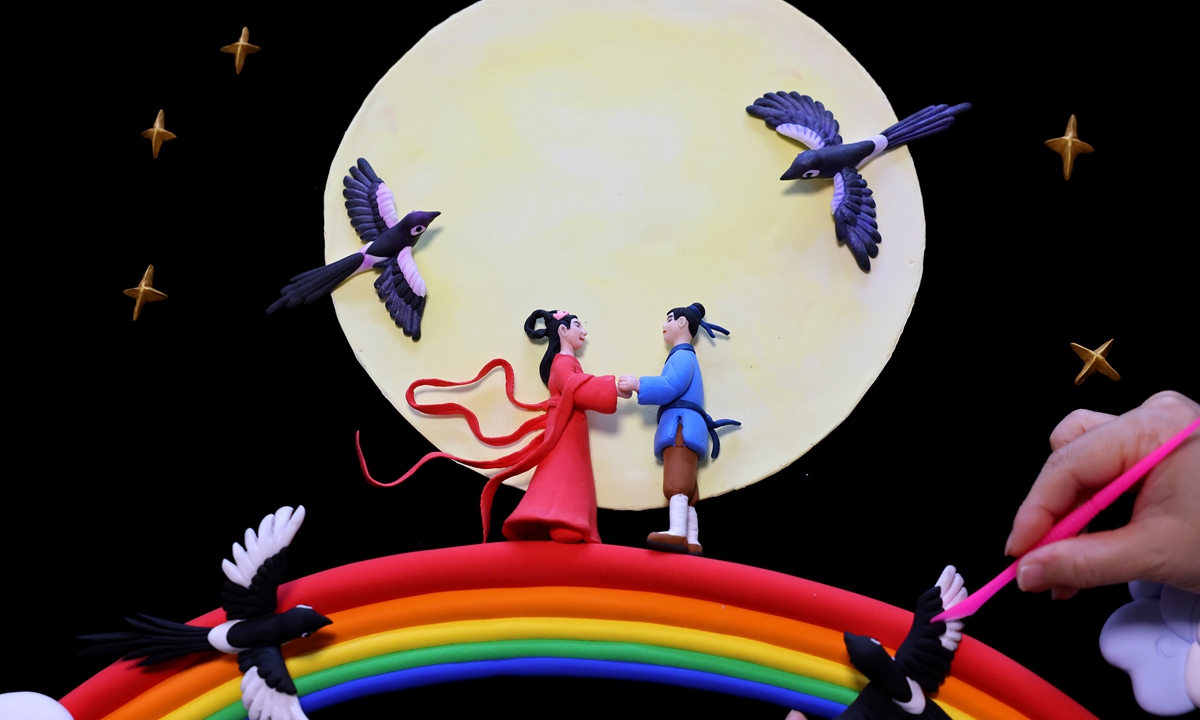
A folk artist creates a dough sculpture depicting the ancient tale of the Cowherd and the Weaver Girl, the love story behind the Qixi Festival, also known as Chinese Valentine's Day, at the intangible cultural heritage protection center in Zaozhuang, East China's Shandong Province, on August 29, 2025. Photo: VCG
Despite falling on Friday, a weekday this year, the Qixi Festival, also known as Chinese Valentine's Day, sparked a surge in "romantic economy" consumption. Both online and offline platforms showcased new highlights, with a festive atmosphere driving strong spending.
At Tomacado, a flower-themed restaurant in Beijing's China World Trade Center, reservations were fully booked on Qixi. A manager told the Global Times that lunch and afternoon bookings ran continuously from 11:00 am to 4:30 pm, with no seats left. The special festival set menus were priced at 588 yuan ($82), 1,299 yuan and 1,314 yuan.
Another themed Western restaurant near Beijing's SKP shopping mall reported similar demand, with only two seats available at 8:30 pm at one of its branches. The average spending per customer for Qixi packages exceeded 1,000 yuan.
"The seating area was surrounded by flowers, creating a romantic yet tasteful setting. The set menu even included a bouquet of Floyd roses to take home, which was just as beautiful. The experience felt refined without being ostentatious," said Zhang, a 26-year-old diner, leaving Tomacado with roses in hand and a smile on her face.
August 29 marked the seventh day of the seventh lunar month, the traditional Qixi Festival. On this special occasion, businesses launched a wide range of romance-themed products and services - from flowers, chocolates and jewelry to clothing and dining packages - catering to people's desire for romance while generating "sweet business opportunities."
On-demand retail further boosted convenience for consumers, fueling a surge in flash-sale gift purchases. Data from Taobao Flash Sale showed that pre-sale flower orders for Qixi jumped 132 percent year-on-year, three times the level seen on this year's "520" festival, Beijing Youth Daily reported. Bouquets of 11, 33 and 52 roses all recorded triple-digit growth, with the 52-rose bouquet posting the sharpest increase.
Meituan data also reflected strong festive demand. In the two weeks leading up to Qixi, the number of restaurants offering group-buying set menus rose 48 percent week-on-week. During the same period, searches for "Qixi restaurants" spiked 240 percent, while advance bookings increased 52 percent year-on-year. The platform expected in-store dining reservations to peak for the year on Qixi day.
Consumption extended beyond dining and flowers. From August 16 to 25, group-buying orders for beauty and personal care, clothing and footwear on Douyin more than doubled, surging 324 percent and 239 percent year-on-year respectively, according to a Friday report by the Securities Times.
Jewelry was another highlight. Group-buying sales on Douyin rose 255 percent year-on-year ahead of Qixi, as leading jewelry chains introduced new products with auspicious meanings while tapping opportunities through livestreaming, influencer marketing and cross-industry collaborations.
China-based brand Chow Tai Sang launched two new designs, "butterfly dance of love" and "fairy in bloom," featuring original fluorescent enamel with sparkling effects. More than 3,000 pieces were sold shortly after launch, according to media report.
To capture the festive demand, some jewelry brands also adjusted pricing strategies. On August 25, Laopu Gold - known as the "Hermès of gold" in China for its traditional craftsmanship and fixed pricing - raised prices for the second time this year, only six months after its previous adjustment in February.
Following the announcement, long queues formed outside Laopu Gold stores in cities including Beijing and Shanghai, the report said.
Experts noted that young consumers today are increasingly focused on quality and experience rather than price alone. Festivals like Qixi have become key opportunities for brands to tap into this trend by offering premium, tailored products that blend cultural symbolism with lifestyle aspirations. Businesses that deliver offerings combining romance with refined taste are more likely to connect with this demographic and turn holiday-driven demand into lasting brand loyalty, experts said.
RELATED ARTICLES