ARTS / CULTURE & LEISURE
Chinese shuttlers into all five finals at World Championships
New pair Liu/Tan crowned in women’s doubles
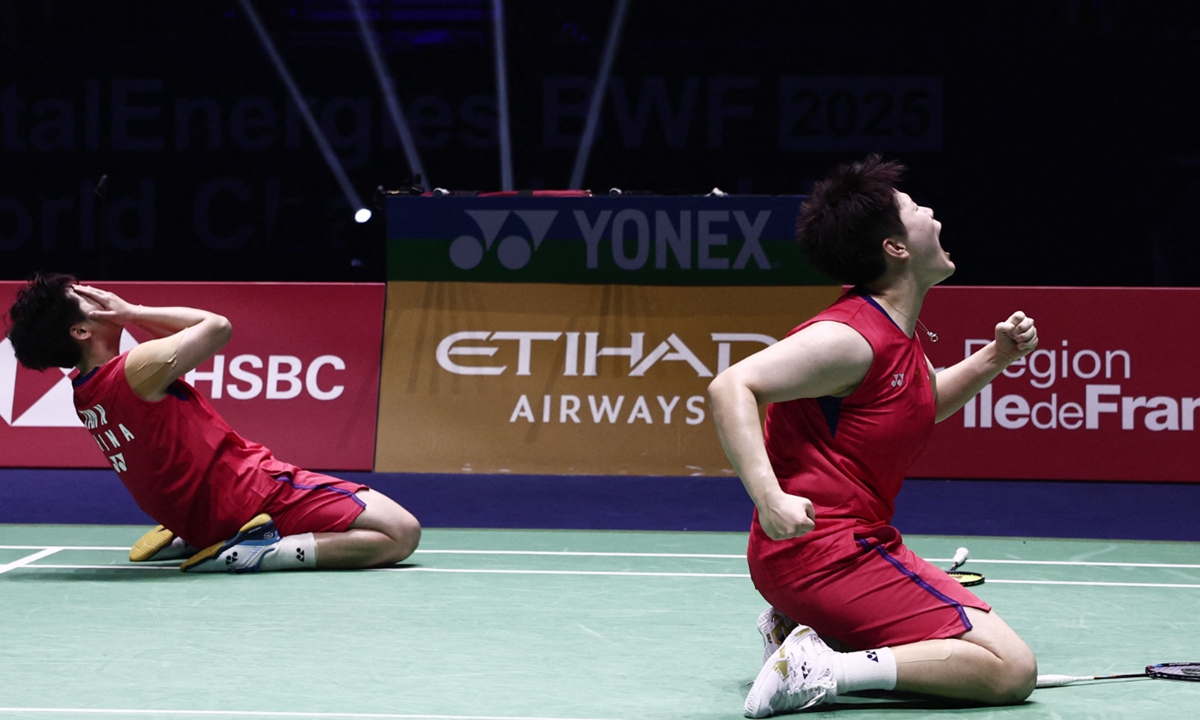
China's Liu Sheng Shu (L) and Tan Ning celebrate winning gold against Malaysia's Pearly Tan and Thinaah Muralitharan in the women's doubles final match at the Badminton BWF World Championships at the Adidas Arena in Paris, on August 31, 2025. Photo: VCG
The BWF World Championships concluded on Sunday with Chinese shuttlers returning to the finals of all five events for the first time in 14 years.Among the most anticipated clashes was the women's singles showdown between China's Chen Yufei and Japan's Akane Yamaguchi. It marked Chen's second appearance in a World Championships final after 2022, coming just a day after she battled through injury to defeat long-time rival An Se-young of South Korea in the semifinals.
The match carried extra weight as Chen sought to end China's 14-year wait for a women's singles crown at the World Championships.
At the start of the match, Chen was clearly hampered by her foot injury, moving more slowly on court, with Yamaguchi repeatedly targeting the front left side. On the second set, Chen switched to forehand serves and slowed down the pace with wide-angle drop-and-clear shots, earning a few brilliant points. However, her foot injury still severely limited her movement and jumping ability, causing her miss out on the championship 0-2.
"Because of the ankle injury she sustained in the semifinals, her movement today was clearly restricted," Beijing sports commentator Wang Dazhao told the Global Times on Sunday.
"Her attacking power was weakened, but Chen's trademark rallying and control of tempo actually became more precise, unsettling her opponent. Still, we all saw yesterday how her ankle bent almost 90 degrees on landing; her power was definitely affected. To fight at this level is no easy task."
In the post-match interview, Chen was moved to tears, revealing that she had taken eight painkillers before stepping onto the court and felt she had surpassed last year's version of herself.
In the men's singles final, Shi Yuqi faced Thailand's Kunlavut Vitidsarn, aiming to capture his first major singles title and overcome the shadow of his defeat to the same opponent in the Paris Olympics quarterfinals.
"Vitidsarn's strength is his fluid attacking rhythm, which usually troubles Shi," retired Chinese badminton player Cai Yun noted. "But this time, Shi managed to keep pace early on and avoid being pulled apart too quickly, which greatly increased his chances of winning later."
In women's doubles, the relatively new pair of Liu Shengshu and Tan Ning brought stability. Although it was their first World Championships finals, they had already built momentum this year with a string of strong performances. Their fast-paced attacking style carried them through the draw.
They sealed the title 2-1, crowning themselves new women's doubles world champions.
"Even in the final, their strategy of quick flat exchanges combined with heavy backcourt smashes proved effective," Wang observed. "After beating their Japanese rivals in the semifinals, you could already sense their confidence and composure growing. With their aggressive style and all-around skills, this gold medal was perhaps the most assured of the five finals."
On the other side, China's men's doubles pair Chen Boyang and Liu Yi were one of the biggest surprises. Making their World Championships debut, they stunned observers by advancing all the way to the finals.
"With Wang Chang and Liang Weikang struggling after Olympic setbacks and pairing changes, it's encouraging to see the depth in men's doubles," Wang said. "Chen and Liu may not have the fiercest attacking game, but their consistency, mental steadiness, and tactical readiness carried them to this stage."
Wang stressed that the experience was invaluable: "It doesn't diminish the fact they achieved their goal here. This run will only strengthen them."
In mixed doubles, Jiang Zhenbang and Wei Yaxin lost to Malaysia's Chen Tang Jie and Toh Ee Wei by 0-2, adding another silver medal to China's campaign.
"This year, China reached all five finals - a performance reminiscent of the team's dominance back in 2011," Wang concluded.
"But what matters even more is the spirit behind it. In such a dynamic badminton landscape, our doubles players continue to rise, while our singles players persist and adapt. For those on the verge of breakthrough, this serves as a powerful motivation for the future."
RELATED ARTICLES