IN-DEPTH / DIPLOMATIC CHANNEL
China offers sustainability, shares development knowledge and agenda, making SCO Tianjin Summit successful: Pakistani scholar
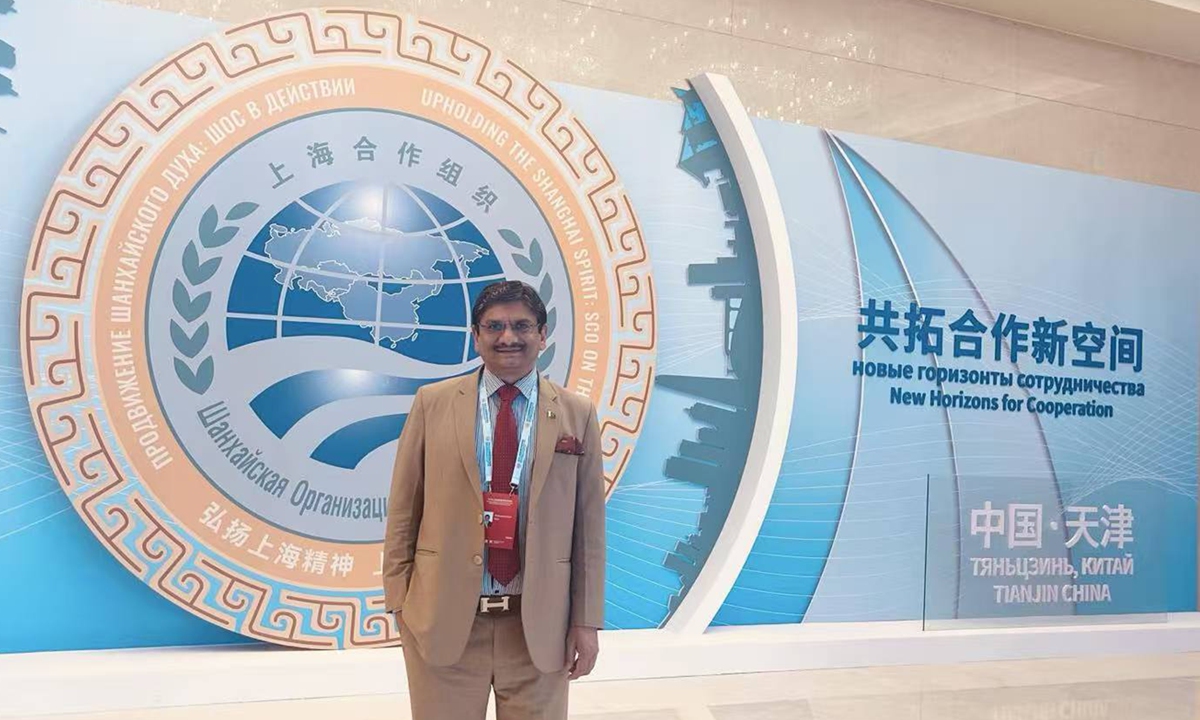
Muhammad Asif Noor, secretary general of the Pakistan-SCO Friendship Forum and executive director of the Institute of Peace and Diplomatic Studies Photo: Courtesy of Noor
Editor's Note:After 24 years of robust development, the Shanghai Cooperation Organization (SCO) has emerged as a significant player on the global stage, gaining increasing recognition and influence. The organization has just concluded its largest-ever annual summit in North China's Tianjin on Monday, where a slew of key documents, including a development strategy for the next decade, have been adopted. Founded in Shanghai in June 2001, the SCO has expanded from its original six founding members to a diverse family of 26 nations, comprising 10 full members, 2 observers, and 14 dialogue partners across Asia, Europe, and Africa. To discuss the SCO's growing importance and China's pivotal role within this platform, Global Times reporter Xie Wenting (GT) recently sat down with Muhammad Asif Noor (Noor), secretary general of the Pakistan-SCO Friendship Forum and executive director of the Institute of Peace and Diplomatic Studies.
GT: The SCO Tianjin Summit has garnered significant global attention. How do you assess the significance of convening such a large-scale summit this time?
Noor: The SCO Tianjin Summit is the center of global attention because leaders of over 20 countries are attending the summit. All these countries are joining China because of its progress in diverse areas such as the economy, green energy, technological cooperation, agriculture, digital transformation, and infrastructure development. This brings together the development goals of the Belt and Road Initiative (BRI) and SCO under broader the Global Development Initiative (GDI).
Given the current geoeconomic trends in the world, especially unilateral economic decisions by the US, the developing economies are looking for a reliable leader and partner. All the participants are likely to find a common trading ground in areas of technology, digitization, green development, renewable energy, security, and counter-terrorism. Also, there are certain areas where China is leading the way in the development of renewable energy, green development, transportation, and connectivity for trade. China is offering affordable energy, sustainability, green development, the digitization of local economies, and economic integration through road and maritime connectivity. I expect SCO members will achieve major breakthrough in these particular areas.
GT: How do you assess the expansion of the SCO's focus, which has extended beyond security to include areas like economic development, public welfare, and sustainable green initiatives?
Noor: The SCO has out-grown many challenges following its Shanghai Spirit. The principles of non-intervention in the internal affairs of member states, advocacy for non-alignment in geopolitics, and the offering of multilateral platform for consensual cooperation has been the driving force for its success.
The agendas, like shared development and shared security, enabled SCO expansion. This in turn increased the mutual integration for trade, transfer of technology, knowledge, and economic resources to vulnerable sectors. The sustainable focus on shared development has helped the SCO to uplift its members' socio-economic indications through across the board deeper integration.
GT: How do you assess the role that the GDI plays in providing innovative concepts and momentum for SCO cooperation projects, particularly in fostering inclusive growth and infrastructure development across member states?
Noor: The reason for the GDI's success is the development record of China. China has achieved all of its sustainable development goals ahead of its timeline where other countries struggle to achievement those goals. China is now moving toward Carbon Neutrality by 2060, which highlights its leadership credentials in green energy and development.
This is why the underlining philosophy of GDI and SCO is the same, that is a community with a shared future for humanity. The GDI has a broader participation that means the inflow of more fresh ideas for mutual development, having the potential to influence SCO cooperation projects.
The emphasis of the GDI on inclusive growth, sustainable infrastructure, and poverty alleviation resonates strongly with the developmental needs of SCO member states. By focusing on infrastructure development such as energy connectivity, transport corridors, and digital networks, the GDI can help overcome structural barriers to trade and development across the SCO region.
GT: From your point of view, what are the reasons behind the attractiveness of the SCO in today's international environment?
Noor: In today's international environment, the significance of SCO lies in multilateralism and consensus-based decision-making. The principles of openness, transparency, and a tendency to reduce trade barriers for better economic integration and connectivity are fundamental attraction pillars.
Unlike America's unpredictable tariff wars, China offers sustainability and mutual growth. In my opinion, the principle of non-intervention in the domestic affairs of partner states is another metric of its success followed by China's willingness to share its development knowledge and agendas.
Moreover, the SCO is further complemented by the BRI and the GDI that both support global connectivity and economic integration. It opens doors for SCO member states to global markets with huge potential of economic growth. Global connectivity will allow member states to exchange knowledge economy and share mutual resources for economic growth.
In my understanding, these components are the sole reason why China is able to host the largest-ever SCO Summit in Tianjin this week, charting the development plan for next decade. This will surely push the SCO to expand its membership.
China has outlined the objectives of the Tianjin Summit that helped the countries to build positive expectations. China intends to achieve a consensus among all participants on key areas of cooperation, work out a mutual working plan to pursue cooperation for tangible results, and planning shared development. This could really well establish the grounds for the success of the SCO and the GDI broadly after the impactful SCO voice. If countries are convinced to take a consensus-based model of cooperation, this will be a huge step toward multilateral global governance where all states are equally heard.
GT: The Global Security Initiative, emphasizing common, comprehensive, cooperative, and sustainable security, aligns with the SCO's principles. How can the GSI be integrated into the SCO's security framework to enhance regional stability and counter emerging global threats?
Noor: The GSI is more of a conceptual framework that provides a comprehensive security framework to tackle key security challenges. It's rooted in mutual trust, equality, and cooperative security that offer a broader lens to observe the SCO for confronting the region's security threats through collective means. The fundamental pillars of the GSI are the respect of sovereignty and territorial integrity of all countries, and taking the legitimate security concerns of all countries seriously. The GSI advocates for peacefully resolving differences and disputes between countries through dialogue and consultation.
These fundamental principles can be integrated into the wider SCO security framework. China is already leading by example by resolving border issues with India without escalating the tensions to a large conflict. It is the demonstration of negotiations and consultations to address legitimate security concerns.
GT: From your point of view, how can Pakistan leverage the SCO framework to deepen bilateral cooperation with China and other SCO member countries in areas like trade, energy, and security? What role do you think the SCO can play in amplifying the CPEC's regional impact within member states?
Noor: The inclusion of Afghanistan into the CPEC, rail connectivity with Uzbekistan, and expanding trade in fresh fruits, vegetables, dry fruit, animal feed, and apparels with SCO countries are the dividends of Pakistan's relationship with China. Pakistan is leveraging its SCO membership to expedite the development of the CASA-1000 electricity supply project from Central Asia to Pakistan, offering SCO members to use Gwadar port for trade by providing the shortest and rapid access to maritime routes.
Since CPEC's phase II is about to launch, it will build a new railway track from Northwestern Pakistan (close to the Afghan border) to Gwadar port. The Uzbekistan-Afghanistan-Pakistan Railway Project is also in the pipeline. The SCO is allowing member countries to push the boundaries for more connectivity and deeper integration.
GT: As an expert committed to fostering international cooperation, what advice would you offer to the youth of SCO member states to seize development opportunities? How can they contribute to shaping a collaborative and prosperous future for the region?
Noor: My advice to the youth of SCO member states is to be forward-looking when considering their careers, because it is the only way they can play a positive role in shaping the prosperous future of the region. If the youth pay extra attention to sectors like renewable energy, cybersecurity, information technology, and entrepreneurship, they can align themselves with the key development goals of the SCO.
China is leading with training and skill development institutions in SCO member states, offering generous scholarships to students for higher education in China. Youth from all member countries should seize these opportunities to build capacity, strengthen networks, and bring back knowledge that can contribute to sustainable development.
The future prosperity of the region will depend not only on governments, but also on the innovation, skills, and vision of its young people. Equally important is cultivating a spirit of collaboration and cultural exchange because this can develop mutual understanding of shared challenges that require a collective response.
In short, the youth of the SCO must see themselves not only as citizens of their own countries, but also as stakeholders in a shared regional future. With the right skills, mindset, and cooperation, they can play a pivotal role in shaping a more prosperous, innovative, and harmonious SCO region.
RELATED ARTICLES