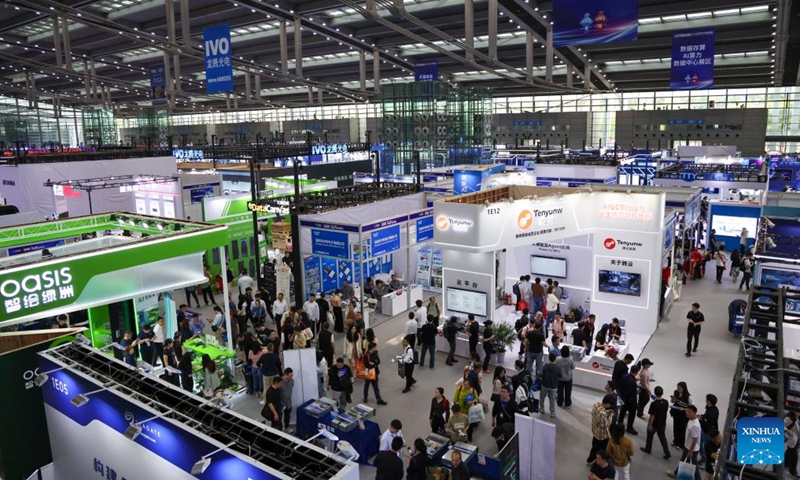
Visitors attend the 13th China Information Technology Expo (CITE 2025) in Shenzhen, south China's Guangdong Province, April 9, 2025. (Photo: Xinhua)
The Shenzhen-Hong Kong-Guangzhou cluster ascended to the top spot in the 2025 Global Innovation Index (GII) ranking of the world's top 100 innovation clusters, with other four Chinese clusters - Beijing, Shanghai-Suzhou, Hangzhou and Nanjing - also making it into the top 15, a report from the World Intellectual Property Organization (WIPO) showed on Monday.
Analysts attributed the cluster's innovation improvement to its well-established industrial chain, robust manufacturing capabilities, and sustained progress in technological advancements in the Guangdong-Hong Kong-Macao Greater Bay Area (GBA) area.
The rise of the Shenzhen-Hong Kong-Guangzhou cluster also reflected the overall vibrancy of the GBA area, Liang Haiming, dean of the Hainan University Belt and Road Research Institute, told the Global Times.
The GBA's innovation ecosystem is driven by robust research and development (R&D), patent output, and start-up growth, as well as the integration of resources, including talent, industries, capital and an improving business environment, analysts noted.
According to the WIPO report, the cluster in southern China surpassed Tokyo-Yokohama to claim the top spot, up from second place last year.
Clusters from China topped the list of scientific publications, with Beijing in first place, accounting for 4 percent of the global total, followed by Shanghai-Suzhou's 2.5 percent, and the Shenzhen-Hong Kong-Guangzhou cluster's 2.4 percent, according to the WIPO.
The global top 100 innovation clusters span 33 economies. China led with 24 clusters, followed by the US with 22 and Germany with seven, the report showed.
Established in 2017, the GII cluster ranking identifies local concentrations of world-class innovation activity using three key metrics: international patent filings via the WIPO's Patent Cooperation Treaty, scientific publications, and in a new addition this year, the number of venture capital (VC) deals. The ranking offers insights into worldwide innovation trends.
VC investment activity helps capture how scientific and technological knowledge translates into start-up creation and, ultimately, new goods and services in the market, the report said.
"Innovation clusters form the backbone of strong national innovation ecosystems, helping to anchor and strengthen the journey from ideas to market. The inclusion of VC deal activity in this year's GII cluster methodology is recalibrating our understanding of innovation strength, and these new results highlight which clusters are turning scientific research into economic results," WIPO Director General Daren Tang said in the report.
Science and technology clusters concentrate regional innovation activities, talent, and R&D investment, serving as critical benchmarks for technological capability, Pan Helin, a member of the Expert Committee for the Information and Communication Economy under the Ministry of Industry and Information Technology, told the Global Times.
"In recent years, China has led globally in the number of innovative clusters, underscoring its technological edge, driving clusters like Shenzhen-Hong Kong-Guangzhou to global leadership," said Pan.
During the current economic transition period in China, innovation-driven sectors such as humanoid robots, chips, AI, and pharmaceuticals are thriving. A virtuous cycle has emerged between VC transaction activities and the prosperity of the technology sector, characterized by "capital support, resource integration, risk mitigation, market expansion, and capital appreciation," Yang Delong, chief economist at Shenzhen-based First Seafront Fund, told the Global Times on Monday.
"VCs fund technology enterprises, integrate resources, and reduce risks, thereby driving the rapid development of the technology industry. In turn, the prosperity of the technology sector delivers substantial returns to VC investors, attracting more capital inflows and further fostering innovation and upgrading within the industry. This dynamic interplay serves as a crucial driving force for innovation-led development during China's economic transformation," said Yang.
RELATED ARTICLES