GT Voice: How will export diversification enable SK to withstand shocks from US tariffs?
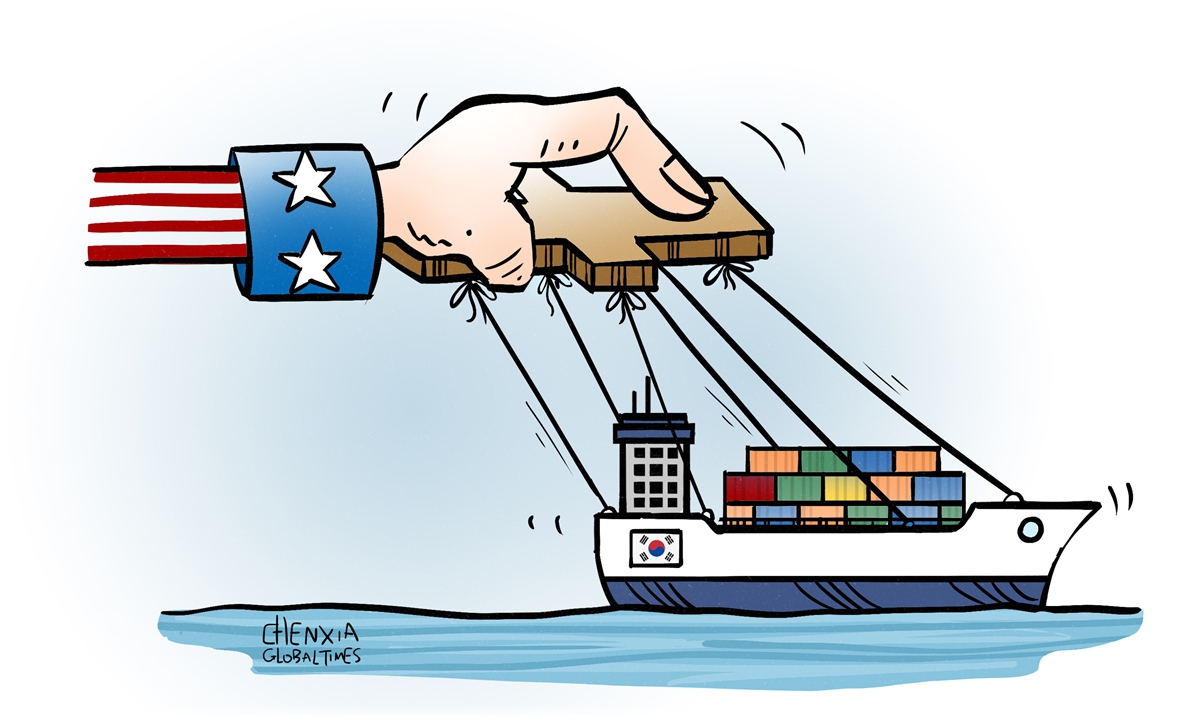
Illustration: Chen Xia/GT
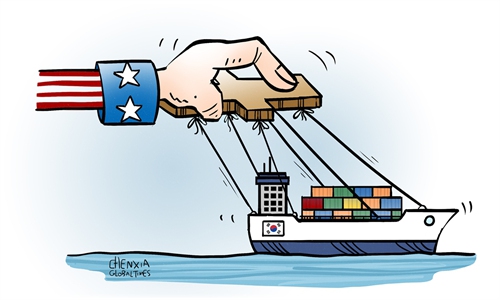
In August, South Korea's exports to the US fell by 12 percent year-on-year, totaling $8.74 billion, Yonhap News Agency reported, citing government data released on Monday. This reportedly marked the most significant decline since May 2020. The decrease contributed to South Korea's overall export growth rate slowing to 1.3 percent, which fell short of some analysts' expectations.While the modest 1.3 percent growth rate in South Korean exports seems largely influenced by external factors such as US tariffs, it also underscores a more profound issue: South Korea's substantial reliance on the US market. This dependency suggests that any disruption in bilateral trade could have a considerable short-term impact on South Korea's trade performance.
For a long time, the risks associated with South Korea's reliance on the US market were largely overlooked. Some in South Korea believed that the strategic relationship between the two countries would provide a degree of stability to their trade ties, or, at the very least, offer South Korea some protection from the broader impact of US tariffs. However, recent developments have challenged this assumption. In July, the US and South Korea struck a trade deal, with a 15 percent tariff on South Korean exports. This has brought to light the vulnerabilities of South Korea's dependence on the US market.
To address this situation, one viable option is to diversify export destinations and strengthen economic ties with markets beyond the US. By tapping into emerging opportunities in regions such as China and ASEAN, South Korea can reduce its dependency on a single market.
Additionally, focusing on industrial upgrades and enhancing the technological content and value-added aspects of its products can boost international competitiveness. This approach not only offers short-term relief but also supports long-term transformation. By improving its export structure and fostering innovation, South Korea can better manage external risks.
According to KBS World Radio News, South Korean Industry Minister Kim Jung-kwan said that the government will announce additional support measures this month to help small businesses minimize the impact of US tariffs and diversify their export destinations. It is anticipated that these efforts will help alleviate the pressures facing South Korean exports.
China is an important export market for South Korea. In light of the challenges posed by US tariffs and sluggish global demand, maintaining and expanding exports to China is a significant factor for the well-being of South Korea's export-driven economy.
According to data from Chinese customs, South Korea's exports to China grew by 0.3 percent year-on-year in the first seven months of the year, and South Korea maintained a trade surplus. Although media reports indicate that, according to South Korean statistics, exports to China fell by 2.9 percent in August, there is still room for growth in bilateral trade that has yet to be fully realized.
First, over the past decade, China's exports to South Korea have shifted from traditional labor-intensive products to high-value-added manufactured goods. Similarly, South Korea's export structure to China has leaned more toward high-end manufacturing. Strengthening cooperation in technology and supply chains within high-end manufacturing sectors such as semiconductors could further expand bilateral trade.
Second, as external uncertainties increase and the pace of industrial adjustments in Asia accelerates, promoting mutual investment could enhance regional supply chains involving economies in China, Japan, South Korea, and ASEAN, thereby boosting intra-regional trade.
Third, efforts to enhance free trade, such as the negotiations on the second phase of bilateral free trade agreement between China and South Korea, may present new opportunities.
Challenges remain on the horizon. One issue for South Korea is determining how to lessen the impact of US influence on its exports to China while enhancing exports of its competitive products, such as semiconductors, to the Chinese market.
The economies of China and South Korea are deeply intertwined, with their supply chains and industries complementing each other significantly. Expanding the potential for trade between the two countries could provide robust support for South Korea, helping it withstand external pressures and sustain its export-driven economic growth.
RELATED ARTICLES