ARTS / CULTURE & LEISURE
2025 Russian Film Festival opens in Beijing, showcasing 8 films to Chinese audiences
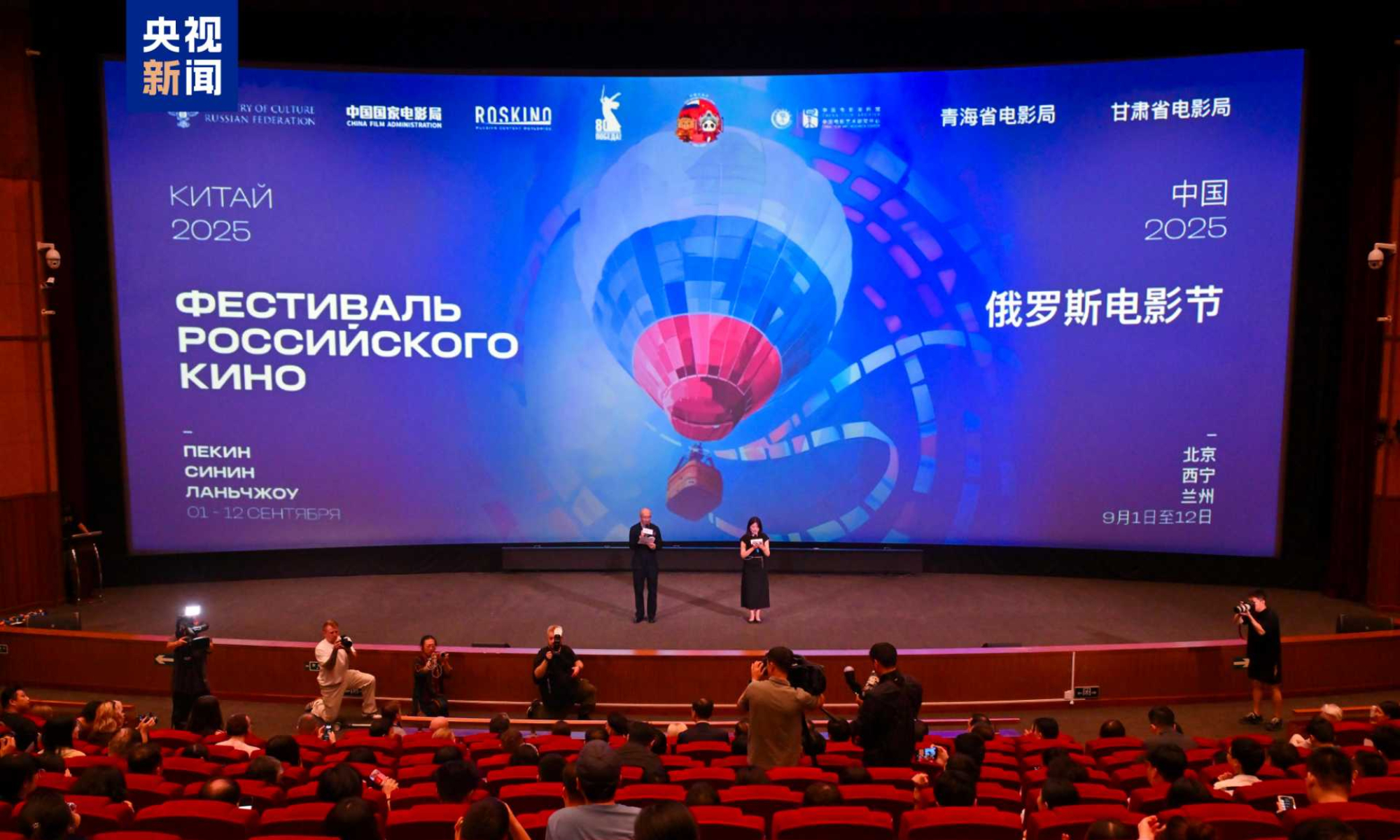
The opening ceremony of the 2025 Russian Film Festival in Beijing on September 1, 2025 Photo: China Media Group
The 2025 Russian Film Festival, jointly organized by the China Film Administration and the Ministry of Culture of the Russian Federation, opened in Beijing on Monday. Chinese and Russian representatives, along with more than 600 attendees, participated in the opening ceremony and watched the festival's opening film, His Name Was Not Listed, according to China Media Group (CMG).
Shen Haixiong, deputy head of the Publicity Department of the Communist Party of China Central Committee and president of CMG, and Olga Lyubimova, Russian Minister of Culture, attended the ceremony and delivered speeches.
This year's Russian Film Festival will be held from September 1 to 12 in Beijing, Xining in Northwest China's Qinghai Province, and Lanzhou in Northwest China's Gansu Province, featuring screenings of eight Russian films covering a wide range of themes and genres, including His Name Was Not Listed, Karuza and The Bremen Town Musicians, according to CMG.
A user of the social media platform Xiaohongshu, or RedNote, with user name Mojito managed to secure tickets in advance for the films Gruppa Krovi and the opening film His Name Was Not Listed. From Monday afternoon to evening, he watched two Russian films back-to-back. Mojito told the Global Times on Tuesday that the Russian films featured in this festival include fantasy, arthouse, and war-themed works, offering Chinese audiences a glimpse into the diversity and latest expressions of Russian cinema. "At the screenings, I noticed many older viewers. They learned Russian when they were young and could deeply resonate with the films' stories," he said.
Mojito was particularly moved after watching Gruppa Krovi. The film, which also tells a story set during World War II, resonated deeply with him. Despite being set in a different country, it shares a profound similarity with Chinese war-themed film Dead to Rights in its portrayal of the faint glimmers of humanity shining through the darkest moments of history.
In his remarks, Shen noted that holding annual film festivals in each other's countries is an important cultural exchange initiative under the China-Russia people-to-people cooperation. He highlighted the upcoming release of the joint Russian-Chinese adventure film Red Silk on September 6 in China as the latest achievement of close collaboration between filmmakers from both countries. Shen expressed confidence that China-Russia film cooperation will continue to deepen and make new contributions to the enrichment of bilateral cultural exchanges.
Lyubimova emphasized in her speech that film festivals are a vital part of cultural diplomacy, helping to tell the stories of each country through the language of art and to foster mutual trust between peoples. She expressed her belief that the Russian films showcased at this festival would resonate with Chinese audiences. These works, she noted, are not only tributes to history but also serve as a spiritual link connecting the peoples of Russia and China, symbolizing their shared historical memories.
Sun Jiashan, a researcher at the Central Academy of Culture and Tourism Administration, told the Global Times that with a foundation of past collaboration, China and Russia have vast potential for deeper cooperation in cinema. Diverse cultural products such as film and esports can help younger audiences in both countries strengthen cultural understanding and share experiences.
This year's film festival is part of the 2024-2025 China-Russia Years of Culture series of events. In May of this year, the two countries held the 2025 Chinese Film Festival in Moscow, Kazan, and St. Petersburg, featuring screenings of eight high-quality Chinese films, including Detective Chinatown 1900 and The Sinking of Lisbon Maru, according to CMG.
RELATED ARTICLES