Trump calls trade with India 'a totally one sided disaster’; Indian media says US increases pressure on New Delhi lately
By Published: Sep 02, 2025 12:24 PM

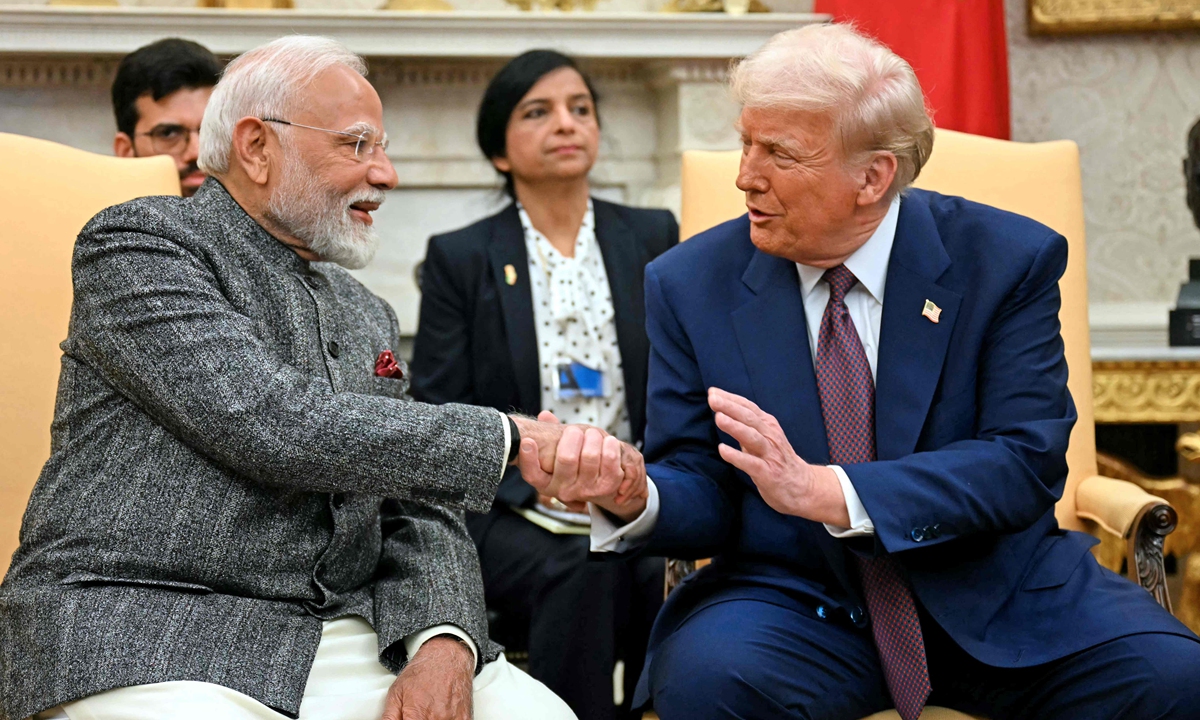
US President Donald Trump and Indian Prime Minister Narendra Modi meet in the Oval Office of the White House in Washington, DC, on February 13, 2025. Photo: VCG
US President Donald Trump on Monday doubled down on his criticism of India, calling trade ties with the country "a totally one-sided disaster," some US media reported.
Trump in a post on Truth Social said that India had offered to cut its tariffs to zero, but it was "getting late," and that the country should have done so "years ago," without elaborating on when such an offer was made, according to CNBC.
This comes against the backdrop of the US imposing 50 percent tariffs on the country, including secondary duties of 25 percent last month for purchasing Russian oil, which India has called "unfair, unjustified and unreasonable," CNBC said.
Some Indian media outlets pointed out that in recent days, officials from the Trump administration have increased public pressure on India. However, just as Trump issued his latest threat, Indian Prime Minister Narendra Modi had just concluded his visit to China to attend the Shanghai Cooperation Organization summit in Tianjin.
Reuters reported that under Trump's trade pressure, Modi publicly demonstrated solidarity with the leaders of China and Russia.
The Hindustan Times pointed out that trade talks between India and the US suffered a setback in August when an expected visit by an American delegation was abruptly put off amid rising tensions.
Trump reiterated that India was buying oil and arms from Russia and accused New Delhi of selling the US a "massive amounts of goods" but imposing high tariffs on US exports to India, CNBC said.
Trump's trade advisor Peter Navarro previously renewed his criticism of India, which sparked a strong reaction from the Indian side. Labelling New Delhi as "nothing but a laundromat for the Kremlin," Navarro, in an interview with Fox News, alleged that the Brahmins were profiteering at the "expense of the Indian people," the Indian Express reported.
Navarro's statement was perhaps the sharpest so far, prompting pushback from Sanjeev Sanyal, a member of Modi's Economic Advisory Council, as well as opposition leaders, including the Congress' Pawan Khera and Shiv Sena's Priyanka Chaturvedi, according to NDTV.
As part of trade negotiations, India had expressed willingness to offer zero tariffs on some goods like auto components and pharmaceuticals, while barriers on sectors like agriculture and dairy remained red lines it would not breach, Bloomberg News reported earlier.
India has made several moves this year, including overhauling its tariff regime to reduce import duties on prominent American goods like bourbon whiskey and high-end motorcycles made by Harley-Davidson, Bloomberg said.
The 50 percent tariffs on Indian goods, which came into effect last week, are expected to impact around $48 billion products including precious gems, textiles and shrimps, NDTV said.
The Indian government called for calm and said it is working on measures to offset any problems arising from the tariffs, including offering affected companies and sectors aid, and expanding export markets, according to the Indian media report.
Long Xingchun, a professor from the School of International Relations at Sichuan International Studies University, told the Global Times on Tuesday that he believes the US government's recent tough rhetoric toward India is more of a negotiation tactic to use maximum pressure to increase bargaining leverage.
Long said that by strengthening ties with Russia and China, and leveraging the platform of the SCO, India is also enhancing its bargaining position in negotiations with the US.
RELATED ARTICLES