China, Malaysia eye broader cooperation from tropical fruits to semiconductors: Malaysian business leader
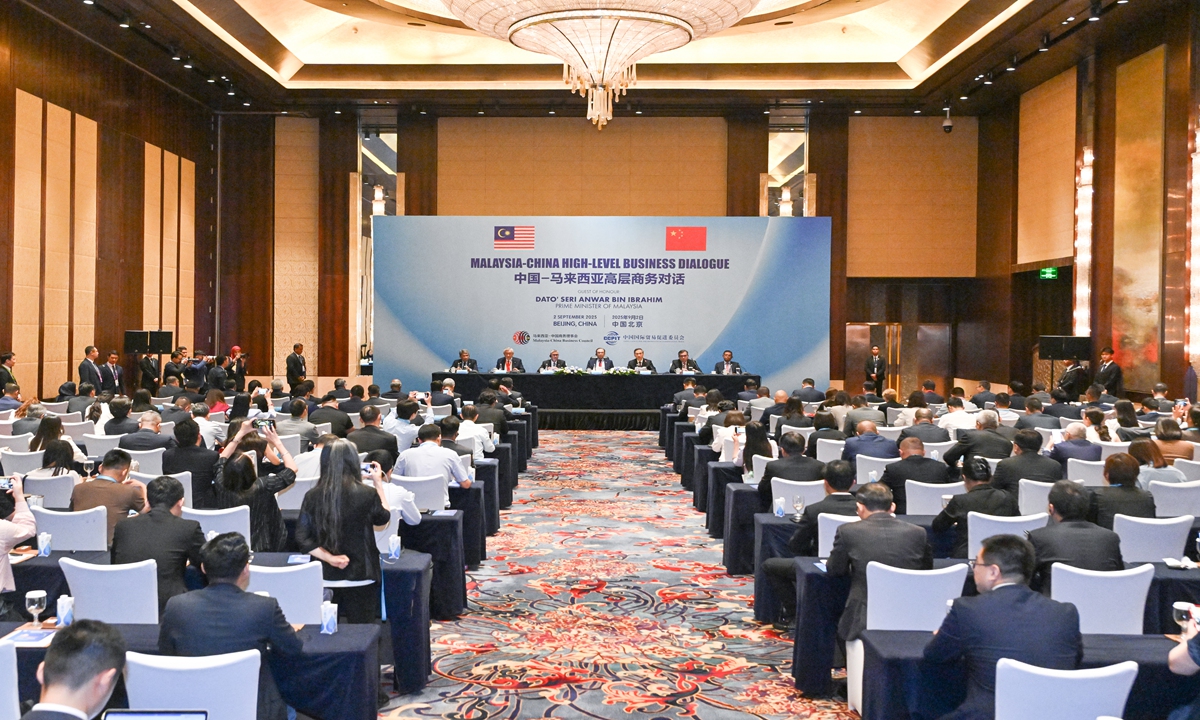
Malaysia-China high-level business dialogue is held in Beijing on September 2, 2025. Photo: Courtesy of China Council for the Promotion of International Trade
Malaysia-China high-level business dialogue was held in Beijing on Tuesday, attended by Low Kian Chuan, president of the Malaysia-China Business Council, who also spoke to the media on the sidelines of the event.
Low Kian Chuan, told the Global Times that while China has been Malaysia's largest trading partner for 16 consecutive years, the potential for bilateral economic cooperation remains immense, especially in emerging areas such as the green economy, artificial intelligence and modern agriculture. "These are sectors where Malaysia can benefit from China's technological strengths, and where small and medium-sized enterprises on both sides can find new opportunities along the supply chain," he said.
Low stressed that Malaysia continues to offer unique advantages to Chinese investors. With its strategic location in Southeast Asia, robust legal framework and a large ethnic Chinese community, the country provides a welcoming environment where Mandarin and dialects are widely spoken, and cultural barriers are minimal. "From food to language to education, Malaysia makes it easier for Chinese businesses and their families to settle and operate," he noted. International schools and Chinese schools coexist, offering education options that further attract investors.
On the other hand, Low pointed out that the Chinese market is equally appealing to Malaysian companies, particularly in the food sector. "China's large population represents a vast market for our tropical fruits and food products," he said. Malaysia's small and medium-sized enterprises, he added, often see China as the most accessible and promising destination to demonstrate their competitiveness.
Despite external uncertainties, including US trade measures, Low believes China and Malaysia should continue to strengthen their mutually beneficial partnership and foster greater cultural understanding. He highlighted that Malaysia has embraced China's Belt and Road Initiative (BRI), citing the East Coast Rail Link (ECRL) as a landmark project that is bringing tangible benefits to both sides.
Looking ahead, Low noted that Malaysia's northern region has built a strong semiconductor industry over the past 50 years, providing the country with a solid industrial base. (Penang, located in northern Malaysia, is widely regarded as the nation's semiconductor hub.) With China holding significant advantages in artificial intelligence (AI) and integrated circuit (IC) design, he sees strong complementarities between the two economies.
"We want to move up the value chain and transform Malaysia into a regional hub for semiconductors, and collaboration with China will be vital to achieving this," Low said. He added that the timing for bilateral cooperation has never been better, noting the frequent high-level exchanges between the two governments in recent years. "This is the best period in the history of Malaysia-China friendship," Low remarked. "With shared commitment and joint efforts, we can turn this friendship into deeper economic collaboration for the future."
Global Times
RELATED ARTICLES