IN-DEPTH / IN-DEPTH
From participant to reporter: At China’s grand V-Day military parade, I share tears of joy, sense of pride with them
By Published: Sep 04, 2025 09:37 PM


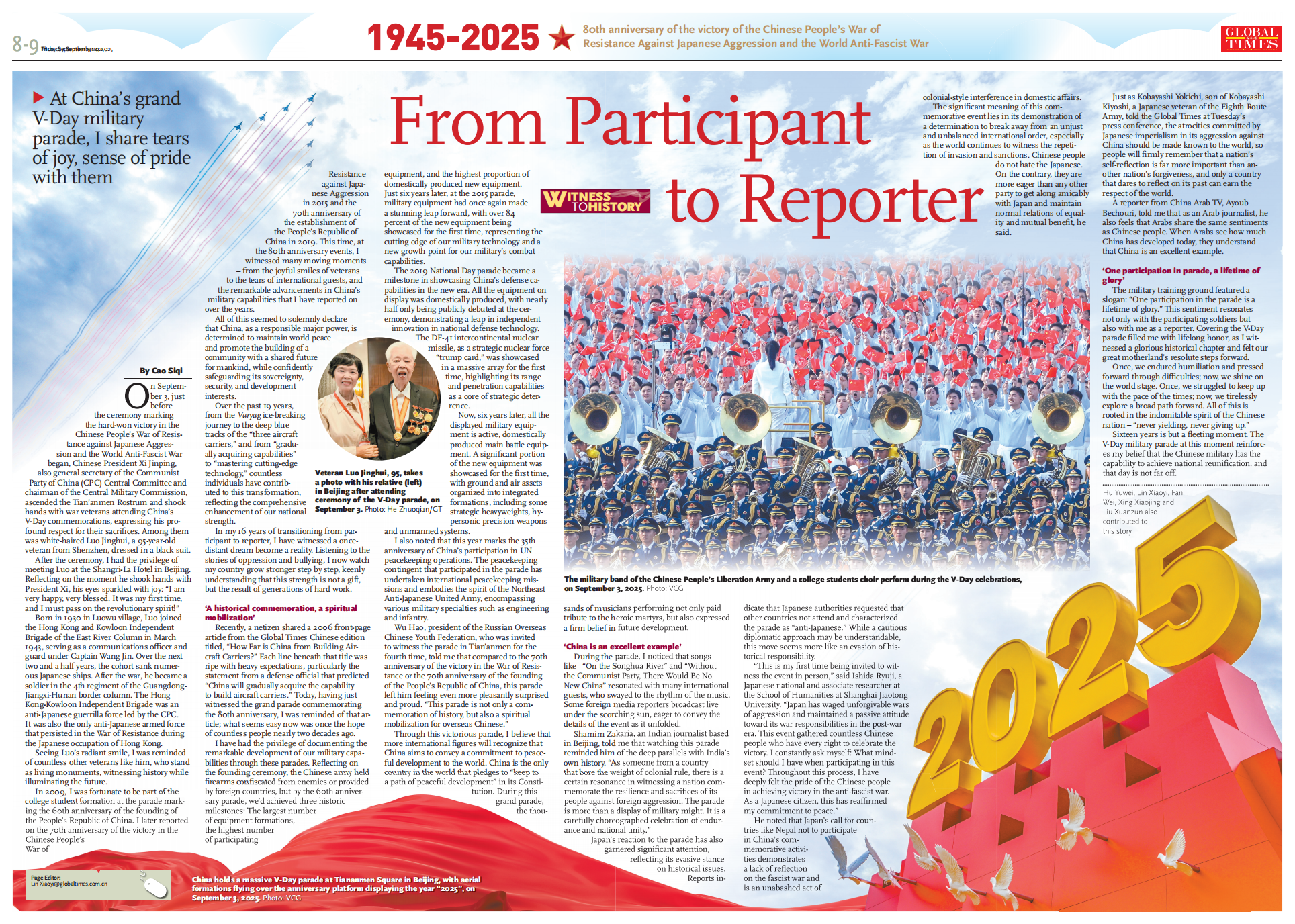
China holds a massive V-Day parade at Tiananmen Square in Beijing, with aerial formations flying over the anniversary platform displaying the year "2025", on September 3, 2025. Photo: VCG
On September 3, just before the ceremony marking the hard-won victory in the Chinese People's War of Resistance against Japanese Aggression and the World Anti-Fascist War began, Chinese President Xi Jinping, also general secretary of the Communist Party of China (CPC) Central Committee and chairman of the Central Military Commission, ascended the Tian'anmen Rostrum and shook hands with war veterans attending China's V-Day commemorations, expressing his profound respect for their sacrifices. Among them was white-haired Luo Jinghui, a 95-year-old veteran from Shenzhen, dressed in a black suit.After the ceremony, I had the privilege of meeting Luo at the Shangri-La Hotel in Beijing. Reflecting on the moment he shook hands with President Xi, his eyes sparkled with joy: "I am very happy, very blessed. It was my first time, and I must pass on the revolutionary spirit!"
Born in 1930 in Luowu village, Luo joined the Hong Kong and Kowloon Independent Brigade of the East River Column in March 1943, serving as a communications officer and guard under Captain Wang Jin. Over the next two and a half years, the cohort sank numerous Japanese ships. After the war, he became a soldier in the 4th regiment of the Guangdong-Jiangxi-Hunan border column. The Hong Kong-Kowloon Independent Brigade was an anti-Japanese guerrilla force led by the CPC. It was also the only anti-Japanese armed force that persisted in the War of Resistance during the Japanese occupation of Hong Kong.
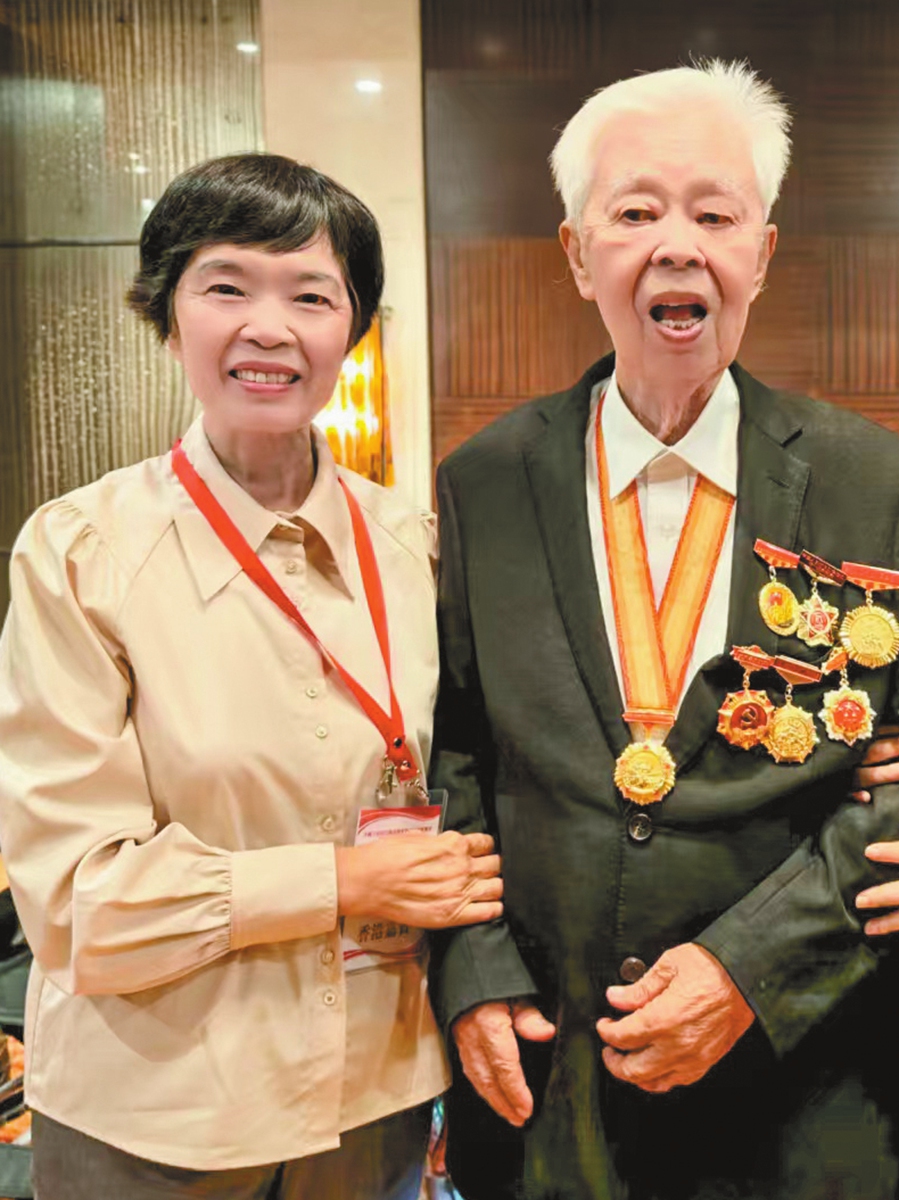
Veteran Luo Jinghui, 95, takes a photo with his relative (left) in Beijing after attending ceremony of the V-Day parade, on September 3. Photo: He Zhuoqian/GT
Seeing Luo's radiant smile, I was reminded of countless other veterans like him, who stand as living monuments, witnessing history while illuminating the future.In 2009, I was fortunate to be part of the college student formation at the parade marking the 60th anniversary of the founding of the People's Republic of China. I later reported on the 70th anniversary of the victory in the Chinese People's War of Resistance against Japanese Aggression in 2015 and the 70th anniversary of the establishment of the People's Republic of China in 2019. This time, at the 80th anniversary events, I witnessed many moving moments - from the joyful smiles of veterans to the tears of international guests, and the remarkable advancements in China's military capabilities that I have reported on over the years.
All of this seemed to solemnly declare that China, as a responsible major power, is determined to maintain world peace and promote the building of a community with a shared future for mankind, while confidently safeguarding its sovereignty, security, and development interests.
Over the past 19 years, from the Varyag ice-breaking journey to the deep blue tracks of the "three aircraft carriers," and from "gradually acquiring capabilities" to "mastering cutting-edge technology," countless individuals have contributed to this transformation, reflecting the comprehensive enhancement of our national strength.
In my 16 years of transitioning from participant to reporter, I have witnessed a once-distant dream become a reality. Listening to the stories of oppression and bullying, I now watch my country grow stronger step by step, keenly understanding that this strength is not a gift, but the result of generations of hard work.
'A historical commemoration, a spiritual mobilization'
Recently, a netizen shared a 2006 front-page article from the Global Times Chinese edition titled, "How Far is China from Building Aircraft Carriers?" Each line beneath that title was ripe with heavy expectations, particularly the statement from a defense official that predicted "China will gradually acquire the capability to build aircraft carriers." Today, having just witnessed the grand parade commemorating the 80th anniversary, I was reminded of that article; what seems easy now was once the hope of countless people nearly two decades ago.
I have had the privilege of documenting the remarkable development of our military capabilities through these parades. Reflecting on the founding ceremony, the Chinese army held firearms confiscated from enemies or provided by foreign countries, but by the 60th anniversary parade, we'd achieved three historic milestones: The largest number of equipment formations, the highest number of participating equipment, and the highest proportion of domestically produced new equipment. Just six years later, at the 2015 parade, military equipment had once again made a stunning leap forward, with over 84 percent of the new equipment being showcased for the first time, representing the cutting edge of our military technology and a new growth point for our military's combat capabilities.
The 2019 National Day parade became a milestone in showcasing China's defense capabilities in the new era. All the equipment on display was domestically produced, with nearly half only being publicly debuted at the ceremony, demonstrating a leap in independent innovation in national defense technology. The DF-41 intercontinental nuclear missile, as a strategic nuclear force "trump card," was showcased in a massive array for the first time, highlighting its range and penetration capabilities as a core of strategic deterrence.
Now, six years later, all the displayed military equipment is active, domestically produced main battle equipment. A significant portion of the new equipment was showcased for the first time, with ground and air assets organized into integrated formations, including some strategic heavyweights, hypersonic precision weapons and unmanned systems.
I also noted that this year marks the 35th anniversary of China's participation in UN peacekeeping operations. The peacekeeping contingent that participated in the parade has undertaken international peacekeeping missions and embodies the spirit of the Northeast Anti-Japanese United Army, encompassing various military specialties such as engineering and infantry.
Wu Hao, president of the Russian Overseas Chinese Youth Federation, who was invited to witness the parade in Tian'anmen for the fourth time, told me that compared to the 70th anniversary of the victory in the War of Resistance or the 70th anniversary of the founding of the People's Republic of China, this parade left him feeling even more pleasantly surprised and proud. "This parade is not only a commemoration of history, but also a spiritual mobilization for overseas Chinese."
Through this victorious parade, I believe that more international figures will recognize that China aims to convey a commitment to peaceful development to the world. China is the only country in the world that pledges to "keep to a path of peaceful development" in its Constitution. During this grand parade, the thousands of musicians performing not only paid tribute to the heroic martyrs, but also expressed a firm belief in future development.
'China is an excellent example'
During the parade, I noticed that songs like "On the Songhua River" and "Without the Communist Party, There Would Be No New China" resonated with many international guests, who swayed to the rhythm of the music. Some foreign media reporters broadcast live under the scorching sun, eager to convey the details of the event as it unfolded.
Shamim Zakaria, an Indian journalist based in Beijing, told me that watching this parade reminded him of the deep parallels with India's own history. "As someone from a country that bore the weight of colonial rule, there is a certain resonance in witnessing a nation commemorate the resilience and sacrifices of its people against foreign aggression. The parade is more than a display of military might. It is a carefully choreographed celebration of endurance and national unity."
Japan's reaction to the parade has also garnered significant attention, reflecting its evasive stance on historical issues. Reports indicate that Japanese authorities requested that other countries not attend and characterized the parade as "anti-Japanese." While a cautious diplomatic approach may be understandable, this move seems more like an evasion of historical responsibility.
"This is my first time being invited to witness the event in person," said Ishida Ryuji, a Japanese national and associate researcher at the School of Humanities at Shanghai Jiaotong University. "Japan has waged unforgivable wars of aggression and maintained a passive attitude toward its war responsibilities in the post-war era. This event gathered countless Chinese people who have every right to celebrate the victory. I constantly ask myself: What mindset should I have when participating in this event? Throughout this process, I have deeply felt the pride of the Chinese people in achieving victory in the anti-fascist war. As a Japanese citizen, this has reaffirmed my commitment to peace."
He noted that Japan's call for countries like Nepal not to participate in China's commemorative activities demonstrates a lack of reflection on the fascist war and is an unabashed act of colonial-style interference in domestic affairs.
The significant meaning of this commemorative event lies in its demonstration of a determination to break away from an unjust and unbalanced international order, especially as the world continues to witness the repetition of invasion and sanctions. Chinese people do not hate the Japanese. On the contrary, they are more eager than any other party to get along amicably with Japan and maintain normal relations of equality and mutual benefit, he said.
Just as Kobayashi Yokichi, son of Kobayashi Kiyoshi, a Japanese veteran of the Eighth Route Army, told the Global Times at Tuesday's press conference, the atrocities committed by Japanese imperialism in its aggression against China should be made known to the world, so people will firmly remember that a nation's self-reflection is far more important than another nation's forgiveness, and only a country that dares to reflect on its past can earn the respect of the world.
A reporter from China Arab TV, Ayoub Bechouri, told me that as an Arab journalist, he also feels that Arabs share the same sentiments as Chinese people. When Arabs see how much China has developed today, they understand that China is an excellent example.
'One participation in parade, a lifetime of glory'
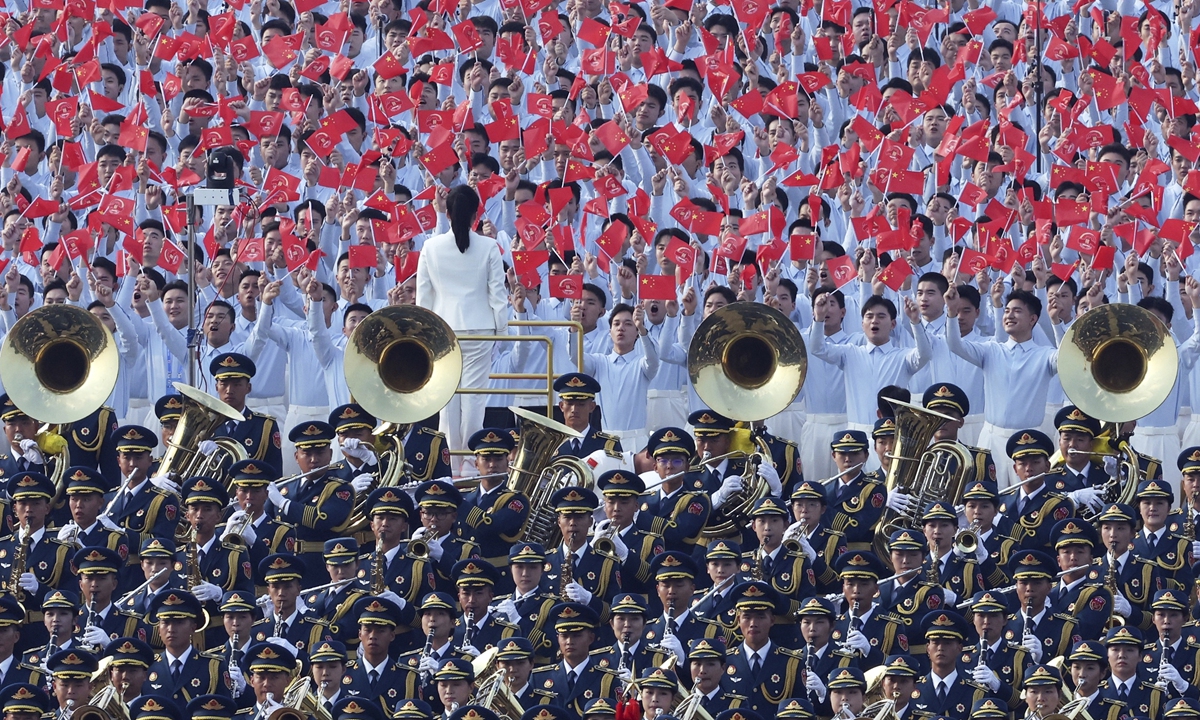
The military band of the Chinese People's Liberation Army and a college students choir perform during the V-Day celebrations, on September 3, 2025. Photo: VCG
The military training ground featured a slogan: "One participation in the parade is a lifetime of glory." This sentiment resonates not only with the participating soldiers but also with me as a reporter. Covering the V-Day parade filled me with lifelong honor, as I witnessed a glorious historical chapter and felt our great motherland's resolute steps forward.Once, we endured humiliation and pressed forward through difficulties; now, we shine on the world stage. Once, we struggled to keep up with the pace of the times; now, we tirelessly explore a broad path forward. All of this is rooted in the indomitable spirit of the Chinese nation - "never yielding, never giving up."
Sixteen years is but a fleeting moment. The V-Day military parade at this moment reinforces my belief that the Chinese military has the capability to achieve national reunification, and that day is not far off.
RELATED ARTICLES