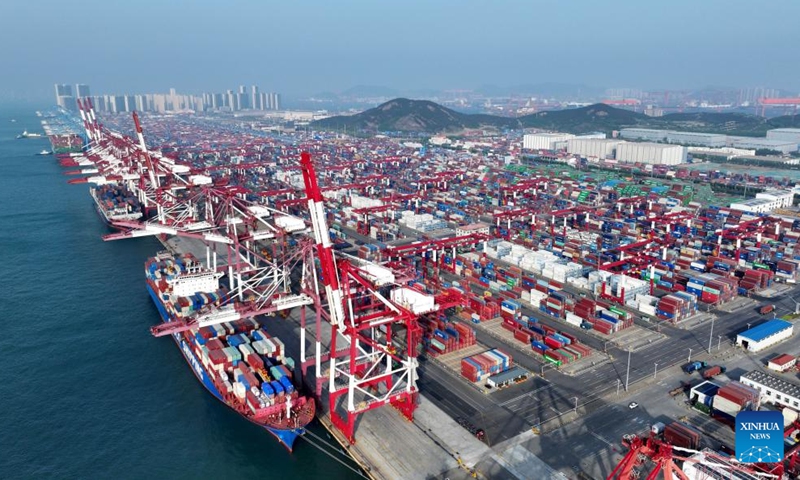
An aerial drone photo taken on April 30, 2025 shows cargo ships berthing at a container dock of Qingdao Port in Qingdao, east China's Shandong Province. This year, Qingdao port has actively expanded its international shipping routes, especially for the Association of Southeast Asian Nations (ASEAN). The direct cargo shipping routes from Qingdao Port to the ASEAN countries has increased to 50, with the cargo volume from Qingdao to ASEAN countries up six percent year-on-year in the first quarter of this year. (Xinhua/Li Ziheng)
China has recently hosted a series of high-profile diplomatic events, including the Shanghai Cooperation Organization summit in Tianjin, and the Commemoration of the 80th Anniversary of the Victory of the Chinese People's War of Resistance against Japanese Aggression and the World Anti-Fascist War in China, drawing numerous foreign dignitaries.
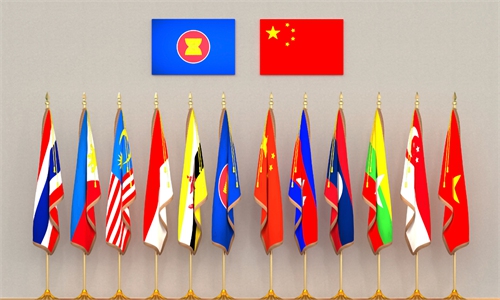
Media outlets in the ASEAN highlighted calls for deeper infrastructure cooperation with China, which experts said reflects the region's confidence in China's development experience and resources.
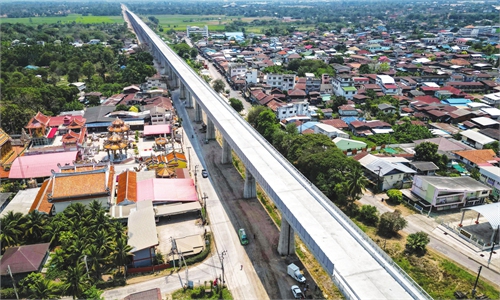
Singapore's Lianhe Zaobao reported on Wednesday that Indonesia and Malaysia have each opened talks with China on major infrastructure projects. Indonesia is discussing with China the construction of an $80-billion mega seawall on Java Island, while Malaysia is preparing to negotiate the extension of the East Coast Rail Link (ECRL) to the Malaysia-Thailand border.
Indonesian President Prabowo Subianto said he would form an agency to run the giant seawall project, stretching from Banten to East Java, which could take 20 years to complete, Reuters reported.
And, the proposal to extend the ECRL project to Rantau Panjang, Kelantan, bordering Thailand, remains in initial discussion stage, Malaysian Prime Minister Dato' Seri Anwar Ibrahim said.
"We hope that with this and a station there, the development and business ecosystem can be improved," the prime minister said.
"ASEAN countries attach great importance to communication with China on large-scale infrastructure projects because China's development model offers valuable inspiration," Xu Liping, director of the Center for Southeast Asian Studies at the Chinese Academy of Social Sciences, told the Global Times.
"In China's modernization process, infrastructure has played a pivotal role. Although the investment cycle can be long, the impact on economic growth and social connectivity is profound. Once completed, such projects help improve the flow of information, goods and people, driving qualitative changes in economy," Xu said.
Xu noted that in China's experience, infrastructure construction has always been coordinated with the planning of industrial parks and development corridors, avoiding the drawback of "building first, planning later."
"Given ASEAN's own shortfalls in large-scale infrastructure, the region is eager to learn from China's experience, technology and expertise to break through development bottlenecks," he said.
"The projects were initiated by ASEAN countries, reflecting their urgent need for infrastructure development, while also showing recognition of China's capability in this field," Zhou Mi, a senior research fellow at the Chinese Academy of International Trade and Economic Cooperation, told the Global Times on Thursday.
Zhou noted that Chinese companies play an important role in global infrastructure, and the government encourages them to expand cooperation overseas.
"In trade and economic cooperation, China and ASEAN share broad common interests built up over many decades," Zhou added. "The two sides have developed complementary industrial chains and mutual supply chain support. ASEAN countries provide raw materials and intermediate goods, while China offers equipment, consumer products and market access. This complementary relationship helps both sides reduce exposure to external risks."
Global Times
RELATED ARTICLES