US plans curbs on imports of Chinese drones, heavy-duty vehicles; expert decries ‘national security’ abuse to disrupt global supply chain
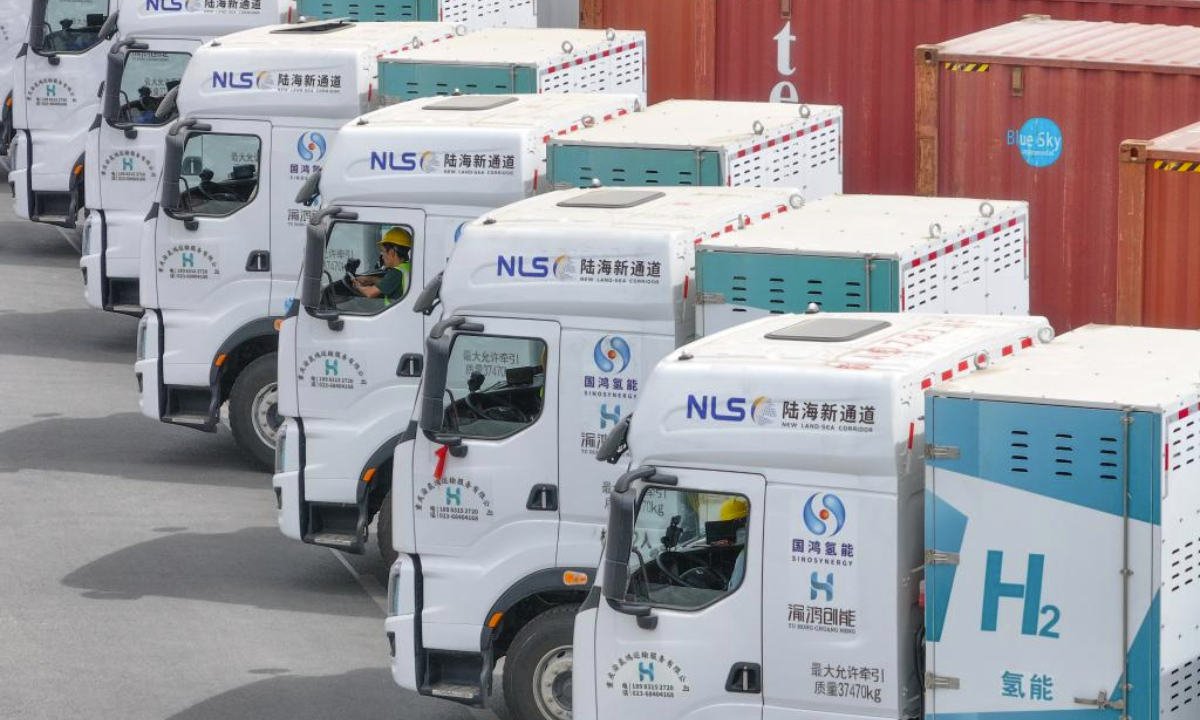
An aerial drone photo taken on April 14, 2025 shows hydrogen-powered heavy-duty trucks awaiting departure from the dry port of the New International Land-Sea Trade Corridor in Chongqing, southwest China. China's first cross-region hydrogen heavy-duty truck route was launched on Monday, marking a milestone in terms of advancing hydrogen energy development in China's western regions. The route, now operational for regular freight services via hydrogen-powered heavy-duty trucks, spans 1,150 kilometers from southwest China's Chongqing Municipality to Qinzhou Port in south China's Guangxi Zhuang Autonomous Region, passing through southwestern Guizhou Province. (Photo: Xinhua)
The Trump administration plans to issue rules to restrict or potentially bar imports of Chinese drones and medium and heavy-duty vehicles after an earlier crackdown on cars and trucks, citing national security concerns, Reuters reported on Friday. A Chinese expert labeled this plan as another potential trade barrier under the guise of "national security," accusing the US of smearing Chinese products without evidence.The expert said that such unreasonable restrictions would further disrupt global supply chain stability and ultimately backfire on US domestic industries.
The US Commerce Department on Friday said it plans to issue rules as soon as this month to address national security risks involving information and communications technology that is integral to drones, and their supply chain, as well as vehicles weighing more than 10,000 pounds from countries like China and other foreign adversaries, according to Reuters.
The US Commerce Department did not give details on what the import rules would be, the Reuters report said.
"The US government has long been inclined to target Chinese firms and smear Chinese products without providing any evidence, which inevitably raises concerns about the legitimacy of its possible moves," Zhou Mi, a senior researcher at the Chinese Academy of International Trade and Economic Cooperation, told the Global Times on Saturday.
The US has abused the concept of "national security" to impose restrictions on normal trade activities, seriously undermining the stability of the global trade system and disrupting legitimate commercial exchanges, Zhou said, adding that such measures will not genuinely protect US domestic interests.
"Instead, they will raise operational costs and expose economic activities to greater risks, running counter to the policy's stated objectives," he cautioned.
The latest move adds to Washington's years-long practice of imposing unreasonable curbs on Chinese imports under the guise of national security. The planned restrictions on drones and heavy-duty vehicles follow similar rules already scheduled for imports of cars and other trucks.
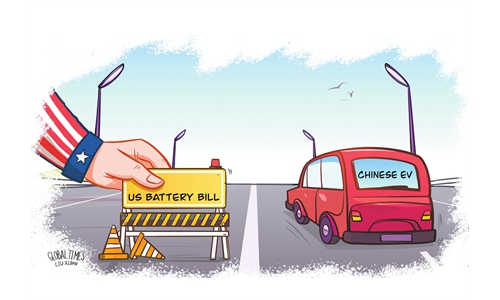
The US administration finalized rules in January that will effectively bar nearly all Chinese cars and trucks from the US market starting in late 2026, as part of a crackdown on vehicle software and hardware from China, according to Reuters.
In another unilateral move, the US Commerce Department opened national security investigations into the import of drones and related components in July and into medium and heavy-duty vehicles and parts in April, which could lead to higher tariffs, Reuters reported.
China firmly opposes the US overstretching the concept of national security, which disrupts and restricts normal economic and trade exchanges, and undermines the security and stability of the global industrial and supply chains, Chinese Foreign Ministry spokesperson Mao Ning said in January in response to the US government considering a new rule that could restrict or ban Chinese drones in the US, citing national security concerns.
The ministry also vowed to take all measures necessary to firmly safeguard our lawful rights and interests.
Zhou stressed that Chinese drones and heavy trucks have clear competitive advantages in performance, quality and price. "Their entry into the US market reflects genuine domestic demand as well as choices made after global comparisons," he noted.
Chinese drone giant DJI has a 90 percent share in the US commercial market, according to the Centre for Strategic and International Studies, a Washington-based think tank. Demand for drones in the US is expected to increase in the US, especially in the farming, construction, maritime and industrial sectors, South China Morning Post reported in July.
Apart from DJI's dominance, Chinese firms also lead in the production of drone components, with many foreign manufacturers relying on suppliers in China for parts they cannot source elsewhere, according to market research firm Drone Industry Insights.
In areas such as environmental surveys, wildlife protection and resource development, suitable alternatives are especially hard to find, Zhou emphasized. "If imports of such products are restricted, US importers will struggle to find substitutes and will inevitably face fewer choices, higher costs and declining reliability," he noted.
RELATED ARTICLES