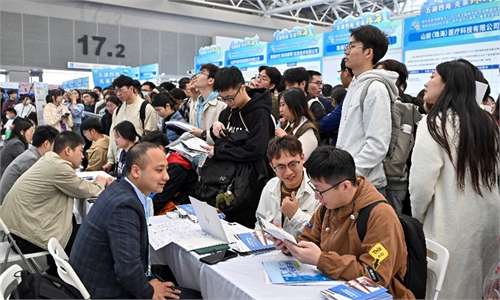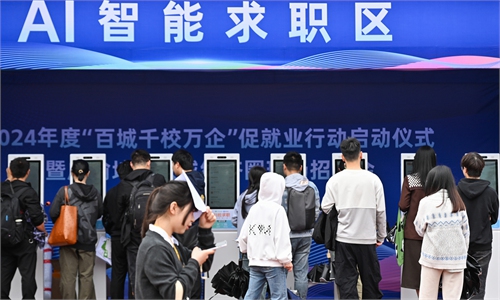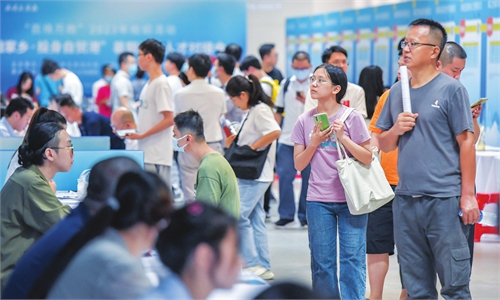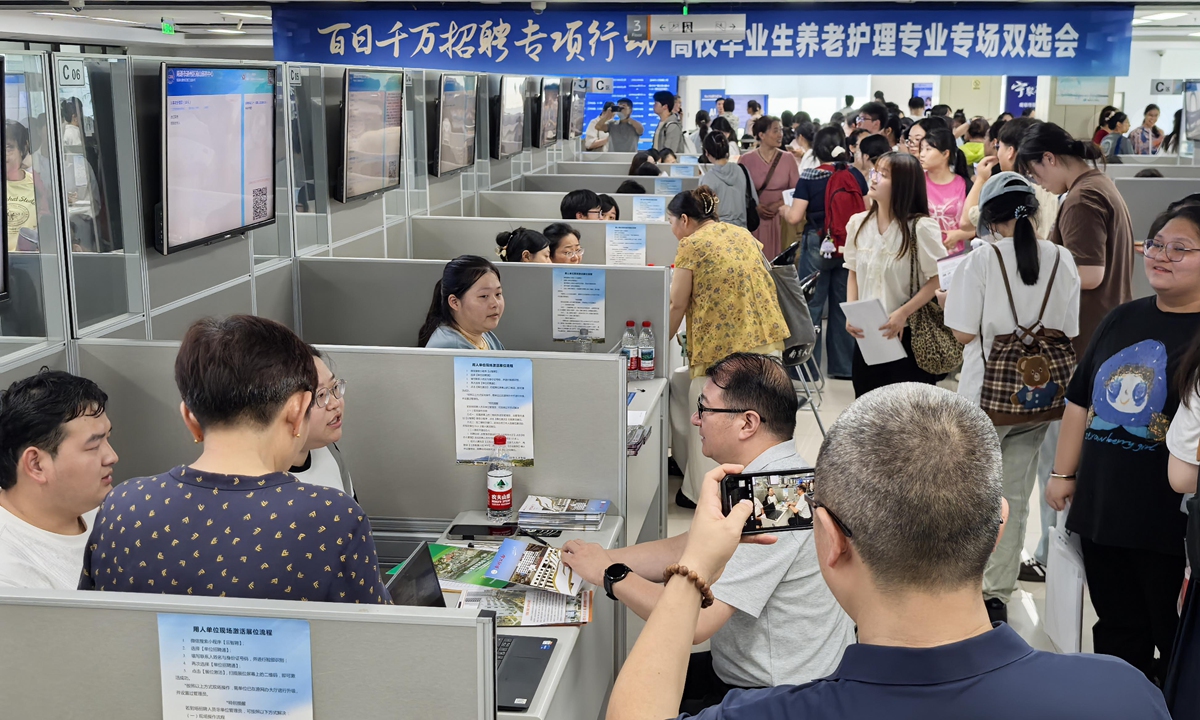
Job seekers attend a comprehensive job fair for university graduates and a special recruitment session for elderly care professionals in Nanjing, East China's Jiangsu Province, on July 5, 2025. Photo: VCG
China's nationwide urban recruitment campaign - for university graduates of the 2025 cohort and those from previous years - kicked off on Saturday its autumn season with a high-profile job fair in Urumqi, Northwest China's Xinjiang Uygur Autonomous Region, which analysts said marks a robust start to the country's efforts to bolster employment for young talent.
Organized by the Ministry of Human Resources and Social Security (MOHRSS), the event drew more than 20,000 attendees and featured more than 500 enterprises and institutions, offering more than 15,000 jobs across key sectors such as energy resources, commerce and logistics, information technology, and advanced manufacturing, according to CCTV News on Sunday.
The event site also introduced an artificial intelligence-powered smart interview cabin, providing college graduates with personalized, precise, and intelligent employment support services such as talent assessment, mock interviews, and resume optimization, the report said.
Running through November, the nationwide autumn recruitment campaign will feature comprehensive and specialized job fairs across major cities, mainly targeting university graduates while focusing on emerging sectors like new quality productive forces, consumer hot spots, and essential public services.
The campaign reflects China's proactive approach to boosting youth employment, Li Chang'an, a professor at the Academy of China Open Economy Studies at the University of International Business and Economics, told the Global Times.
"To promote employment, governments at all levels have introduced policies, whose efforts will continue to intensify this year," said Li.
To further support graduates, multiple provinces have introduced one-time employment subsidies for eligible candidates. For example, Southwest China's Guizhou Province will subsidize the relevant expenses of graduates in difficulty during their job search process, at a standard amount of 1,500 yuan ($210.3) per person. Central China's Henan will hand out a one-time subsidy of 2,000 yuan.
An official said at a press conference on April 28 that the MOHRSS and the Ministry of Finance recently allocated 66.7 billion yuan of central employment assistance funds to ensure the implementation of the policies to boost employment.
To promote employment and entrepreneurship among college graduates, in addition to the one-time job-seeking subsidy, local governments have introduced measures, such as vocational training subsidies and one-time entrepreneurship subsidies.
Apart from financial support, Chinese authorities are enhancing vocational training to meet evolving corporate needs to align with industrial upgrades.
Improving workers' skills is critical to supporting industrial development. By fostering diverse employment channels and aligning with national innovation goals, relevant policies not only address immediate job needs but also strengthen China's global competitiveness in cutting-edge industries, Wang Peng, associate research fellow at the Beijing Academy of Social Sciences, told the Global Times on Sunday.
In April, the MOHRSS and the ministries of education and finance issued a circular to support 2025 college graduates and youth, highlighting their value as human resources.
The circular also aims to train 1 million graduates and youths in 2025 to improve their employability, according to the Xinhua News Agency.
Starting this year and continuing for three years, China's annual vocational skills training subsidies will benefit more than 10 million trainees, with a focus on key areas such as healthcare, eldercare and infant care, advanced manufacturing, modern services, and emerging professions, Xinhua reported.
This year's Government Work Report set a target of creating more than 12 million new urban jobs in 2025, with an aim to keep the surveyed urban unemployment rate at about 5.5 percent for the year.
In the first half of 2025, 6.95 million new jobs were created in urban areas across the country, meeting 58 percent of the annual target, official data showed.
RELATED ARTICLES