China’s foreign trade up 3.5% in first 8 months, showcasing strong resilience despite external volatility
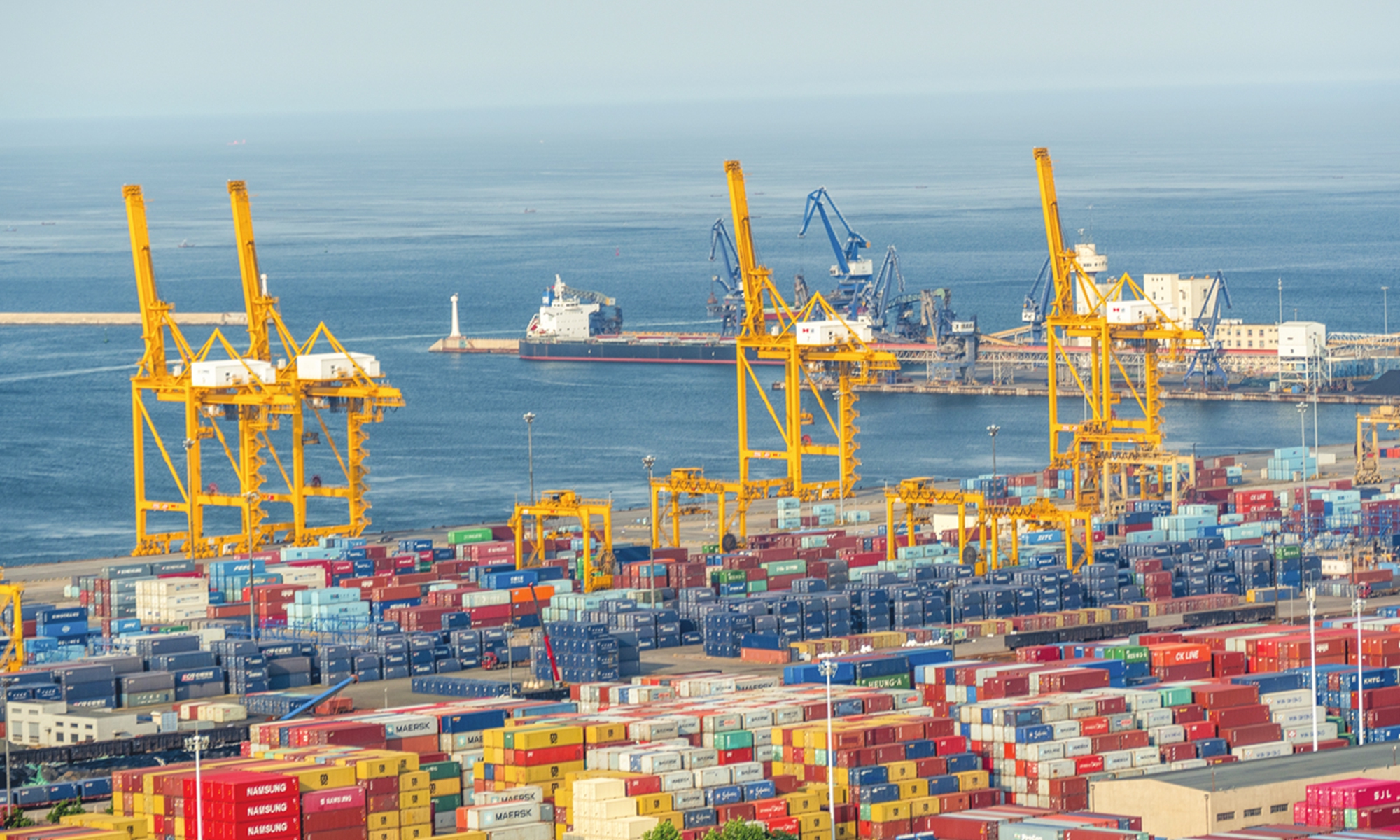
An aerial view of Dalian Port, Northeast China's Liaoning Province. Photos: VCG
China's foreign trade in goods remained steady in the first eight months of this year, with total imports and exports in yuan-denominated terms growing by 3.5 percent year-on-year to reach 29.57 trillion yuan ($4.14 trillion), the General Administration of Customs (GAC) announced on Monday. Despite lingering pressure from a complex external environment, analysts remain optimistic about the stable growth of China's foreign trade thanks to policy support, innovation and market diversification.
The growth rate accelerated by 0.6 percentage points from the reading for the first six months, said Lü Daliang, director of the Department of Statistics and Analysis of the GAC.
"Despite a challenging external environment, China's foreign trade has remained quite resilient while greater potential continues to be unleashed," Lü said.
This fully confirms that China's industrial system advantages continue to gain international market recognition amid the current global economic environment. Countries are actively expanding imports from China, particularly electromechanical products and high-tech products, to meet critical demand for their economic development, He Weiwen, a senior fellow at the Center for China and Globalization, told the Global Times on Monday, while pointing out multiple highlights in the country's foreign trade sector in August.
Customs data showed a stable performance in foreign trade for August, with total goods trade rising 3.5 percent year-on-year. Exports jumped 4.8 percent, while imports climbed 1.7 percent to mark the third consecutive month of growth.
In the first eight months, exports were mainly driven by mechanical and electrical products, which accounted for about 60.2 percent of China's total exports. Notably, exports of automatic data processing equipment and parts grew by 0.6 percent year-on-year to reach 946.6 billion yuan, with those of integrated circuits soaring by 23.3 percent and vehicle exports growing 11.9 percent, according to the GAC.
"The accelerated exports of machinery and high-end products underscore the further improvement of China's foreign trade structure and the resilience of China's manufacturing sector, which will help the country's export-oriented companies navigate external challenges," He said.
On the import side, while volumes of certain bulk energy commodities declined, crude oil and soybeans rose.
The import value of mechanical and electrical products recorded steady growth.
ASEAN retained its position as China's largest trading partner in the first eight months of 2025, with bilateral trade growing 9.7 percent year-on-year, accounting for 16.7 percent of the country's total foreign trade. The EU ranked second, with trade up by 4.3 percent year-on-year, accounting for 13.1 percent of China's total foreign trade value. The US was China's third-largest partner, though bilateral trade declined by 13.5 percent during the period, accounting for 9.2 percent of the total in value, according to GAC data.
Meanwhile, China's trade with countries participating in the Belt and Road Initiative (BRI) reached 15.3 trillion yuan, up 5.4 percent from a year earlier.
"Our umbrellas have been exported to more than 170 countries and regions, with significant demand coming from BRI countries," Zhang Jiying, an umbrella wholesaler in Yiwu, China's small commodities hub, told the Global Times on Monday, stressing Chinese exporters' emphasis on both product quality and brand building to enhance their international competitiveness.
"Looking ahead, while China's foreign trade still faces pressure for the rest of 2025, it is expected to achieve sound growth in 2025 amid policy support," He said. In addition to policies to stabilize foreign trade, efforts should also be made to actively expand trade with emerging markets including BRI partner countries and members of the Regional Comprehensive Economic Partnership (RCEP), and to strengthen innovation so as to build a more resilient foreign trade framework, the expert said.
A Political Bureau meeting of the Communist Party of China Central Committee held on July 30 called for efforts to stabilize foreign trade, the Xinhua News Agency reported.
"High-level opening-up should be expanded to stabilize the fundamentals of foreign trade and investment. Efforts should be made to support foreign trade enterprises significantly affected and strengthen financial support. Export tax rebate policies should be optimized, and high-standard development of pilot free trade zones and other opening-up platforms should be advanced," according to the meeting.
China's exports are projected to achieve mid-single-digit growth in 2025, Yu Xiangrong, chief economist of Citigroup China, wrote in a recent note sent to the Global Times.
"We cannot underestimate the competitiveness and resilience of China's export sector. Affordable yet high-quality Chinese exports see continuous innovation and upgrades, which enable them to remain attractive in the international market. As Chinese enterprises expand overseas, China's industrial chains are extending outward, driving exports of intermediate goods and capital goods," Yu noted.
In addition, China's export network has diversified significantly, with the US share of Chinese exports having dropped to about 10 percent since the US imposed tariffs, while Chinese companies' exports to Africa have grown at a rate exceeding 30 percent over recent months, said Yu.
The global situation is evolving rapidly, yet China's economy remains resilient, Liu Jing, chief economist for greater China at HSBC, said in a note sent to the Global Times recently, noting that China's manufacturing industry is undergoing a process of upgrading and moving up the value chain.
The country's manufacturing industry will continue to extend toward both ends of the "smiling curve," and Chinese enterprises are actively expanding overseas and pursuing higher added value and deep integration into global industrial chains, Liu said.
RELATED ARTICLES