IN-DEPTH / IN-DEPTH
The US is in the highly dangerous 'fifth stage'; AI's productivity unlikely to grow our way out of debt crisis: Ray Dalio
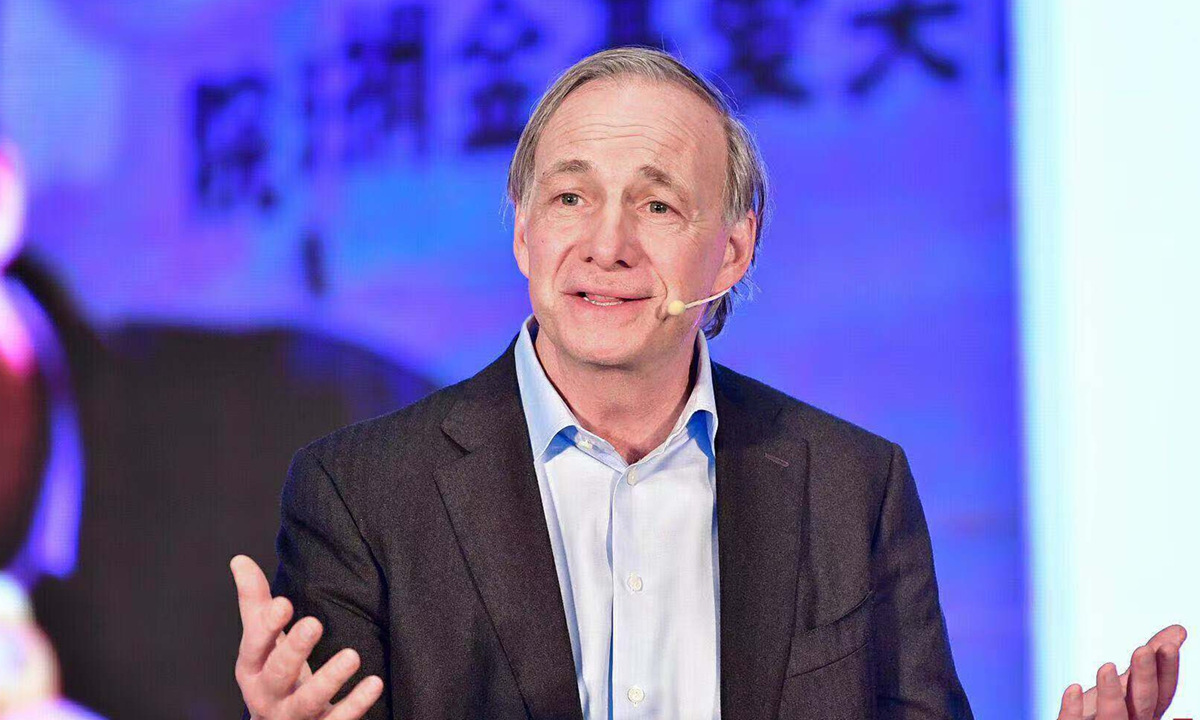
Ray Dalio, the founder of Bridgewater Associates
Editor's Note:Ray Dalio, the founder of Bridgewater Associates, was named one of the "100 Most Influential People in the World" by Time magazine in 2012. Throughout his over 50-year investment career, he has experienced multiple debt cycles in various countries. After conducting an in-depth study of significant debt cycles over the past century, Dalio is convinced that he has grasped the keys to navigating these cycles and feels a responsibility to share the very valuable things he has discovered with the public. Following the publication of the Chinese version of his new book, "How Countries Go Broke: The Big Cycle," in July, Dalio recently gave an exclusive interview to the Global Times (GT), during which he elaborated on the concept of the "big debt cycle." In his view, the US is on the brink of significant conflict and dramatic change, particularly as the government's debt supply and demand situation continues to deteriorate like cancer.
GT: What motivated you to write the book "How Countries Go Broke?"
Dalio: I wrote How Countries Go Broke: The Big Cycle because I wanted to convey my practical understanding of the mechanics of the debt dynamic that I had acquired over my more than 50 years of investing and have advised high-level policymakers about. While I previously kept this valuable understanding to myself, I am now at a stage in my life where I want to pass along the practical understandings that can help others.
GT: You believe that the US is currently in the highly dangerous "fifth stage" of its internal cycle — the critical eve of a continued deterioration of its fiscal situation and the eventual outbreak of class conflict. This process ultimately leads to the most painful stage — the sixth stage, where funds are exhausted, usually accompanied by the outbreak of revolution or civil war. How long do you think the country may take to slide from the fifth stage to the sixth stage?
Dalio: I view what is happening like a doctor watching the typical progression of a life cycle or a disease cycle that goes through various stages that exhibit symptoms that tell us what stage it is in. There are five major interrelated forces that together drive that big cycle and the changing of orders. They are: Debt/money/economic force that drives the monetary order that shapes what happens with money and the economy; the domestic political and social force that determines how the political order within countries works; the international geopolitical force that determines how the world geopolitical order works; acts of nature such droughts, floods, and pandemics such as climate change; and people learning that the lead to improvements is technologies. Each one of these forces and the interactions between these forces can be monitored through their progressions from their beginnings to their ends.
In all countries, throughout time, all monetary orders that determine how the money system works, all political orders that determine how the political system works, and all geopolitical orders that determine how the world geopolitical system works have evolved and broken down in periods of great disorder in basically the same ways that I explain in detail in my books. I describe this progression through six stages, and I describe why the US and the world appear to be in Stage 5, which is the period that is just before the period of great disruption (Stage 6). My profession has taught me to be a realist in order to make my bets as accurate as possible. That and my understanding of the dynamics of the big cycle leads me to believe that there will almost certainly be great disorder over the next 5 to 10 years, though I can't say what exactly that will look like.
GT: You have warned for years about the risks associated with US debt, and in your new book, you also explain the process by which countries can go broke. From your perspective, what are the most concerning aspects of US debt? What do you believe is the most urgent problem that needs to be addressed right now?
Dalio: Debts work for countries like they work for people and companies, except that countries can print the money to pay their debts and can confiscate money from others through taxes. When debts and debt service obligations rise relative to the incomes that are needed to pay them, debt service costs squeeze out other spending. When that happens to governments and their debt assets are undesirable to hold (so that there is a selling of debt assets such as bonds), that is when governments "go broke." At that point, they typically print money, which depreciates the value of money, to pay the creditors back in cheaper money so they don't go bankrupt in the strict sense of the word.
The US government now spends about $7 trillion a year and takes in $5 trillion, so it is overspending by 40 percent and rapidly adding to its debt. It has an existing debt that is six times the amount of money it is taking in, it can't cut expenses because they are required, and debt service (which is about $1 trillion and half the deficit) is squeezing out spending. At the same time, the large deficits are requiring large sales of government debt, which will likely make the debt sales much larger than the demand for that debt.
This will likely lead to a government debt crisis in the next 3 to 5 years. The situation would be best managed by cutting the budget deficit to roughly 3 percent of GDP, which would keep the debt-income ratio stable because the economy will probably grow by about 3 percent, but that 3 percent deficit can only be achieved by making adjustments to all three of the determinants of deficit (spending, taxes, and interest rates on the debt) because balancing the deficit using only one or two of these determinants would have unbearable consequences.
GT: After the publication of your book, what kind of feedback did you receive?
Dalio: Contrary to my expectations, most do [agree with my view]. Because the book describes big theories and the mechanics behind them that have not existed before, I thought that my theories would not have gained the almost universal acceptance that they have gained. I think that they gained that acceptance because the mechanics are so clear and clearly explained that they are almost indisputable. I have spoken with many policymakers of different political sides and leaders around the world, including most former US Treasury Secretaries and central bank heads who endorsed this book, and they all agree with the way I am describing the mechanics of debt and the implications of too much debt.
GT: According to your book, the next 5 to 10 years will be a period of significant changes in all major orders. What are the main factors that determine the rise and fall of a country, company, or individual? What suggestions do you have for China?
Dalio: For all countries throughout time, the formula for success has been the same. The formula that makes countries and people strong and healthy has three essential elements, and it's simple. First, educate your children well so that they have the skills and civility to be productive. Second, have a domestic environment that is conducive to producing broad-based productivity and prosperity, ideally one in which there are efficient markets for goods, services, and capital that bring these things from those who have an excess of them to those who have shortages of them to use to be productive. Third, don't get into an intolerable external war.
GT: One of the five major forces that will affect the future of the world is natural forces (droughts, floods, and epidemics), and history has proven that natural disasters cause more deaths than wars. What do you think the world should do to avoid major natural disasters on a global scale? What impact will the US' formal withdrawal from the Paris Agreement on January 27, 2026 have on the world?
Dalio: This challenge, like most of the challenges we face today, arises from human nature's strong inclination to put pursuing self-interest above common interests. It is called the "tragedy of the commons." Speaking from a practical perspective, in order to achieve this goal, policymakers need to find ways of making achieving this common interest rewarding for those who are pursuing their self-interests. Obviously, China's remarkable advances in a number of green energy sources are a great example of this happening, while global cooperation has been very disappointing.
GT: How do you view the current competition between China and the US in key technological fields such as chips, artificial intelligence (AI), quantum computing, biotechnology, robotics, and space technology?
Dalio: I think that China and the US will be keen competitors — in fact the only important competitors — in these areas for the foreseeable future. Without getting too much into specifics because there are too many of them for this limited space, I expect that lead-times will shorten, efforts to prevent competitors from learning from each other won't work, and the health of the environment to train, attract, and motivate the most talented people to try, fail, and advance what is produced will be critically important.
GT: AI will profoundly impact all fields in unprecedented ways. What is your perspective on the rapid development of the AI industry? Based on your analysis, could AI potentially delay the next global debt crisis?
Dalio: I am enthusiastic about AI technology because it has the potential to improve human thinking and decision-making in all areas, which will lead to great advances in all areas. I have used different types of AI, mostly building expert systems, for decades and have found doing so to be essential to whatever success I and Bridgewater have had over the last 50 years. I also believe that, like all very powerful technologies, AI can be used in harmful ways, like harming others for one's own benefit, or can have unexpected and unintended negative consequences like social media is having. Once again, the outcome will be determined by human nature, most importantly whether man can rise above his animal-like inclinations to fight to get the most for oneself or instead act in the interest of the common good.
As far as whether or not AI's productivity gains could allow us to grow our way out of a debt crisis, I would say that this is possible but unlikely. When I did my research for How Countries Go Broke: The Big Cycle, I looked at times in history when there were great transformative technologies introduced at the same time as there were headwinds from large debt burdens, internal political conflict, and wider international conflict. In those cases, the other forces tended to overwhelm the gains made by the technologies, so that's why I say unlikely — though AI has the potential to be even more transformative than any past technology, so this is not a high-confidence view.
RELATED ARTICLES