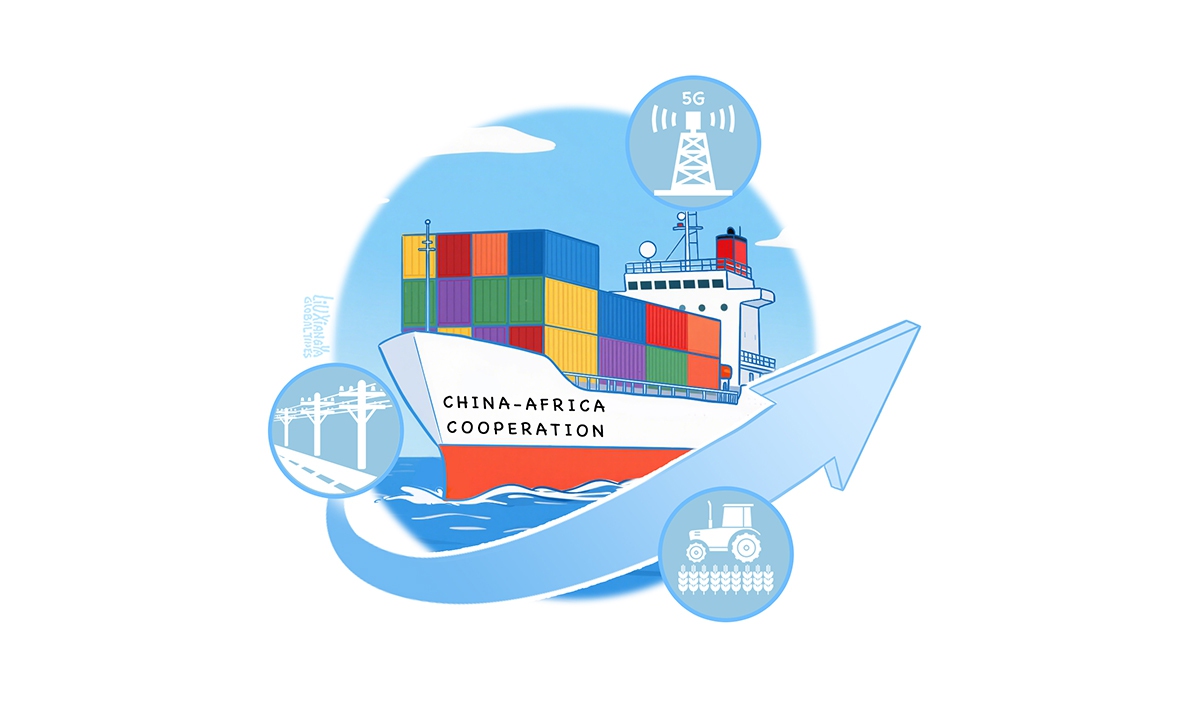
Illustration: Liu Xiangya/GT
This year marks the 25th anniversary of the Forum on China-Africa Cooperation (FOCAC). Over the past 25 years, under the guidance of head-of-state diplomacy, China-Africa relations have continued to deepen, with economic and trade cooperation becoming ever closer and expanding in both scope and depth. This has made important contributions to promoting Africa's economic growth and advancing its modernization.Recently, the IMF released a report titled Africa-China Linkages: Building Deeper and Broader Connections. The report gave positive evaluations of how African countries, together with China, have leveraged the FOCAC platform to expand and deepen economic and trade cooperation, thereby providing vital support for Africa's economic growth and helping Africa achieve significant development progress.
Over the past 25 years, China-Africa trade has grown by leaps, with total imports and exports rising from $10.6 billion in 2000 to $295.6 billion in 2024. China has remained Africa's largest trading partner for 16 consecutive years. According to the IMF, after China joined the World Trade Organization (WTO) in 2001, its position in global trade improved significantly, while its trade ties with Africa strengthened at the same or even faster pace, making China Africa's largest trading partner.
Under the FOCAC framework, China has opened "green lanes" for African agricultural exports, speeding up inspection and quarantine procedures. Increasing numbers of African agricultural products are gaining market access in China. Meanwhile, China has steadily expanded zero-tariff treatment for exports from Africa's least-developed countries. These measures further open the Chinese market, enabling African countries to share the dividends of China's vast consumer market, and they create more opportunities for the development of African agriculture and other industries.
Since the establishment of the FOCAC, Africa has become an emerging destination for China's outbound investment. China's investment flows to Africa have grown rapidly, with $3.96 billion in flows recorded in 2023. As of the end of 2023, China's investment stock in Africa had reached $42.1 billion. The IMF report noted that China is the continent's fourth-largest source of investment.
The report also pointed out that China's investments in Africa have primarily been in construction, mining and manufacturing. Gradually, Chinese investment has broadened from natural resource extraction to manufacturing, including developing export-processing zones, processing of primary products, and more recently to green growth and digitalization as reflected in the FOCAC action plans. Generating local employment and making technology transfers to African counterparts have also gained prominence. This shift has played an important role in advancing Africa's industrialization, diversifying industries, and upgrading local production.
Weak infrastructure has long been a major bottleneck for Africa's economic development, and China has become a key financier and participant in the continent's infrastructure building. According to the IMF report, the Belt and Road Initiative offers African countries opportunities to address infrastructure bottlenecks, evident in the Chinese share of projects, job creation, and the involvement of companies in foreign direct investment. Chinese enterprises have helped Africa build more than 6,000 kilometers of railways, 6,000 kilometers of highways, nearly 20 ports and more than 80 large-scale power facilities.
In response to Africa's recent financing challenges, China has explored new cooperation models to participate in infrastructure project operations, alleviating Africa's debt burden and promoting project sustainability. China has also advanced both flagship projects and "small yet smart" initiatives, including drilling wells, and building rural schools, hospitals and low-cost housing, thereby improving livelihoods and enhancing local well-being.
The IMF report noted that within the FOCAC framework, China has placed an increasing emphasis on cooperation with Africa in emerging fields such as green growth and digitalization.
In green growth, China actively supports Africa in building green, low-carbon, and sustainable development capacity. It trains African professionals in environmental management, pollution control, and green economy, supports solar, wind, small hydropower, and geothermal projects, and provides related products and technologies to aid Africa's green transition. China has also strengthened cooperation with Africa in climate change, marine protection, desertification control and disaster risk reduction.
In digitalization, China has responded to Africa's calls for advancing the digital economy. On the one hand, it supports Africa's digital infrastructure by upgrading mobile broadband networks, promoting 5G rollout and building data centers. On the other hand, it helps drive Africa's digital applications by expanding cooperation in e-commerce, mobile payments and artificial intelligence. These efforts help Africa bridge the digital gap, seize the opportunities of the new technological revolution, and inject technological momentum into economic growth.
The IMF report noted that poverty eradication remains a major challenge for African countries, while China's success in eliminating absolute poverty through sustained growth and policy support offers valuable lessons and experience.
China has hosted multiple China-Africa Poverty Reduction and Development Conferences, launched the Africa-China Alliance for Poverty Alleviation, and organized poverty alleviation-themed training programs to share its experience. Advanced agricultural technologies such as juncao, hybrid rice and hybrid millet have been widely promoted, helping African farmers increase yields and incomes.
China has also supported poverty reduction through cooperation in infrastructure, education, healthcare and climate response. These efforts have made tangible contributions to Africa's poverty alleviation.
The author is a senior research fellow and director of the Institute of West Asian and African Studies, Chinese Academy of International Trade and Economic Cooperation, Ministry of Commerce. bizopinion@globaltimes.com.cn
RELATED ARTICLES