ARTS / CULTURE & LEISURE
International friendship during wartime highlighted at new exhibition
400 photos from war against aggression showcased

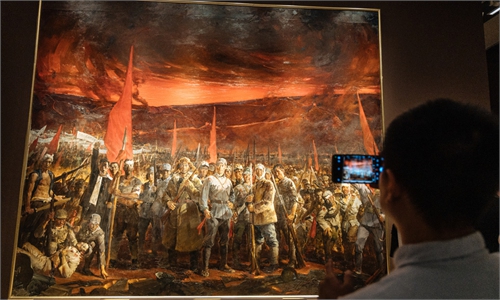
A visitor explores a preview of the exhibition International Friends and China's War of Resistance at the National Museum of China in Beijing on September 7, 2025. Photo: Li Hao/GT
International Friends and China's War of Resistance, an exhibition featuring more than 400 historical photos, is set to open at the National Museum of China in Beijing on Tuesday. A day prior to its debut, the show's chief curator Huang Li unveiled to the Global Times that the exhibition is going to show "how justice can reach beyond cultural differences to connect people."The exhibition is dedicated to the 80th anniversary of the victory in the Chinese People's War of Resistance against Japanese Aggression (1931-45) and the World Anti-Fascist War. It is special due to its focus on friendship and mutual exchanges between China and its international friends during wartime.
Among its 300 artifacts and 400 historical photos, a special archive documenting the assistance provided to China by the Soviet Union during the war is a major highlight.
After meticulous researching of the archive, Huang and his team discovered that in the early stages of Chinese People's War Against Japanese Aggression, the Soviet Union was the first to extend aid to China. It provided over 1,000 aircraft to China, and more than 2,000 Soviet pilots fought alongside Chinese forces in the skies over cities including Nanjing, Wuhan, and Chongqing against Japanese invaders. Some of them sacrificed their lives in these efforts.
Such details in the archive have never been showed publicly.
"Through historical artifacts like this, we want to inform visitors that such choices made by these international friends reflect a universal commitment to justice," the curator noted.
All the exhibition's artifacts present history across four sections: "Reporting and Voices," "Military and Combat," "Rescue and Medical Care" and "Aid and Donations."

Visitors explore a preview of the exhibition International Friends and China's War of Resistance at the National Museum of China in Beijing. Photo: Li Hao/GT
In the final section, a photograph of humanitarian Canadian surgeon Norman Bethune, also known by his Chinese name "Bai Qiu'en," deeply moved visitor Liang Xinyao, who attended the exhibition preview on Sunday. The photo shows the doctor performing surgery on wounded soldiers on the battlefield. "Had I not seen this photo, I would not have felt that human compassion thrived during the war," Liang told the Global Times.Other similar historical photos are also on display featuring figures such as Rewi Alley, who helped cultivate industrial talents for China to revitalize industries and save the nation, and Michael Lindsay, a British radio technology expert who aided China.
The exhibition will also engage visitors through immersive displays. At the hall, the location where German businessman John Rabe wrote his diaries, which have been presented in the book The Good Man of Nanking: The Diaries of John Rabe, has been recreated.
Hao Junshan, the exhibition's spatial designer, said that the hall's visuals use red and gray as the primary color scheme for very specific reasons.
The vibrant red on the walls delivers a sense of passionate patriotism, while the interior exhibition zones employ a subdued gray palette to symbolize "the oppression and harsh conditions endured during wartime." Brighter colors are incorporated throughout the four sections, representing the "unyielding confidence and unwavering determination for victory" that persisted among the people amid their arduous struggles.
Noting that the War against Japanese Aggression "was never fought in isolation," Huang remarked that China's victory was also a crystallization of the united efforts of worldwide anti-fascist forces. The exhibition itself is "a walking example that the idea of a shared future for humanity thrived during the war."
In addition to the National Museum of China, the exhibition is co-organized by the National Cultural Heritage Administration and the National Archives Administration of China.
RELATED ARTICLES