SPORT / MISCELLANY
Player Xiaohai continues to claim top spot amid higher education recognition for esports
First to defend EWC title
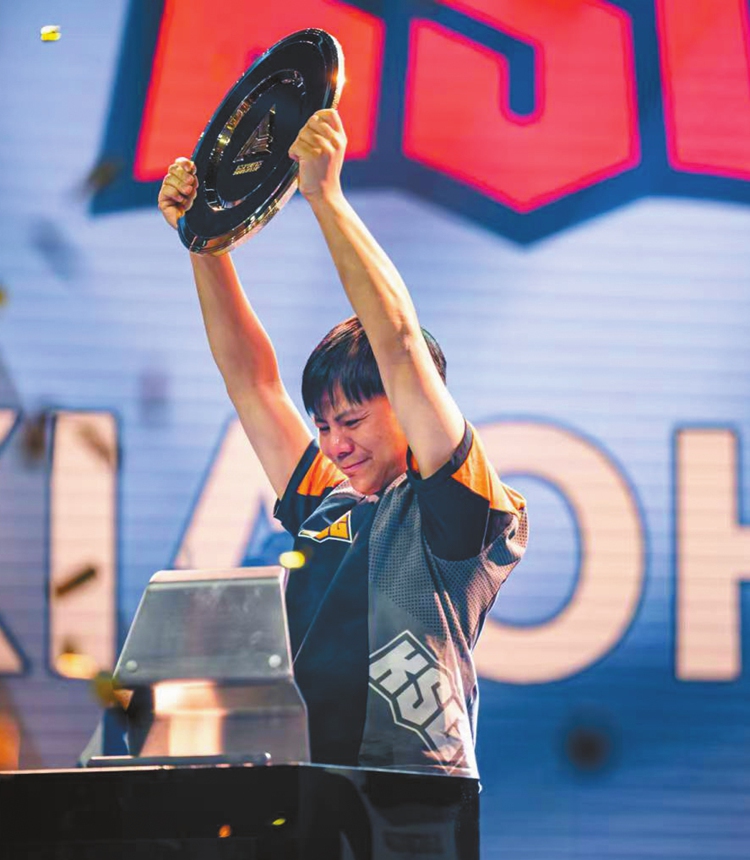
Zeng Zhuojun Photo: Courtesy of Zeng Zhuojun
At the recent Street Fighter 6 finals of the Esports World Cup (EWC), 36-year-old Chinese player Zeng Zhuojun, or more widely known as Xiaohai, made headlines by reversing a deficit to defeat Chilean player Derek Blaz, becoming the first competitor in EWC history to successfully defend a World Cup title.In the EWC group stage, Zeng faced American player Victor "Punk" Woodley. After a flashy combo, Punk prematurely set down his controller and stood up to celebrate, thinking he had won, but Zeng's character made a stunning comeback, thrilling the audience.
A clip of the match immediately went viral, racking up over 1 million views on Chinese video platform BiliBili, shining the spotlight on Zeng once more.
Even in defeat, Punk praised the experience.
"I enjoyed every minute here. The esports community is so nice, people take lots of pictures and treat you like a superstar," Punk said. "I hope I can come back here again."
While Punk embraced the experience with optimism, for Zeng the triumph carried a deeper meaning.
Passion drives destiny
This moment on the international stage was just the latest chapter in Zeng's long journey, which began in the late 1990s in Guangzhou, South China's Guangdong Province.
Unlike most kids who snuck into arcades, Zeng first entered hand-in-hand with his father.
"My dad was the first person to support me playing games," Zeng told the Global Times.
"Back then, society generally saw gaming as a waste of time, but he would often accompany me to the arcade, even sitting beside me as I played."
Zeng praised his father's belief in his unique path so early on, noting "He believed that as long as you excelled at something, even if it was playing games, you could make your mark."
In 2004, 15-year-old Zeng made his international debut representing China at a King of Fighters tournament. Fighting games were dominated by Japanese and South Korean players at the time.
Yet the young player, relying on his calm mind-set and exceptional skill, broke into the realm of the global elite. That moment not only earned him personal recognition, but also showed the world the potential of Chinese players.
"That match made me realize that what starts as a hobby can become a career," Zeng said.
Over the next 20 years, he competed in nearly every major international fighting game tournament.
From King of Fighters to Street Fighters, and from Guangzhou's arcade halls to the global stage, he defied the typical "three-to-five-year career span" of esports players with near-miraculous endurance.
"Of course, my journey was fraught with challenges. Confronted by successive waves of younger talents and whispers of doubt about my age, I sometimes questioned myself," he revealed.
"Yet each time I sat before the console, my father's unwavering gaze came to mind, a quiet strength that became the bedrock of my perseverance."
Zeng's career mirrors the broader evolution of China's esports scene: from scattered arcade halls to a structured and professional industry, a transformation that continues to accelerate.

An exterior view of the Hangzhou Esports Center in Hangzhou, East China's Zhejiang Province Photo: VCG
Industry risingWith esports to be featured in the 2026 Asian Games in Aichi-Nagoya, Japan, and the first-ever Olympic Esports Games in 2027 in Riyadh, Saudi Arabia, such international recognition has spurred domestic educational institutions to respond, prompting more universities in Beijing, Shanghai, and Guangzhou to offer esports majors.
Today, esports is truly more than just "playing for fun." Universities no longer simply train professional players, but instead nurture versatile talents with skills in operations, management, and communication, according to the Xinhua News Agency. Many students now choose esports as their first-choice field of study. This academic foundation is already bearing fruit.
The Capital University of Physical Education and Sports has welcomed its first cohort of esports bachelor's graduates, who are entering roles in tournament organization, broadcasting, operations and planning, becoming the new talent fueling the industry.
"These graduates are not only familiar with competition rules and broadcasting processes, but also possess hands-on skills in tournament operations, player management, and content promotion," League of Legends coach and expert researcher Wu Yueyang told the Global Times on Monday.
"Their entry means China's esports industry now has a more complete talent pipeline, allowing future large-scale international events, professional player development and esports culture promotion to be carried out professionally," Wu said.
Beyond education, local governments are also stepping in to accelerate industry growth.
Shi Wei, deputy secretary of the Beijing Economic-Technological Development Area (BDA), announced last week that the BDA had upgraded the Beijing Smart Esports Center and established a new technology application center for online games, creating an integrated ecosystem combining tournaments, R&D, content production, and experience.
"With structured talent development, world-class tournaments, and innovative business models, China is not only cultivating the next generation of players and managers, but also shaping the future of esports globally," Wu noted.
RELATED ARTICLES